
 View Piece
 View Piece
 View Piece
 View Piece
 View Piece
 View Piece
 View Piece
 View Piece
 View Piece
 View Piece
 View Piece
 View Piece
 View Piece
 View Piece
 View Piece
 View Piece
 View Piece
 View Piece
 View Piece
 View Piece
Frequently Asked
Three-Stone Engagement Rings FAQ
What do the three stones symbolize?
The most common reading is past, present, and future: the center stone marks where you are now, with a companion on either side for the road already traveled and the life still ahead. Many couples read it more simply as the two of them standing together, or as friendship, love, and fidelity. There is no single official meaning, which is part of the appeal. The design gives you a built-in story to make your own, and it has carried that romantic weight for well over a century, from Edwardian jewelry to some of the most famous engagement rings of the modern era.
Why does a three-stone ring look bigger than a solitaire?
Because you are adding light and width right where the eye lingers. Two side stones extend the sparkle outward from the center and fill the space along the finger, so the whole design covers more visual real estate than a single stone of the same center weight. Well-matched sides also blend into the center at a glance, which can make the center itself read larger. If you want maximum presence for your budget, pairing a modest center with generous side stones is one of the smartest ways to get it, and every ring here is shown with the exact sides it ships with so there are no surprises.
Which center shape should I choose?
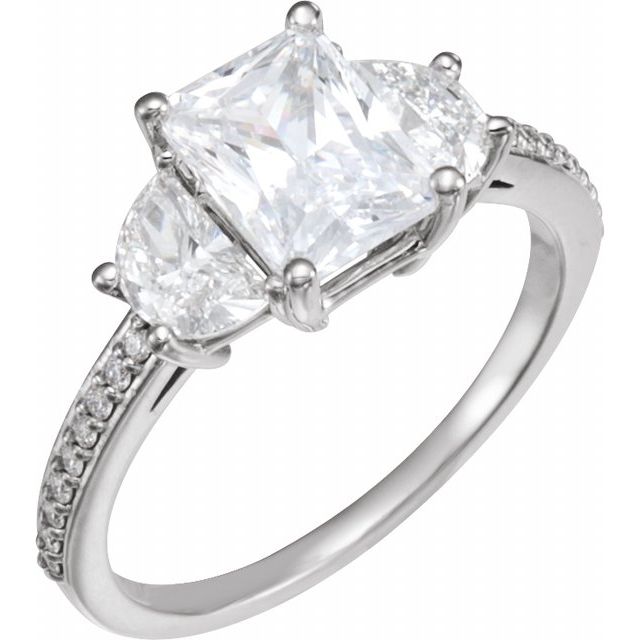
It comes down to the personality you want. A round center is the most brilliant and the most classic. An oval gives you that same sparkle stretched into a flattering, finger-lengthening outline. A pear is a distinctive teardrop with a romantic point. An emerald cut is calm and architectural, trading fire for a clean hall-of-mirrors glow. A princess is crisp and modern with a square silhouette. A marquise is the boldest of all and reads largest per carat. Use the comparison table above to match a center to how you want the ring to feel, then let the side stones, tapered baguettes, trapezoids, half-moons, or matching-shape brilliants, frame it.
Are lab-grown diamonds real diamonds?
Yes. A lab-grown diamond is chemically, physically, and optically the same material as a mined diamond, pure crystallized carbon, grown in a matter of weeks rather than over a billion years. It is not a simulant like moissanite or cubic zirconia; it tests as diamond because it is diamond. The center of every ring in this collection is a lab-grown stone graded by an independent laboratory such as GCAL, IGI, or GIA, and each ring links to its certificate. Choosing lab-grown is also what lets a three-stone ring, which uses more diamond than a solitaire, stay within reach, since you are paying for three real diamonds without the mined premium.
What does the all-in price include?
Everything you see on the ring. The price covers the setting, the certified lab-grown center diamond, and both matched side stones, set and finished to your ring size. We do not show a low setting-only figure and then add the diamonds at checkout. If you would like a larger center, a different color or clarity, or natural diamonds instead of lab-grown, our concierge can quote and hand-select the stones for you, but the number on the page is the price of the complete ring as shown.
How long does a three-stone ring take to make?
Each ring is made to order. Because the center and both sides are set by hand and the band is finished in your exact size, most rings ship within about two to three weeks. If you are working toward a proposal date or an anniversary, tell us when you need it and we will confirm the timeline before you order and do our best to prioritize it.
Can I match it to a wedding band later?
Yes. Three-stone rings sit relatively flat and even along the finger, which makes them friendly to pair with a wedding band. A plain metal band or a slim shared-prong band both sit cleanly alongside most of these designs. Tell our concierge which ring you have chosen and we will recommend a band that nests well against its gallery and side stones.