
Cushion Cut vs Emerald Cut
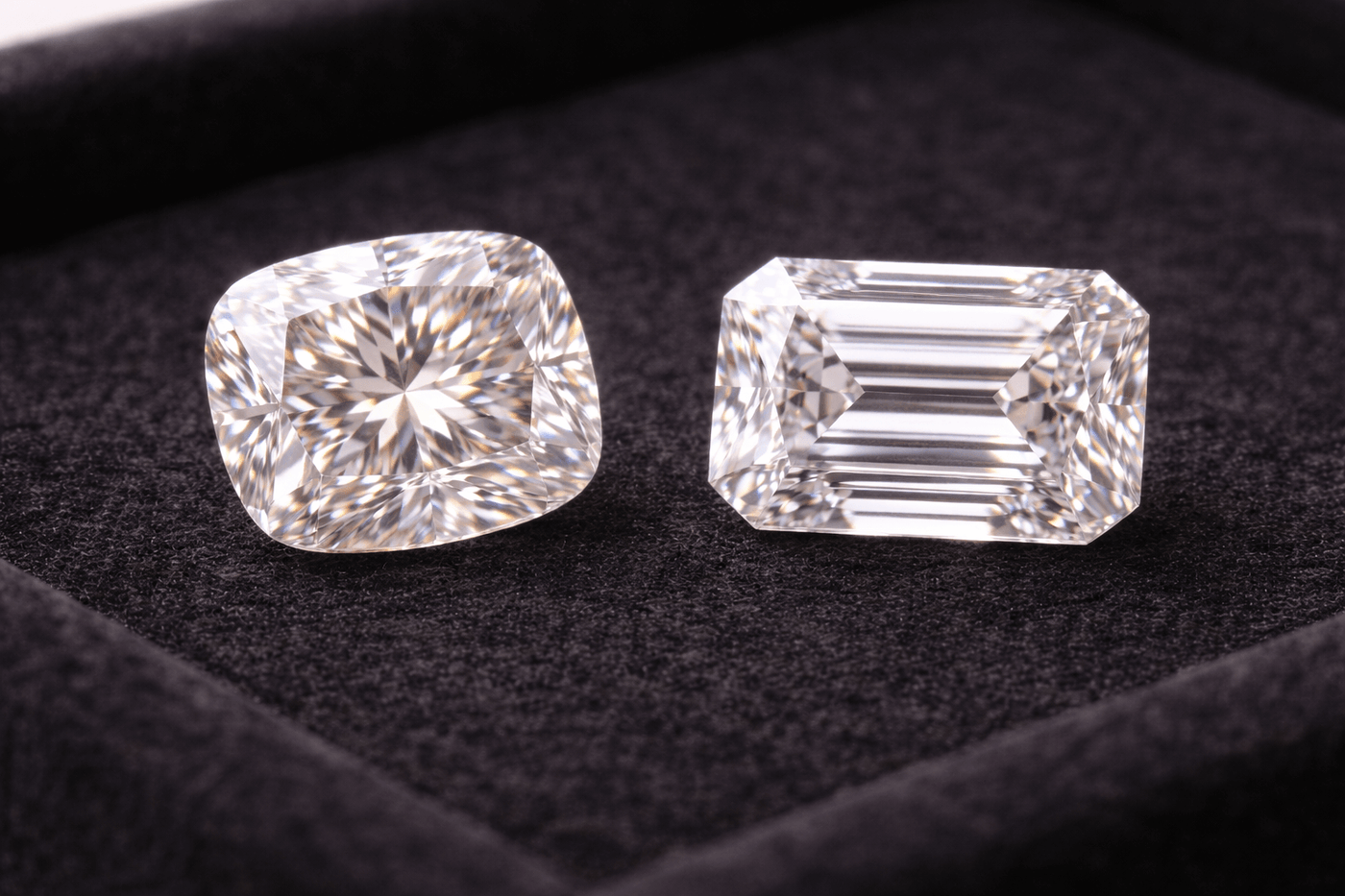

Diamond shape is both a practical and an emotional choice. The cut determines how a stone interacts with light, how it suits the hand, and how well it captures the wearer's personality. Among fancy shapes, cushion and emerald cuts are perennial favorites — each with a distinct visual character and a loyal following. One delivers soft, fiery sparkle through rounded corners and large brilliant facets; the other offers clean geometry and a serene "hall of mirrors" effect through long, parallel step-cut facets. Both carry rich histories and stand entirely on their own merits. Understanding how they differ in appearance, quality standards, price, and care will help you choose the stone that tells your story best (1). This guide covers origin, structure, quality assessment, buying considerations, care, common myths, and current market trends — everything needed to compare the two shapes with confidence and make a decision you will be glad to wear for decades.
What Is Cushion Cut vs Emerald Cut?
Cushion Cut Diamonds
The cushion cut descends from the old mine cut, which dominated the 18th and 19th centuries. A modern cushion diamond is square or squarish-rectangular with gently curved sides and corners that are either rounded or softly pointed — often described as a cross between a round and a princess cut (2). Larger facets amplify the stone's fire, producing a warm, candlelit sparkle that sets it apart from more modern cuts (1). Historically, the shape was designed to retain weight from rough crystals; the old mine cut's high crown and deep pavilion were later refined to improve light return (2). Two main types exist today: standard cushion brilliants, with broader facets and a softer glow, and modified cushion brilliants, which layer in extra facets for a "crushed ice" effect similar to a radiant cut (1). You will find both styles in our diamond engagement rings collection.
Emerald Cut Diamonds
The emerald cut began life as a technique developed for emerald gemstones to reduce chipping during the cutting process. Applied to diamonds, it produces a rectangular silhouette with cropped corners and long, linear step-cut facets that generate a sleek "hall of mirrors" effect — broad, luminous flashes rather than the rapid scintillation of brilliant cuts. Symmetry, clarity, and quiet sophistication are its hallmarks, which is why the emerald cut has become the shape of choice for those who favor understated refinement. For stones above two carats, experts recommend VS2 clarity and G color or better, since the large table and open facets leave little room to hide inclusions or body color. The elongated footprint also flatters the hand by creating the appearance of longer, slimmer fingers (1).
Types / Variations of Cushion and Emerald Cut Diamonds
Cushion Cut Variations
Cushion Brilliant

-
Appearance: Rounded corners paired with large kite-shaped facets produce a soft, even radiance. The style blends antique charm with contemporary appeal and has a pillow-like silhouette that gives the cut its name (1).
-
Composition: Like all diamonds, cushion cuts are nearly pure carbon — typically 99.95 percent — with trace elements accounting for only 0.05 percent. Carbon atoms bond in an isometric crystal structure, giving the gem its exceptional hardness (6).
-
Durability: At 10 on the Mohs scale, cushion diamonds resist scratching exceptionally well. Rounded corners reduce chipping risk, though a thin girdle can still be vulnerable to impact. Bezel or halo settings add an extra layer of protection (2).
-
Common Uses: Cushion brilliants appear frequently in vintage-style solitaires, halo engagement rings, and heirloom pieces. Their romantic warmth appeals to buyers drawn to old-world elegance (1).
Cushion Modified Brilliant

-
Appearance: Additional facets on the crown or pavilion create a sparkling "crushed ice" mosaic that reads as higher brilliance than the standard cushion brilliant (1).
-
Composition: Identical to cushion brilliants — pure carbon with trace elements; the only difference lies in facet arrangement (6).
-
Durability: Comparable to other diamonds, though deeper proportions may make the stone appear slightly smaller face-up for its carat weight (1).
-
Common Uses: A popular choice for modern halo rings and architectural designs where maximum sparkle takes priority over vintage character (1).
Emerald Cut Variations
Standard Emerald Cut

-
Appearance: A rectangle with beveled corners and parallel step facets that produce a mirror-like depth (1).
-
Composition: Nearly pure carbon atoms arranged in an isometric lattice, yielding exceptional hardness and transparency (6).
-
Durability: Diamonds are inherently hard, but the emerald cut's long, open facets make inclusions and color more visible, so quality grades carry extra weight (1). Cropped corners improve structural stability, reducing chipping risk compared to pointed shapes.
-
Common Uses: Pairs well with clean solitaires and Art Deco or vintage-inspired settings. The elongated form flatters narrow fingers and highlights architectural metalwork (1).
Asscher (Square Emerald) Cut

-
Appearance: A square variant of the emerald cut with a higher crown and deeper pavilion, producing a compact hall-of-mirrors effect (8). Viewed from above, the facets form a distinct "X" pattern (1).
-
Composition: Shares the same carbon makeup and step-cut structure as the standard emerald cut (6).
-
Durability: VS2 clarity or higher is recommended, as the open facets reveal inclusions readily. Double prongs are often used on larger stones to secure the beveled corners (1).
-
Common Uses: Ideal for vintage and Art Deco-inspired designs. Its symmetrical geometry appeals to buyers who prize refined glamour and a sense of nostalgia.
How to Identify Quality in Cushion and Emerald Cuts

Cut Quality
Cut has more influence on a diamond's visual performance than any other factor. GIA issues official cut grades — Excellent to Poor — only for round brilliants, so fancy shapes like cushion and emerald cuts require a closer look at proportions and symmetry. Cushion cuts should display even curves on all four sides; irregular outlines or bulging edges diminish beauty (2). Modified cushions may carry deeper pavilions that reduce face-up size while increasing sparkle. Emerald cuts demand precise symmetry and parallel facets — misaligned steps are immediately noticeable given the cut's minimal facet count (1).
Color and Clarity
Brilliant faceting scatters light, so cushion diamonds are forgiving — buyers can often step down in color or clarity without any visible compromise. Emerald cuts are a different matter: body color and inclusions show clearly through the large table. For stones over two carats, experts recommend VS2 clarity and G color or above. The open table acts as a window, and higher grades ensure a clean, polished look (1). Browse our natural diamond rings to see how color reads across different shapes.
Carat and Size
Cushion cuts tend to be slightly deeper than other shapes of equivalent carat weight, which can make them appear smaller face-up (1). Emerald cuts spread their weight across a larger footprint, reading bigger even at lower carat weights — though the premium on clarity and color can offset the per-carat savings. Length-to-width ratio is a useful comparison tool: cushions typically fall between 1.0 (square) and 1.2 (slightly rectangular), while emerald cuts range from 1.3 to 1.5. The right ratio comes down to personal preference and hand proportions.
Certifications and Hallmarks
Always request a GIA or IGI grading report covering carat weight, color, clarity, and — for round brilliants — cut grade. Fancy shapes carry no official cut grade, but GIA reports document proportions and symmetry, giving you a reliable proxy for quality. IGI provides similar reports and also grades lab-grown diamonds and moissanite, with findings widely trusted for authenticity verification (7). Laser engraving on the girdle ties the stone to its certificate, offering additional confidence at purchase.
Buying Guide: How to Choose the Right Cut
Budget Considerations
Cushion cuts generally cost less per carat than round brilliants and can price competitively against emerald cuts, particularly in modified styles. Strong supply keeps options accessible across a range of budgets. Emerald cuts also undercut round brilliants on a per-carat basis, but the need for higher clarity and color grades often narrows that gap. A smaller, well-proportioned emerald with excellent grades can look far more compelling than a larger stone with visible inclusions (1).
Lifestyle and Occasion
Active lifestyles reward thoughtful setting choices. Cushion cuts with rounded corners are less prone to snagging, and a bezel setting adds further protection. Emerald cuts have inherently stable beveled corners, but a secure four-prong or bezel setting — combined with regular check-ups — keeps the open facets safe from impact. Style-wise, cushion cuts suit romantic and vintage aesthetics, making them natural picks for engagement and anniversary rings. Emerald cuts appeal to modern minimalists and Art Deco enthusiasts. Either cut, paired with the right metal and setting, can serve beautifully as an everyday ring or a special-occasion piece (1).
Finger Shape and Hand Proportions
The elongated silhouette of an emerald cut draws the eye along the finger, creating the impression of length. Cushion cuts — available in both square and rectangular proportions — have a softer presence that suits a wide range of hand shapes. Shorter fingers often benefit from longer cushions or emeralds, while longer fingers can carry a square cushion with balanced proportions. Trying on different length-to-width ratios is the surest way to find a fit that feels as good as it looks.
Skin Sensitivity and Metal Choices
Diamonds themselves are hypoallergenic, but the setting metal can cause discomfort. Platinum and high-karat gold are the safest choices for sensitive skin. Metal also influences how the stone reads: warmer yellow or rose gold draws out the subtle fire of a cushion cut, while cooler platinum or white gold sharpens the architectural lines of an emerald cut. Consider both comfort and aesthetic when making your selection.
Long-Term Value
Natural diamonds generally retain value better than lab-grown stones, which have seen significant price compression over recent years. Fancy shapes like cushion and emerald cuts hold their own on the secondary market when backed by strong color and clarity grades. Market data shows enduring buyer interest in both shapes — National Jeweler noted emerald and oval cuts gaining ground in 2024, with marquise, pear, rose, and cushion cuts positioned among the most sought-after shapes heading into 2025. Strong proportions and a credible grading report matter more to long-term value than carat size alone (7).
Care, Cleaning & Maintenance

Diamonds rank at the top of the hardness scale, yet they remain vulnerable along natural cleavage planes where a sharp impact can cause chipping. Emerald cuts are especially sensitive at the corners — their broad, open facets make it easy to spot damage — so prong and setting inspections should be part of a regular maintenance routine.
For cleaning, simplicity works best. Warm water, a mild detergent, and a soft lint-free cloth remove oils and residue without risk. Avoid abrasive or powdered cleaners, and skip home ultrasonic or steam cleaning, which can loosen settings or stress the stone (6). Keeping an emerald cut clean matters more than it might seem — smudges spread visibly across its wide table. A cushion cut loses its fire and warmth when dirt accumulates on the facets.
Store each piece separately to prevent diamonds from scratching other items. Consistent cleaning and professional check-ups every six to twelve months will keep both cushion and emerald cuts looking their best for years. If a prong appears loose or a setting feels different, take the ring to a jeweler promptly rather than waiting for the next scheduled visit — minor repairs caught early are far less costly than resetting a stone that has shifted or a prong that has worn through entirely. Proper storage, routine cleaning, and timely professional maintenance together form the simplest insurance policy for a fine diamond ring.
Common Myths & Misconceptions
A common assumption is that a larger diamond always looks better. Cut quality actually drives brilliance far more than size does. A smaller stone with well-balanced proportions can outshine a larger one with a poorly executed cut (4).
Some buyers assume emerald-cut diamonds lack visual interest. The distinction is deliberate: step-cut facets produce broad, mirror-like flashes of light rather than intense scintillation. Many people find that depth and stillness more striking than rapid sparkle (1).
Diamonds are also sometimes believed to be unbreakable. They are the hardest natural material, but a hard knock at the right angle — particularly on edges, corners, or the girdle — can still cause chipping (4). Correct settings and routine inspections are essential, especially for fancy shapes.
Round brilliants are often treated as the default engagement ring choice. GIA recognizes cushion, emerald, princess, marquise, and other fancy shapes as equally valid alternatives — typically at a lower per-carat price and each with its own distinct character.
Pros & Cons of Cushion vs Emerald Cut
Feature |
Cushion Cut |
Emerald Cut |
Sparkle |
Warm, subtle brilliance with fire |
Sleek flashes; hall-of-mirrors effect |
Facet Style |
Brilliant or modified brilliant; many facets |
Step cut; long parallel facets |
Inclusion Visibility |
Hides inclusions and color well |
Shows inclusions and color; requires higher grades |
Per-Carat Cost |
Often lower than round and other shapes |
May be higher due to clarity requirements |
Durability |
Rounded corners reduce chipping risk; deeper pavilion can look smaller |
Cropped corners improve stability, but long facets can expose flaws |
Aesthetic |
Vintage, romantic, softly contoured |
Modern, minimalist, architectural |
Finger Appearance |
Balanced; square or rectangular versions suit many hands |
Elongated shape lengthens fingers |
Trends & Modern Market Demand
Celebrity influence and editorial coverage continue to shape diamond preferences. Trend reports from 2024 highlighted growing demand for oval and emerald cuts, prized for their elongated elegance. Today's buyers are less focused on what's trending and more drawn to rings that feel personally meaningful — shapes that express character rather than follow the crowd (7).
Heading into 2025, heritage-influenced shapes are holding their ground. Marquise, pear, rose, and cushion cuts remain favorites among buyers who value uniqueness and historical resonance. Emerald cuts continue to attract those who prefer clean lines and quiet detail, while cushion cuts — with their soft curves and romantic warmth — draw buyers seeking heirloom-style designs. Social media has amplified interest in east-west settings and unconventional orientations for both shapes. Self-expression is now a stronger driver of diamond selection than trend-following, with more buyers choosing shapes that carry personal meaning (7).
Investment & Resale Value
Sound diamond investment means balancing quality, rarity, and market appeal. Natural diamonds with strong color, clarity, and cut proportions hold value better than lab-grown stones, which have experienced consistent price compression — by 2024, lab-grown diamonds accounted for roughly 14% of the U.S. jewelry market, prized for accessibility rather than long-term investment potential (7).
Resale value for natural fancy shapes depends heavily on quality and desirability. GIA-certified cushion and emerald cuts with balanced proportions and good color grades — generally H or above — sell best on the secondary market. Rare vintage cushions, including old mine and old European cuts, can command premium prices at auction due to scarcity and historical value (2). Emerald cuts with exceptional clarity draw collectors who appreciate refined craftsmanship. Both shapes tend to be less liquid than round brilliants, which benefit from universal demand. Quality and traditional proportions matter far more to long-term buyers than carat size alone.
Who Should Buy Cushion vs Emerald Cut?

Cushion Cut Lovers
Romantics who gravitate toward soft sparkle and antique aesthetics will find a natural home in the cushion cut. Rounded corners and balanced proportions give it a look that feels at once timeless and fresh. The larger facets amplify fire (8), producing a warmth that more geometric shapes cannot replicate. Buyers who prefer a relaxed, feminine silhouette and a lower per-carat price will likely feel at home here. The modified cushion brilliant suits those who want maximum sparkle without the straight lines of radiant or princess cuts. Square cushions suit many hand shapes; rectangular proportions do particularly well on shorter fingers. The cut's range — solitaires, halos, three-stone settings, antique mountings — makes it one of the most adaptable shapes in fine jewelry (1). Explore our full range of diamond rings to see cushion cuts in various settings.
Emerald Cut Enthusiasts
Understated elegance draws buyers to emerald cuts. Vogue's editors have noted that emerald cut engagement rings radiate quiet confidence — their luminous but unhurried light play suits those who appreciate modern architecture or pared-back minimalism over dazzling sparkle. Beveled corners and long, linear step-cut facets create the signature hall-of-mirrors effect, producing broad flashes rather than rapid scintillation. Symmetry, clarity, and hypnotic depth are the reasons emerald cuts appeal to collectors and connoisseurs alike. They pair beautifully with Art Deco-inspired settings and are especially flattering on long, slim fingers. Since inclusions read clearly through the open table, buyers with the flexibility to prioritize higher clarity and color grades will get the most from this style (1). Our classic diamond collection features several emerald cut options worth exploring.
Frequently Asked Questions (FAQ)
1. Which cut sparkles more: cushion or emerald?
Cushion cuts use brilliant or modified brilliant faceting that produces lively fire and subtle sparkle. Emerald cuts use step-cut facets that generate elongated flashes rather than intense scintillation. Overall, cushions appear more sparkly (1).
2. Do emerald cuts cost more than cushion cuts?
Per carat, cushion cuts often price below round brilliants and can be more affordable than emerald cuts. Emerald cuts typically need higher clarity and color grades to look their best, which can raise the overall cost (1).
3. Which cut hides inclusions better?
Brilliant-style faceting in cushion cuts scatters light, masking inclusions and lower color grades effectively. Emerald cuts have fewer, larger facets and a wide table, making inclusions and color more visible. For emerald cuts, VS2 clarity and G color or above is the standard recommendation (1).
4. Are cushion and emerald cut diamonds durable enough for everyday wear?
Diamonds rank 10 on the Mohs hardness scale, so both cuts resist scratching (3). Rounded corners on cushions lower chipping risk; the emerald cut's cropped corners add structural stability. Correct settings and regular maintenance protect both.
5. What settings suit cushion and emerald cuts?
Cushion cuts work beautifully in vintage-inspired halos, clean solitaires, and three-stone designs. Emerald cuts pair best with minimalist solitaires and Art Deco styles; halos or side stones can add brilliance without overpowering the center stone (1).
6. Can fancy shapes like cushion and emerald cuts be certified?
Yes. GIA and IGI both issue grading reports for fancy shapes, covering carat weight, color, and clarity. No official cut grade exists for cushion or emerald cuts, but the reports describe proportions and symmetry in enough detail to assess quality (7).
Expert Jeweler Tips
-
See the diamond in person. Each cushion or emerald cut stone has its own character. Viewing a selection under different lighting reveals differences in fire and clarity that photographs rarely capture (2).
-
Prioritize cut and symmetry. Without formal cut grades for fancy shapes, look for balanced outlines, even corners, and harmonious facets. Avoid cushions with bulging sides or emeralds with misaligned steps.
-
Do not sacrifice quality for size. A slightly smaller diamond with excellent color and clarity routinely outshines a larger stone with visible inclusions (4).
-
Protect the corners. Bezel or halo settings work well for cushions with thin girdles; double prongs secure the beveled corners of emerald and Asscher cuts against chipping.
-
Work with a reputable jeweler. Choose someone who provides GIA or IGI grading reports and can walk you through the stone's proportions and light performance. A trusted advisor helps you balance budget, lifestyle, and aesthetic priorities (5).
-
Let trends inform, not decide. Market demand can affect resale value, but the most important factor is how the diamond makes you feel. Choose the cut that resonates most — the romantic glow of a cushion or the clean elegance of an emerald (7).
Conclusion
Deciding between a cushion cut and an emerald cut comes down to which quality resonates most: cushion cuts offer soft edges and lively sparkle with vintage warmth; emerald cuts bring clean geometry and a "hall of mirrors" depth that reads as quietly confident and modern.
Practical factors — cut quality, clarity standards, budget, and setting style — all shape how the diamond performs and holds up over time. A cushion cut with balanced proportions and a GIA-certified color grade of H or above will give years of warm, lively fire. An emerald cut with VS2 clarity or better will reward the eye with that signature hall-of-mirrors depth every time light catches the table. The best choice looks beautiful in the light and fits comfortably into daily life.
Take time to look at both shapes in person, ask the right questions, and trust your instincts. With thoughtful consideration and guidance from reliable sources, you will find a diamond that reflects your personality and tells your story with clarity and grace.
Ready to explore your options? Browse our curated cushion and emerald cut engagement rings, learn more about diamond grading and certification, or sign up for our newsletter for expert insights and jewelry news.
Vintage warmth or sleek sophistication.
Find the cut that reflects your style in Diamond and Sapphire's curated selection.
Read more
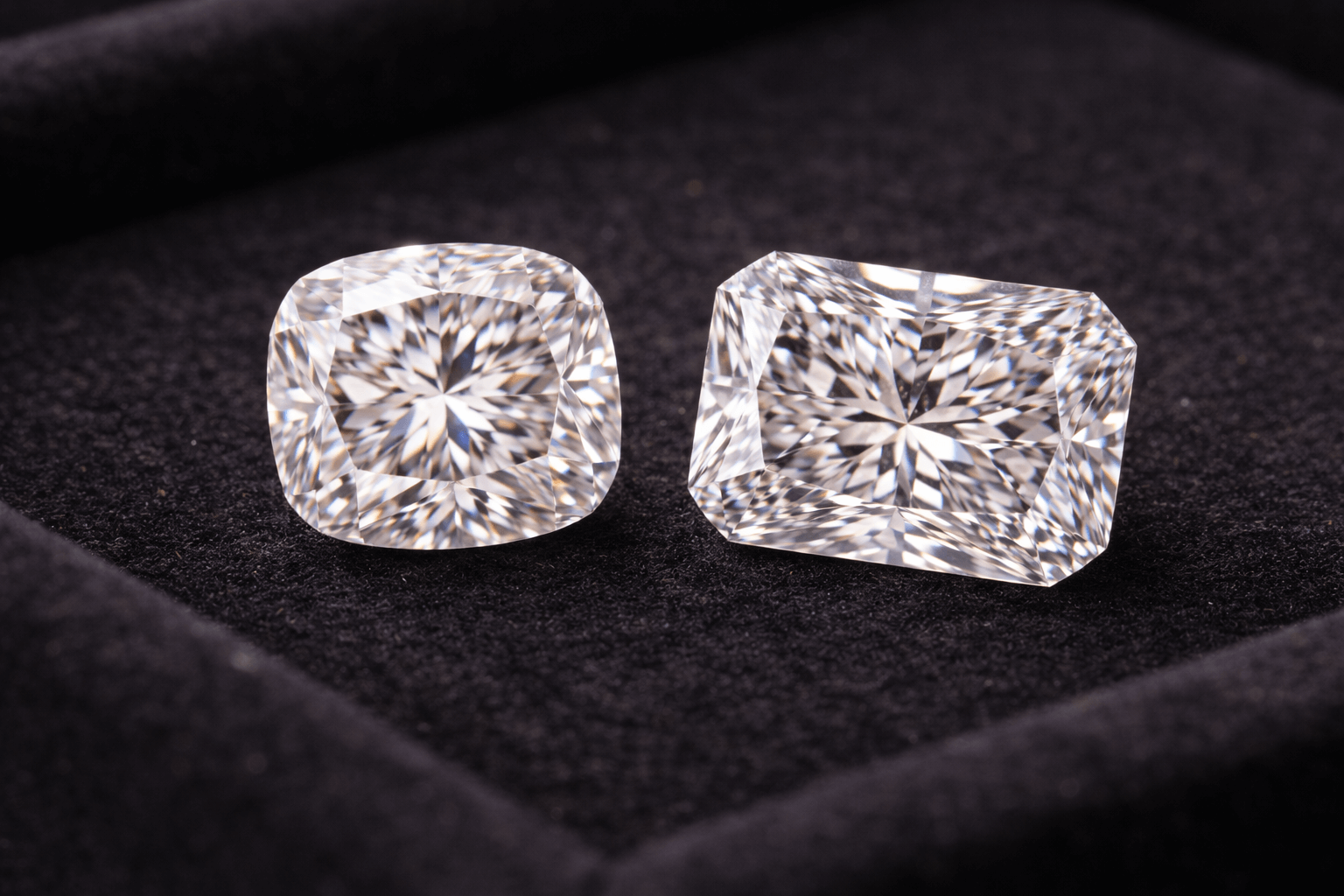
Cushion cut diamonds have a soft, “pillow-like” shape with rounded corners and a warm, vintage sparkle, whereas radiant cut diamonds combine a square/rectangular outline with trimmed corners and ab...
Read moreCushion cut diamonds have a soft, “pillow-like” shape with rounded corners and a warm, vintage sparkle, whereas radiant cut diamonds combine a square/rectangular outline with trimmed corners and ab...
Read more