
Do Lab Grown Diamonds Pass a Diamond Tester?
Lab-grown diamonds promise the same sparkle as mined stones at a much lower price. As interest grows, so do concerns about how to tell if something is real. One of the most common questions is if a lab-grown diamond will pass a diamond test. No one wants to buy a gem only to find out it's not what they thought it was. You will learn how diamond testers work, why lab-grown diamonds often "pass," and the small differences that gemologists look for to tell the difference between natural and man-made stones in this guide. We will talk about the science behind high-pressure high-temperature (HPHT) and chemical vapor deposition (CVD) diamonds, look at different types of testing devices, and give you useful tips on how to choose, care for, and enjoy these amazing new things. You will leave with a clear understanding of the pros, cons, and future of lab-grown diamonds (2), whether you are thinking about getting a lab-grown engagement ring or just want to know more about this technology.
What Is a Lab-Grown Diamond and How Does It Relate to Testing?

A lab-grown diamond is a crystal of carbon that people made by copying the high pressures and temperatures of the earth's mantle or by putting carbon atoms from a gas onto a diamond seed. The U.S. Federal Trade Commission says that diamonds are "essentially pure carbon crystallized in the isometric cubic system." Lab-grown diamonds have the same chemical makeup, optical properties, and hardness as natural diamonds (2). Both natural and lab-grown diamonds are considered "diamond" on simple thermal or electrical testers because they have the same hardness and thermal conductivity. (1) The small differences are in how they grow: HPHT crystals usually grow in a cuboctahedral shape, while CVD crystals grow in square plates (2). Gemologists use advanced tools to look at fluorescence patterns, inclusions, and spectroscopic signatures to tell them apart. Traditional handheld testers can't do this reliably (2).
Types and Variations of Lab-Grown Diamonds and Diamond Testers
HPHT Diamonds
Appearance: High‑pressure high‑temperature diamonds form in a metal‑press that imitates earth’s mantle. They usually have a cuboctahedral shape before cutting, and may contain metallic inclusions from the metal catalysts used in growth (2).
Composition: These gems are chemically identical to natural diamonds—pure carbon with possible traces of nitrogen or boron. Metallic inclusions can increase electrical conductivity, sometimes causing an electronic tester to misidentify them as moissanite (1) .
Durability: HPHT diamonds rank 10 on the Mohs scale and share the same hardness and toughness as natural diamonds, making them ideal for everyday jewelry (1) .
Common Uses: HPHT stones are used in engagement rings, fashion jewelry and industrial applications. Their high conductivity also makes them valuable for laser windows and electronic components (1) .
CVD Diamonds
Appearance: Chemical vapor deposition diamonds grow as square, tabular crystals. They may show growth striations and require additional treatments like heat or irradiation to improve color (2).
Composition: CVD diamonds consist of carbon atoms deposited from a carbon‑rich gas such as methane onto a seed crystal. They often have fewer metallic inclusions than HPHT stones and may contain silicon or hydrogen impurities.
Durability: Like HPHT diamonds, CVD stones score 10 on the Mohs scale and exhibit high thermal conductivity, so they also pass basic diamond testers (1).
Common Uses: CVD diamonds are popular in jewelry and are being explored for quantum computing and semiconducting applications because of their ability to withstand extreme conditions (1).
Thermal Diamond Testers
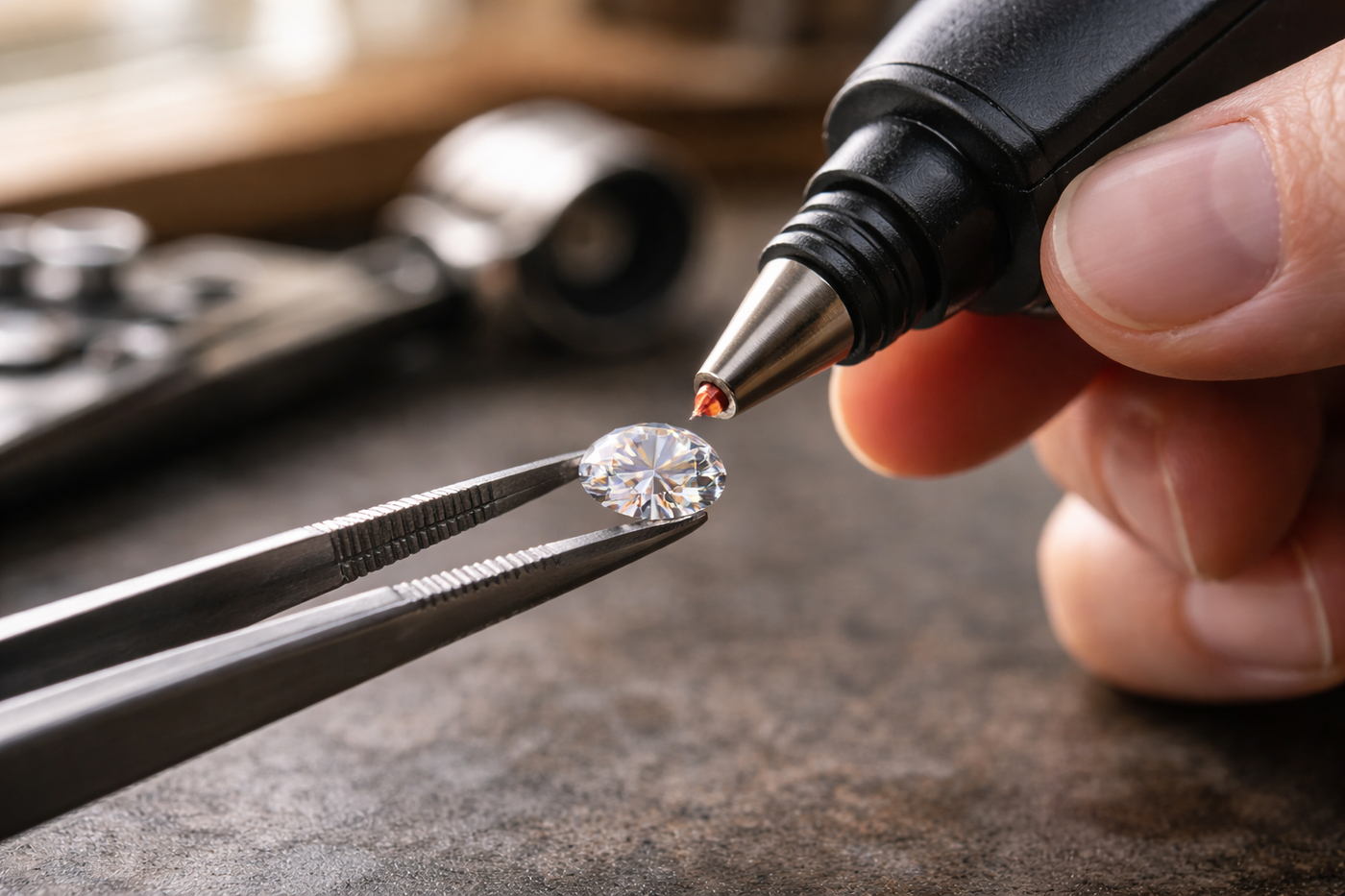
Appearance: Handheld thermal testers are small pen‑like devices with a heated probe and digital display. Jewelers often use them to differentiate diamond from simulants.
Technology & Composition: These testers measure thermal conductivity by touching the probe to the stone’s surface. Since both natural and lab‑grown diamonds conduct heat similarly, thermal testers cannot tell them apart and will indicate “diamond” for either. They often misidentify moissanite as diamond because moissanite has similar thermal properties (1).
Durability & Limitations: Thermal testers are reliable for distinguishing diamond from cubic zirconia but can’t separate natural from lab‑grown. They’re portable and inexpensive, but their limitations can create false confidence (3).
Common Uses: Jewelers use thermal testers for quick screening at the counter, but they should not rely on them to certify origin or quality (3).
Electronic Conductivity Testers
Appearance: Electronic testers resemble thermal testers but assess electrical conductivity.
Technology & Composition: They measure how quickly electricity travels through a gemstone. While they can separate moissanite from diamond, they sometimes label HPHT‑grown diamonds as moissanite due to metallic inclusions that make the diamond more conductive. Fancy blue diamonds and lab‑grown stones doped with boron can also register as conductive (1).
Durability & Limitations: These devices offer more accuracy than thermal testers for identifying simulants but still cannot reliably distinguish natural from lab‑grown diamonds and may confuse the user.
Common Uses: Jewelers use them when moissanite is a concern; however, they still need lab verification for conclusive results (3).
UV and Spectroscopic Testers
Appearance: Advanced testers, such as the GIA iD100, resemble small desktop units and use spectroscopy and UV fluorescence to analyze diamonds.
Technology & Composition: GIA’s tester uses fluorescence spectroscopy to detect subtle differences between natural and lab‑grown diamonds, including growth patterns and impurity spectra (6). These instruments are more expensive but can provide accurate results across a range of colors.
Durability & Limitations: These devices require professional training and are intended for jewelers or gem labs. Even they may not be 100% conclusive, especially on mounted stones; a gemological laboratory remains the gold standard (3).
Common Uses: Serious retailers and grading laboratories invest in UV and spectroscopic testers to screen large quantities of stones and reduce the risk of misrepresentation (3).
How to Identify Quality in Lab-Grown Diamonds
The same four Cs—color, clarity, cut, and carat weight—are used to judge the quality of a lab-grown diamond as they are for a natural diamond. The 4Cs, which were created by GIA, make it possible to grade diamonds in a way that is fair and consistent (4). Color measures how much color is missing from a diamond, from D (colorless) to Z. Clarity checks for flaws inside and outside the diamond. Cut checks how well the diamond's proportions and facets maximize its brilliance. Carat weight measures the diamond's size. When you buy lab-grown diamonds, make sure you get a grading report from a well-known lab like GIA or IGI. IGI was the first to grade lab-grown diamonds in 2005. They use cutting-edge technology to tell if a stone is natural, lab-grown, or a simulant, and they also check the stone's clarity, color, and cut (1). Certification makes sure that the growth method and treatments are clear and lists any changes to color or clarity. Always make sure the grading report matches the stone you want to buy.
Buying Guide: How to Choose the Right Lab-Grown Diamond

You should think about your choice of a lab-grown diamond just as much as you would a natural one. Set a budget that makes sense to you. Lab-grown diamonds are usually 20–40% less expensive than natural diamonds of the same size because they are easier to make and not as rare (3).
Next, choose which of the 4Cs are most important to you. Many buyers are willing to accept small differences in color or clarity in order to get the most sparkle. They focus on cut and carat weight. Your way of life is also very important. If you work with your hands or are active, bezels or halos can help keep the stone safe. Regarding metal choice, platinum and higher-karat gold are less likely to irritate skin, so they are better for people with sensitive skin.
It's also important to think about your own values, especially when buying an engagement ring. Many people like lab-grown diamonds because they are better for the environment or because they don't want to deal with problems that come with conflict mining. Finally, think about the long term. Lab-grown diamonds don't usually hold their value as well as natural diamonds, and prices have been going down (5). A high-quality natural diamond may be the better choice if you want to sell it later or make improvements to it.
Care, Cleaning & Maintenance

Even though diamonds are the hardest natural material, they still need to be cared for to keep their shine. You can safely clean diamonds with lint-free cloths, commercial jewelry cleaners, or mild household cleaners. Don't use harsh abrasives or ultrasonic or steam cleaners at home. Ultrasonic and steam cleaning can even loosen stones in professional settings, which is why jewelers always check for weak or loose prongs first. (2)
Treated gemstones and some colored stones need extra care. Stones that have been treated or are naturally sensitive can be hurt by heat, strong solvents, and ultrasonic cleaning. The best way to clean most jewelry is to use warm water, a little bit of mild dish soap, and a soft brush. To avoid losing a stone, it's better to rinse jewelry in a bowl than under running water. (2)
To keep your jewelry from getting scratched, put each piece in a padded box or an anti-tarnish pouch. Getting your settings checked by a professional every six months helps keep stones safe and lets you get a deep cleaning when you need it.
Common Myths & Misconceptions
A common myth is that cheap diamond testers can tell the difference between natural and lab-grown diamonds. Basic thermal and electronic testers either can't tell the difference at all or say that both are the same material (3). Some electronic testers even mistake diamonds grown in HPHT for moissanite because of metallic inclusions left over from the growth process (1).
People often think that lab-grown diamonds aren't "real." Diamonds made in a lab and diamonds found in nature are both made of pure carbon that has crystallized in the same way. Lab-grown diamonds have the same physical and optical properties as natural diamonds. (2)
Some people think that lab-grown diamonds are always perfect, but this isn't true. Like real diamonds, they can have flaws and may get lower clarity grades based on how they were made (5). Finally, some people think that lab-grown diamonds are always the best choice on the ethical front. They do avoid a lot of the environmental and social problems that come with mining, but making lab-grown diamonds takes a lot of energy, and the way they are made varies a lot. Because of this, it's a good idea to ask stores about their environmental certifications and energy sources before you buy something.
Pros & Cons of Lab-Grown Diamonds
|
Pros |
Cons |
|
Chemically and physically identical to natural diamonds, offering the same sparkle and durability |
Lack long‑term investment value; prices are declining rapidly |
|
Often 20–40% less expensive, making larger stones more accessible |
Can be mistaken for moissanite on electronic testers due to metallic inclusions |
|
Appeal to buyers seeking conflict‑free or environmentally conscious options |
Energy consumption during production can be high; sustainability varies by manufacturer |
|
Widely available in many cuts and carat weights; growing demand among younger consumers |
May require advanced testing to distinguish from natural stones, adding cost to retailers |
|
Certified and graded using the same scales as natural diamonds, ensuring transparency |
Not considered rare, so resale value is limited and continues to drop as supply grows |
Trends & Modern Market Demand
In the last few years, lab-grown diamonds have become very popular very quickly. Even though prices went down, demand kept going up. This made lab-grown diamonds a great choice for younger buyers who wanted cheaper options.
The Edge Retail Academy's industry data shows how big the change has been: in 2024, 45% of engagement rings sold had lab-grown diamonds. Retailers have also benefited, with margins on lab-grown loose stones reaching as high as 70%, which is much higher than those of natural diamonds.
That said, the group has some problems to deal with. Prices are going down because there is too much supply and more competition. Prices at stores are likely to go down even more as wholesale prices keep going down. Because of this, experts say that jewelers may need to change how they set prices and focus more on total revenue than just margin percentages to keep the category profitable. (3)
These trends mean more options and lower prices for consumers, but they also mean more uncertainty about long-term value.
Investment & Resale Value
Even though lab-grown diamonds are pretty, they aren't thought to be a good investment. Prices keep going down because supply is rising quickly, which makes them worth a lot less when they are sold. If you're looking at diamonds as a long-term investment, you should probably think about natural diamonds instead. They are rarer and tend to keep their value or even go up over time. (5)
Because lab-grown diamonds can be made in large quantities, they are not very rare. Prices are likely to keep going down because there is too much of it (3). This is because production technology is getting better and output is going up. If you want a piece that can be passed down as an heirloom or are worried about resale value, a certified natural diamond ring is usually the safer choice. If you just want to wear the jewelry, though, the lower cost and ethical appeal of a lab-grown diamond may be more important than how much it will be worth in the future.
Who Should Buy Lab-Grown Diamonds?

If you care more about value, size, and where the diamonds come from than their long-term investment potential, lab-grown diamonds are a good choice. If you want a bigger stone but don't have a lot of money, their lower price makes it easier to focus on carat weight and cut quality without going over budget (3). They also appeal to shoppers who want to avoid conflict or care about the environment, but it's still a good idea to look into the sustainability practices of each producer.
Younger couples are especially interested in lab-grown diamonds because they look modern and can be upgraded later. If, on the other hand, long-term financial value is most important to you, natural diamonds are still the best choice (5). People who value the history, rarity, and tradition of natural gemstones may also feel more emotionally connected to mined diamonds.
Frequently Asked Questions (FAQ)
Do lab-grown diamonds pass a diamond tester?
Yes. Simple thermal and electrical testers measure properties like heat conductivity, which are identical for natural and lab‑grown diamonds (1). Consequently, both stones register as “diamond,” and you’ll need advanced equipment or laboratory analysis for definitive identification (2).
Are lab-grown diamonds real diamonds?
Absolutely. The FTC defines diamonds as pure carbon crystalized in the isometric cubic system, and lab‑grown diamonds meet this definition (2). They share the same hardness, brilliance and optical properties as natural diamonds; the only difference is their origin.
How are lab-grown diamonds made?
Lab‑grown diamonds are produced using either high‑pressure high‑temperature (HPHT) or chemical vapor deposition (CVD) methods. HPHT mimics the extreme conditions deep within the earth to crystallize carbon, while CVD breaks down carbon‑rich gas in a vacuum chamber, depositing carbon atoms on a diamond seed (2).
Do lab-grown diamonds retain value?
Lab‑grown diamonds generally do not hold their value like natural diamonds. Forbes notes that increased supply has led to falling prices and limited resale potential. Buyers seeking investment value should consider natural diamonds instead (5).
Can jewelers tell the difference between natural and lab-grown diamonds?
It’s extremely difficult without advanced equipment. Traditional observations and basic diamond detectors cannot distinguish lab‑grown from natural stones (2). Jewelers rely on spectroscopic testing, fluorescence analysis or sending stones to gemological laboratories for accurate identification (3).
Are lab-grown diamonds ethically superior?
Lab‑grown diamonds avoid the environmental impact of mining and are attractive to socially conscious consumers. However, their production still requires significant energy, and sustainability varies by manufacturer. Ask your retailer about the source of their stones and any environmental certifications to make an informed choice.
What certifications should I look for?
Look for grading reports from reputable labs like GIA or IGI. GIA’s reports describe color, clarity, cut and carat weight using the same 4C standards as natural diamonds and indicate the growth method and treatments. IGI pioneered lab‑grown diamond grading and offers comprehensive analyses that confirm whether a stone is natural, lab‑grown or a simulant (1).
Expert Jeweler Tips
-
Insist on certification. A GIA or IGI report verifies the diamond’s origin and quality, providing peace of mind and aiding insurance or resale (1).
-
Understand tester limitations. Basic diamond testers only confirm that a stone is diamond; they cannot determine whether it’s natural or lab‑grown (3). Don’t accept an unverified origin based on a handheld tester alone.
-
Check for engravings. Many lab‑grown diamonds are laser‑inscribed with their report number. Use a jeweler’s loupe to look for microscopic inscriptions on the girdle for traceability.
-
Consider long‑term goals. Decide whether you value rarity and investment or affordability and size. If you plan to upgrade or resell, lean toward natural diamonds (5).
-
Work with reputable jewelers. Seek professionals who are transparent about sourcing and who invest in advanced screening technology. Third‑party certification protects both buyer and seller (3).
-
Maintain your jewelry. Have your settings checked periodically and avoid harsh cleaning methods to keep your diamond secure and sparkling (2).
Conclusion
Lab-grown diamonds have changed the jewelry world by giving people beautiful, cheap, and ethically appealing options to mined gems. Because they are physically and chemically the same as natural diamonds, they can pass standard thermal and electrical tests, which can confuse buyers who aren't trained. But specialized spectroscopic tools and lab tests can tell where something came from, making sure that those who care know the truth. As you move through this changing market, keep your long-term goals, budget, and aesthetic needs in mind. Knowledge is your best asset, whether you choose a lab-grown diamond for its affordable luxury or a natural diamond for its rarity and investment potential. Your diamond, whether it was grown or mined, can stay a treasured symbol of love and brilliance for generations to come if you take care of it and buy it wisely.
Are you ready to learn more about diamonds? Browse our carefully curated diamond collection to compare certified natural and lab-grown stones side by side. You can also sign up for our newsletter to get helpful guides, news about the industry, and special deals. Begin your diamond journey with confidence and find a piece that really stands out.
Yes—and they pass every test of beauty.
See our certified lab-grown diamonds in person or online and experience their brilliance firsthand.
Read more
Cubic Zirconia vs Lab Diamonds
Cubic zirconia (CZ) is a man-made diamond substitute made of zirconium dioxide and other chemicals that keep it stable. It is cheap and beautiful, but it is not as hard as a diamond and can be scra...
Read moreCubic Zirconia vs Lab Diamonds
Cubic zirconia (CZ) is a man-made diamond substitute made of zirconium dioxide and other chemicals that keep it stable. It is cheap and beautiful, but it is not as hard as a diamond and can be scra...
Read more