
Cubic Zirconia vs Diamond
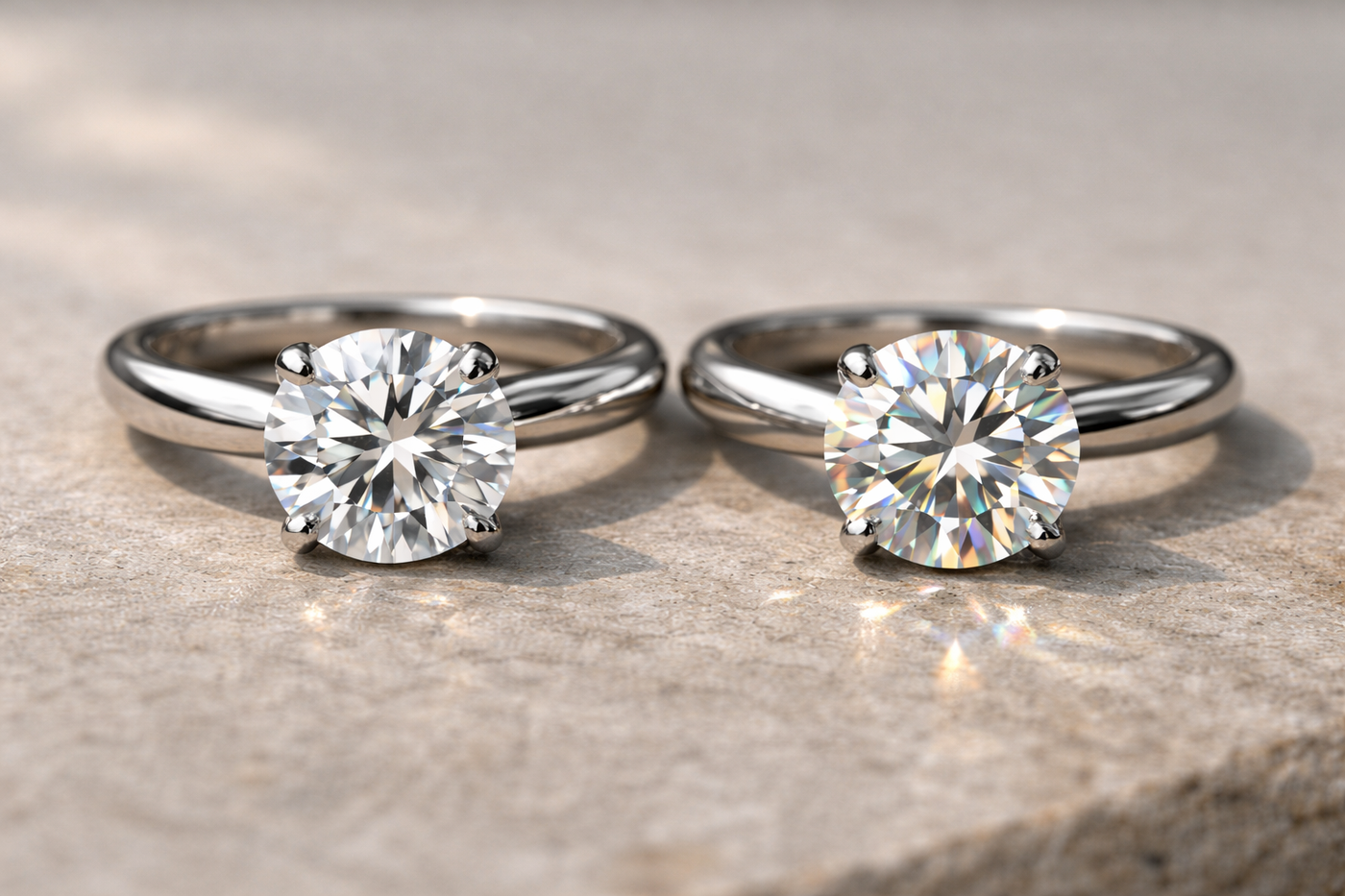
Fine jewelry often carries deep meaning — a proposal, a milestone, a quiet declaration of love — and the stone at its center matters. If you find yourself drawn to the brilliance of a large stone but undecided between a traditional diamond and its popular stand-in, cubic zirconia, understanding how these materials differ in composition, optical behavior, durability, price, and long-term value will help you buy with confidence. This guide examines the facts behind cubic zirconia and diamonds, explains quality factors, and offers clear advice for finding the right stone for your lifestyle and budget (1).
What Is Cubic Zirconia? What Is Diamond?

Cubic zirconia, commonly known as CZ, is a lab-created material with the crystal structure of zirconium dioxide. The mineral form (baddeleyite) was identified in 1937; the synthetic gem-quality version came later through stabilization of zirconium oxide with calcium or yttrium, which holds the material in a cubic form at room temperature (1). Skull-melting — a process of heating powdered zirconia inside a water-cooled metal shell and cooling it slowly — yields the large, facetable crystals sold in jewelry today (1).
Diamonds are pure carbon crystals formed under extreme pressure and heat deep in the Earth's mantle; they are the hardest material found in nature and have been prized since antiquity (2). Lab-grown diamonds share the same chemical and physical properties as their mined counterparts but are produced in controlled laboratory settings through either high-pressure, high-temperature (HPHT) or chemical vapor deposition (CVD) processes.
Mechanical properties of CZ compared to diamond.
CZ (r.i. ≈ 2.15–2.18, dispersion 0.058–0.066) produces vivid color flashes — what gemologists call fire — in greater abundance than diamond, but it lacks the sharp white brilliance that diamond's superior refractive index delivers (1). CZ is also considerably denser, with a specific gravity of 5.6–6.0 versus diamond's 3.52; a CZ stone weighs roughly 75–80% more than a diamond of equal diameter, so a 1 ct CZ and a 1 ct diamond are not the same size. Diamonds have perfect octahedral cleavage, while CZ is brittle with no cleavage — it chips rather than cleaves — a difference gemologists exploit when testing stones with thermal conductivity meters, since diamonds conduct heat efficiently and CZ does not.
Types and Variations
Both cubic zirconia and diamonds present a range of varieties that are worth understanding before you shop.

Cubic Zirconia
Appearance: Trace dopants can produce almost any color, yet most CZ is sold colorless with exceptional clarity. Its high dispersion yields more fire than diamonds, though trained eyes notice the difference in quality of light (1).
Composition: CZ is always synthetic — entirely different from lab-grown diamonds, which are real carbon-based diamonds grown in a controlled setting.
Durability: At 8.0–8.5 on the Mohs scale, CZ handles occasional wear reasonably well, but it is substantially softer than diamond (10 on the Mohs scale). With regular use, skin oils accumulate on the surface and the stone gradually clouds (3).
Common Uses: CZ appears widely in costume jewelry, fashion rings, and budget-friendly engagement alternatives. Its low cost makes it practical for large statement pieces and as a travel substitute for valuable diamonds (3).
Natural Diamonds
Appearance: Natural diamonds range from colorless through the full spectrum of fancy colors — yellow, blue, pink. Their balance of brilliance and fire stems from a refractive index of 2.419 and dispersion of 0.044, which together produce the recognizable sparkle found nowhere else (2).
Composition: Diamonds are pure carbon arranged in a tetrahedral lattice, formed over billions of years under conditions found only deep within the Earth.
Durability: At 10 on the Mohs scale, diamonds are the hardest material known; they resist scratching and hold their polish across generations (2).
Common Uses: Diamonds are the standard for diamond engagement rings and heirloom jewelry. Their hardness and thermal conductivity also serve industrial applications in cutting tools and precision instruments.
Lab‑Grown Diamonds
Appearance: Lab-grown diamonds are visually and physically indistinguishable from natural diamonds because they share the same carbon lattice structure.
Composition: Produced by HPHT or CVD, lab diamonds consist of pure carbon with none of the simulant materials present in CZ (1).
Durability: Identical to natural diamonds — Mohs 10, with the same toughness and resistance to daily wear.
Common Uses: Lab-grown diamonds serve as ethical, often lower-cost alternatives to mined diamonds in engagement rings and fine jewelry, appealing to buyers who prioritize sustainability alongside value.
How to Identify Quality
A diamond's cut, color, clarity, and carat weight are all evaluated under the standardized 4Cs system developed by the Gemological Institute of America (GIA). Cut determines how well the facets interact with light; round brilliants are graded from Excellent to Poor. Color runs from D (colorless) to Z (light yellow or brown). Clarity, assessed under 10× magnification, ranges from Flawless to Included. Carat weight measures the stone's mass — larger stones are rarer and command a premium (3). Any diamond you purchase should arrive with a laboratory report from GIA or IGI confirming these grades.
Cubic zirconia has no comparable grading system. Retailers sometimes assign marketing labels such as "hearts and arrows" or "AAAAA," but these are not scientific grades (3). Because CZ is produced consistently with high clarity and a colorless appearance, quality variations are minimal. Focus instead on even faceting, symmetry, and a setting that holds the stone securely. Since CZ may need replacing within a few years, pair it with durable metals like sterling silver or stainless steel rather than expensive 14K gold — the metal's longevity should match the stone's expected lifespan.
Buying Guide: How to Choose the Right Stone
Budget:
The price difference between CZ and diamond is stark. A 2-carat CZ runs approximately US$30; a comparable natural diamond costs roughly US$15,000, and even a lab-grown diamond comes in around US$5,400 (3). CZ makes sense for a large statement piece or a tight budget. Those seeking long-term value should look at lab-grown or natural diamonds instead.
Lifestyle:
Diamond's exceptional hardness makes it suitable for active daily wear. CZ works well for fashion jewelry or travel rings — sturdy enough for occasional use but prone to dulling and scratching with consistent wear (3). Lab-grown diamonds match natural diamond durability at a significantly lower price point.
Occasion:
Diamonds carry traditional significance for engagements, weddings, and anniversaries. CZ suits couples who plan to upgrade later, or anyone who needs a temporary or placeholder ring (3). It also holds its own in fashion pieces where size and visual impact matter more than longevity. Browse our classic diamond styles for pieces built to mark life's lasting moments.
Skin Sensitivity:
CZ stones are hypoallergenic, but metal settings can cause reactions. Nickel alloys sometimes irritate sensitive skin; choose platinum, palladium, or surgical stainless steel if this is a concern. Most diamond jewelry is set in high-quality gold or platinum that rarely causes issues, though some nickel-white-gold alloys can be problematic.
Long-Term Value:
Diamonds retain worth through rarity, prestige, and an established resale market. Cubic zirconia commands almost no resale price — used CZ jewelry typically sells only for its metal's scrap value. Lab-grown diamonds hold some resale value, though less than natural diamonds given their greater availability and falling production costs.
Care, Cleaning & Maintenance

Both diamonds and cubic zirconias stay bright with regular care. Soak the piece in warm water with a few drops of mild dish soap once or twice a week, then use a soft toothbrush to clear debris from around prongs and facets (1). Rinse thoroughly and dry with a lint-free cloth. Ultrasonic cleaners are safe for diamonds but should be avoided for CZ, as the vibration can loosen stones in already-worn settings. Avoid abrasive cleaners and harsh chemicals like chlorine bleach, which can damage metal settings over time. CZ in particular benefits from prompt cleaning since skin oils accelerate clouding; a dedicated jewelry cleaning solution applied weekly keeps the stone looking its best. Store pieces in separate padded compartments or soft cloth pouches to prevent contact scratches (1). Have a jeweler inspect prongs periodically — diamond settings need secure mounting to prevent stone loss, and CZ settings can loosen with extended use.
Common Myths & Misconceptions
A persistent myth holds that cubic zirconia is a synthetic diamond. It is not. CZ is made from zirconium dioxide, while diamond is composed of pure carbon — entirely different materials that merely share a visual resemblance (1).
Another misconception is that CZ is nearly as durable as diamond because both score high on the hardness scale. The Mohs scale is not linear but exponential. Diamond's rating of 10 makes it roughly four times harder than CZ's 8.5, which translates to a significant real-world difference in scratch and wear resistance over time (3).
Some buyers assume CZ's flawless clarity makes it superior. In practice, natural diamonds often carry small inclusions that confirm natural formation. CZ appears inclusion-free because it is manufactured to exacting tolerances, not because it is rare or extraordinary (4).
Finally, the idea that CZ holds value over time is unfounded. CZ jewelry has minimal resale value and, with regular wear, typically needs replacement within a few years (3).
Pros & Cons of Cubic Zirconia and Diamond

Feature |
Cubic Zirconia |
Diamond |
Composition |
Synthetic zirconium dioxide stabilized with oxides |
Pure carbon arranged in a crystal lattice |
Hardness (Mohs) |
8.0–8.5 – scratches easily; chips if struck |
10 – hardest natural material; extremely scratch-resistant |
Refractive Index & Fire |
RI ≈ 2.15–2.18; high dispersion (0.058–0.066) giving intense fire |
RI 2.419; lower dispersion (0.044) but superior brilliance and scintillation |
Weight & Size |
Specific gravity 5.6–6.0; heavier than diamond, so equal carat stones appear smaller |
Specific gravity 3.52; lighter stones appear larger for same carat weight |
Cost |
Very affordable; 2 carat CZ approx. US$30 |
Expensive; 2 carat natural diamond ~US$15,000 |
Durability & Longevity |
Loses luster over a few years; prone to scratches and cloudiness |
Lasts generations; retains polish and value with proper care |
Value & Resale |
Minimal resale value; considered costume jewelry |
Retains significant value; established resale market |
Ethics & Sustainability |
Lab-made; no mining impact |
Natural diamonds require mining; lab-grown offer an ethical alternative |
Trends & Modern Market Demand
Cubic zirconia gained mainstream traction in the late 1970s when commercial production made the material widely accessible to shoppers seeking diamond alternatives at a fraction of the cost (1). It remains popular for affordable, eye-catching costume jewelry, though consumers generally regard it as a travel or temporary stone rather than an heirloom (3). Diamond demand stays strong, driven by tradition and the stone's enduring symbolic weight. Natural diamonds hold their position in the engagement ring market for precisely those reasons. Lab-grown diamonds have grown rapidly in popularity as buyers recognize that ethical, lower-cost alternatives can offer identical beauty and durability (1). The market divides predictably: diamonds — natural or lab-grown — represent permanence and luxury, while CZ appeals to the price-conscious and fashion-forward.
Investment & Resale Value
Diamond investing is nuanced. Most retail diamonds resell at a discount given retail markups, though premium natural stones can appreciate over decades. Diamonds carry intrinsic worth and can be passed down or resold through established channels. Cubic zirconia, by contrast, has virtually no secondary market value — used CZ jewelry sells only for the metal content of its setting. Anyone focused on long-term return should look at high-quality natural diamonds or fine colored gemstones rather than CZ. Lab-grown diamonds sit in the middle: they are real diamonds with real grading credentials, but their resale value is lower than natural diamonds and continues to decline as production scales and costs fall (3).
Who Should Buy Cubic Zirconia vs Diamond?
Cubic zirconia suits buyers who want the look of a large stone without the corresponding price — ideal for a placeholder ring, a budget engagement, or someone who prefers not to wear expensive jewelry while traveling (3). CZ also works well in fashion jewelry, where trends change quickly and longevity is less of a priority. Those who value tradition, rarity, and long-term durability gravitate toward natural diamonds — the right choice for heirloom pieces meant to be worn daily and passed down through generations. Lab-grown diamonds bridge the gap: real diamond properties at a meaningfully lower price, with a reduced environmental footprint. Explore our full selection of natural diamond rings to find the stone that fits your moment. (1)
Frequently Asked Questions
1. What is cubic zirconia made of?
Cubic zirconia is synthetic zirconium dioxide stabilized with oxides like calcium or yttrium to maintain a cubic crystal structure; it differs chemically and physically from diamond (1).
2. How can you tell a diamond from cubic zirconia?
Professionals use tests like thermal conductivity — diamonds conduct heat efficiently while CZ does not (1). Inclusions, weight, and spectral features also help gemologists distinguish them (4).
3. Is cubic zirconia as durable as a diamond?
No. Diamond's hardness (10) far exceeds CZ's 8.0–8.5; CZ scratches and dulls relatively quickly and lacks the lifetime durability of diamond (3).
4. Does cubic zirconia have any resale value?
CZ has minimal resale value; its appeal lies in affordability and temporary beauty rather than investment (3).
5. Are lab‑grown diamonds the same as cubic zirconia?
No. Lab-grown diamonds are real diamonds produced in a laboratory and share the same carbon composition and properties as natural diamonds (1). CZ is an entirely different material.
6. Which stone is better for an engagement ring?
For longevity and lasting value, diamonds — natural or lab-grown — are the stronger choice. Cubic zirconia is best suited for temporary or travel rings given its limited lifespan (3).
Expert Jeweler Tips
Always request a GIA or IGI grading report when buying a diamond — it verifies cut, color, clarity, and carat weight independently. Avoid uncertified stones. To maximize sparkle per dollar, a well-cut lab-grown diamond or a natural diamond with slightly lower color but eye-clean clarity often outperforms a higher-grade stone with a mediocre cut. For CZ jewelry, pair the stone with durable metals like sterling silver or stainless steel, since the stone itself may need replacing within a few years (3). Reserve prong settings for diamonds; for CZ, bezel or channel settings protect the edges better and extend the stone's life. Clean both stone types regularly with mild soap and a soft brush, and store pieces separately to prevent surface scratches (1).
Conclusion
Cubic zirconia and diamonds may both catch the light, but they serve fundamentally different purposes. CZ is an affordable, lab-made option suited to fashion jewelry and temporary rings — its main trade-offs being a shorter lifespan and negligible resale value. Diamonds, mined or grown in a laboratory, remain the global standard for enduring beauty and lasting worth. They are the hardest gemstones available and hold their value far better over time.
Knowing the differences in composition, appearance, durability, cost, and care makes the choice straightforward. Prefer a sparkling CZ for everyday fashion, or invest in a diamond ring built to be worn for generations — either way, understanding what you are buying is what makes the decision yours. The right stone is the one that serves the specific purpose you have in mind, fits your budget honestly, and holds its place in your jewelry box for as long as you need it to.
Ready to explore your options? Browse our selection of diamonds and speak with our team for personalized guidance on finding the stone that suits your style and values.
Choose authenticity over imitation.
Experience the unmistakable fire and prestige of real diamonds at Diamond and Sapphire. View our expertly selected diamond pieces today.
Read more
How much should an engagement ring cost?
How much should an engagement ring cost? There’s no fixed rule. The old “two months’ salary” guideline is largely outdated. In the U.S., couples spend about $5,000 on average for an engagement ring...
Read more