
The Complete Guide to Diamond Shapes: Meaning, Types, Buying Tips & Care
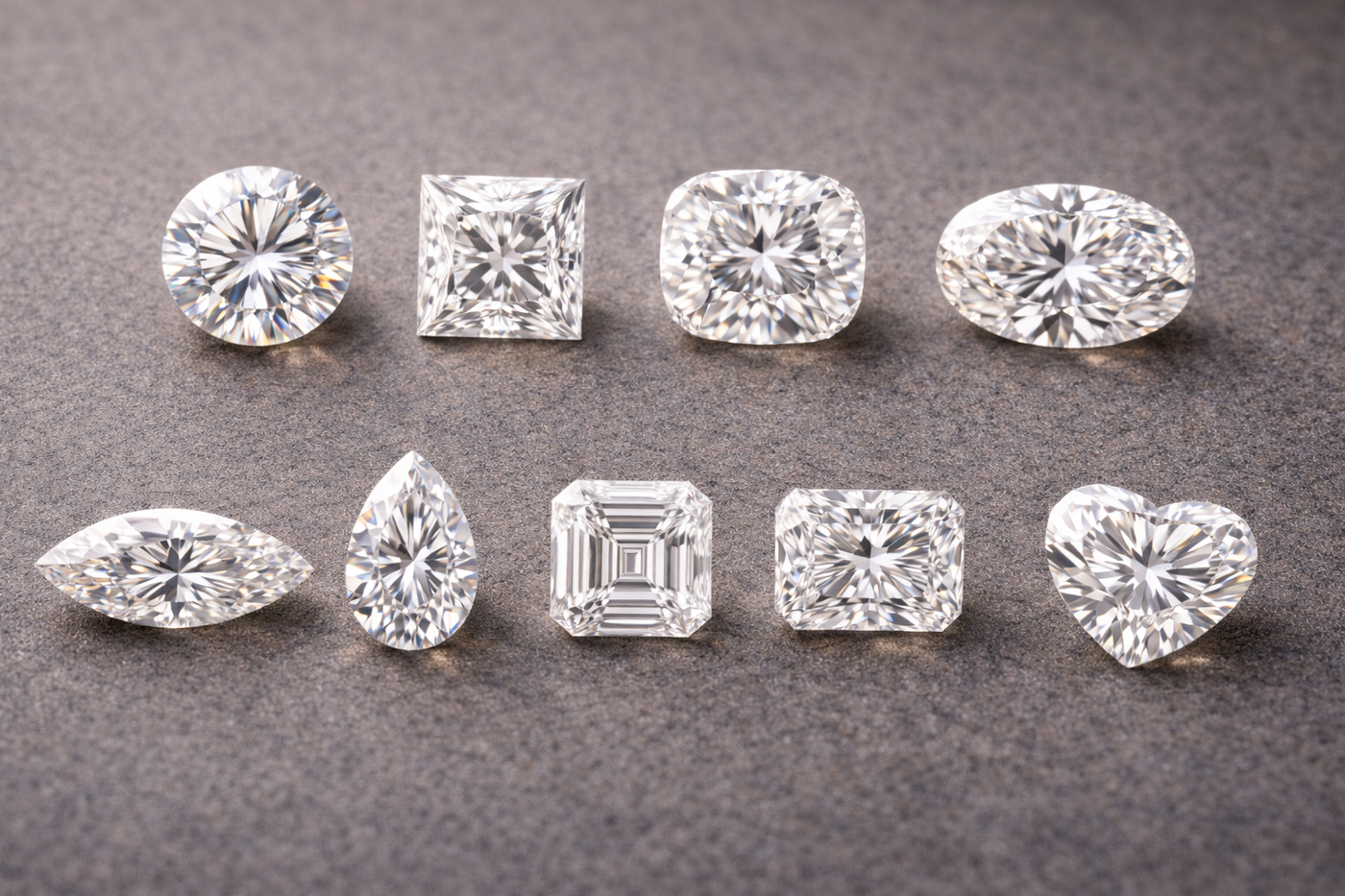
A diamond's shape does far more than define its outline. It governs how light travels through the stone, how large the gem appears in the setting, and the emotional register of the entire piece. (1) Shape is deeply personal — a round brilliant speaks one language; a sleek emerald cut speaks another. This guide covers every major shape, what makes each one distinctive, how to read quality across shapes, and how to match a cut to your life and budget. By the end, you'll have a clear, confident basis for the decision. Whether you are buying your first diamond or adding to a collection built over years, understanding shape is the place to start — it narrows the field faster than any other single consideration.
What Is a Diamond Shape?

In gemology, "diamond shape" refers to the stone's silhouette when viewed from above — round, oval, square (princess), pear, marquise, heart, and others. Shape and cut are related but distinct. Shape is the outline; cut describes the facet arrangement and the quality of craftsmanship that controls sparkle. The two terms are often used interchangeably in casual conversation, but understanding the difference helps you evaluate a stone properly. (1)
The round brilliant remains by far the most popular diamond shape, featuring a perfectly circular outline and 57–58 precisely arranged facets. Every other shape — emerald, oval, marquise, pear, cushion, and the rest — falls under the umbrella term "fancy shape" or "fancy cut." Each carries its own optical character, and knowing the differences makes the selection process considerably clearer. The distinction also affects pricing: rounds command a premium because they generate the most rough-stone waste in cutting, while fancy shapes retain more of the original crystal and typically carry a lower price per carat for equivalent quality.
Types of Diamond Shapes
Below is a shape-by-shape breakdown — faceting style, durability considerations, and the kind of person each cut tends to suit.
Round Brilliant Cut

The round brilliant is the benchmark of diamond cutting — a perfectly circular outline with 58 facets arranged in a symmetrical pattern engineered for maximum light return. (1) A well-cut round dazzles from every angle. Its curved perimeter has no sharp corners prone to chipping, making it one of the most resilient everyday shapes. For diamond engagement rings, the round brilliant has held the top position for decades — and for good reason. Its light performance is unmatched, its silhouette works in any setting, and its appeal doesn't hinge on seasonal trends.
The round brilliant accounts for roughly 60 percent of all diamonds sold worldwide, a dominance that reflects genuine performance advantages rather than convention alone. Because so much demand concentrates here, GIA offers a formal cut grade exclusively for rounds — ranging from Poor through Fair, Good, Very Good, and Excellent — giving buyers a reliable benchmark that simply doesn't exist for any other shape. That grading infrastructure also means the market for round brilliants is the most liquid and most transparent of any diamond category. For someone who wants maximum sparkle, maximum resale flexibility, and a shape that will never read as dated, the round brilliant is the clear starting point.
Princess Cut

Sharp 90-degree corners and a square (occasionally slightly rectangular) outline give the princess cut its contemporary edge. Despite the angular shape, its brilliant facet arrangement produces a sparkle that rivals a round. The pointed corners require protective V-shaped prongs to guard against chipping under daily wear. (1) Technically classified as a "square modified brilliant," the princess also carries a useful financial advantage: its cutting style retains more of the rough crystal, which typically translates to a lower price per carat than a comparable round — a meaningful consideration when allocating a budget.
The princess cut emerged in the 1960s and 1970s as cutters experimented with ways to bring round-brilliant-level fire to a square silhouette, and it quickly became the second most popular diamond shape in the world. On the hand, it reads clean and modern — the 90-degree corners give it a graphic quality that pairs naturally with contemporary cathedral settings, pavé bands, and channel-set side stones. One color-related note: the corners of a princess cut can concentrate tint slightly, so buyers sensitive to color may prefer a grade one step higher than they might choose in a round. That minor trade-off is easily offset by the lower price per carat the shape typically commands.
Cushion Cut

Rounded corners on a square or rectangular outline give the cushion cut its soft, pillow-like silhouette. This shape has existed since the 1800s — there's an inherent romance to its vintage lineage combined with modern faceting refinements. Some cushions carry larger facets that produce a chunky, velvety sparkle; others are cut in a "crushed ice" style for a more modern, scattered brilliance. (1) The rounded corners mean no fragile points, which keeps durability high. Cushions do run slightly deeper than rounds, so they can face up a touch smaller for the same carat weight — though they generally cost less per carat, which helps offset that trade-off. Halo and vintage settings both suit this shape particularly well.
The older "old mine" cushion cut — with a high crown, small table, and large culet — is the direct ancestor of the modern cushion, and estate pieces in this style carry enormous charm. Modern cushion cuts have been reengineered with shallower depths and more brilliant-style faceting to improve light performance, so today's buyer can choose between a classic chunky sparkle and a contemporary crushed-ice effect depending on personal preference. Length-to-width ratio also varies considerably: a square cushion (ratio close to 1.00) reads bold and balanced, while a rectangular cushion (ratio 1.15 and above) elongates the finger and works well in east-west orientations.
Oval Cut

An oval diamond carries the fiery brilliance of a round cut in an elongated silhouette that's flattering on almost any hand. The stretched form means a larger face-up surface area per carat, so ovals often read bigger than a round of the same weight. (1) Because neither end comes to a sharp point, chipping risk is considerably lower than with marquise or pear cuts. The main quality consideration: proportions must be well-balanced to prevent a "bow-tie" shadow from forming across the center. A well-cut oval — bright, lively, and correctly proportioned — is a strong choice for someone who wants the round's optical power with a silhouette that feels a little less expected. Price per carat typically runs lower than an equivalent round as well.
Oval diamonds have surged in popularity over the past decade and show no sign of retreating. Their finger-lengthening effect appeals broadly across hand sizes and finger shapes, making them one of the most flattering options available. The ideal length-to-width ratio for an oval falls roughly between 1.30 and 1.50 — ratios below 1.30 begin to look almost round, while ratios above 1.50 can appear narrow and wand-like. Evaluating bow-tie intensity in person or through high-resolution video is important; a mild bow-tie is acceptable and nearly unavoidable, but a pronounced one that dominates the center of the stone signals a proportioning issue worth avoiding.
Marquise Cut

Long, narrow, and tapered to pointed ends at both tips, the marquise has a dramatic silhouette said to have been inspired by the smile of an eighteenth-century French noblewoman. Its elongated outline maximizes apparent size — a marquise consistently faces up larger than a round of the same carat weight. (1) The pointed ends must be set with V-tip prongs to prevent snagging or chipping; a quality setting handles this beautifully. Marquise diamonds feel distinctly vintage yet have been cycling back into favor as an uncommon, statement-making choice. On the finger, the long silhouette visually lengthens and slims — a quality many wearers find striking.
The marquise achieves the largest face-up surface area of any brilliant-cut shape relative to its carat weight, which makes it an especially effective choice for buyers who want visual impact from a modest budget. Because the shape tapers to two points, a slight bow-tie effect across the center is common — the same phenomenon seen in ovals and pears — and proportions matter greatly. An ideal marquise typically has a length-to-width ratio between 1.75 and 2.25. Stones that fall much shorter start to read almost oval; stones that are excessively long can look fragile at the points. The shape pairs especially well with slender, tapered band settings that keep attention focused on the center stone.
Pear Shape

The pear — sometimes called a teardrop — blends the rounded end of an oval with a marquise-style point. Brilliant faceting gives it tremendous sparkle, and the elongated form carries the same size-per-carat advantage as an oval. (1) On a ring, the point traditionally faces the wearer's fingertip and requires a secure prong. Pear shapes have grown noticeably in popularity as an artistic, individually-minded choice — a stone for someone who wants brilliance and a silhouette that opens the door to creative settings. Quality to watch for: both halves of the rounded end should mirror each other, and the outline should taper smoothly to the tip without any flat spots.
One of the most versatile fancy shapes, the pear transitions effortlessly from an engagement ring center stone to a pendant drop to a pair of earrings. In a drop pendant setting, the pointed end hanging downward creates a particularly graceful, elongating line at the neckline. On a ring, wearing the point toward the fingertip is traditional, but some people prefer it oriented upward toward the knuckle for a more unconventional look — both orientations are entirely valid. Pear diamonds are also commonly chosen for east-west settings, where the stone is mounted horizontally across the finger, which creates an unexpectedly modern effect with a shape rooted in centuries of jewelry history.
Emerald Cut

The emerald cut is a rectangular step cut with cropped corners and parallel facets that run down the pavilion in broad, stairlike planes. Rather than the rapid-fire scintillation of a brilliant cut, it produces long, glassy flashes — a "hall of mirrors" effect prized for its understated elegance. (1) The open table of an emerald cut is unforgiving of inclusions and color — large, window-like facets put the stone's interior on full display. For this reason, higher clarity and color grades are generally advisable. The trimmed corners reduce chipping risk, and corner prongs keep the setting secure. Emerald cuts appeal strongly to buyers with a preference for quiet, architectural luxury — they suit three-stone ring designs and solitaire pendants beautifully. Browse our natural diamond rings for a range of step-cut options in this shape.
Originally developed to protect actual emerald gemstones from chipping during the cutting process, the emerald cut was later applied to diamonds and became the definitive choice of the Art Deco period. The style perfectly suited that era's love of geometric precision and clean horizontal lines. Today an emerald-cut diamond in a simple four-prong or bezel setting is one of the most quietly confident pieces a person can wear. The recommended length-to-width ratio for an emerald cut that reads proportionally balanced is typically between 1.30 and 1.60; ratios at the lower end look more square, while ratios above 1.60 produce a particularly long, lean silhouette well suited to slender fingers and long pendants.
Asscher Cut

Think of the Asscher as a square emerald cut with a distinctly vintage soul. Developed in the early 1900s and celebrated during the Art Deco era, it features layered step facets and a high crown that produce a deep, X-shaped "hall of mirrors" reflection — symmetrical and mesmerizing. (1) Like the emerald, it's honest about clarity: inclusions and color show more readily here than in brilliant cuts, so quality selection matters. Asschers are less common than emeralds or cushions, which makes them an appealing option for someone drawn to Art Deco styling or a genuinely rare silhouette. Double prongs on the corners are the standard protective setting approach.
The Asscher cut was first introduced by the Royal Asscher Diamond Company of Amsterdam in 1902 and gained widespread recognition when the company released an updated "Royal Asscher" cut in 2001 with 74 facets — significantly more than the original 58 — designed to improve light performance while preserving the distinctive octagonal geometry. Even the original 58-facet version produces a striking windmill pattern of light when you look straight into the table, a visual effect unlike anything in the brilliant-cut family. The square proportions, nearly equal in length and width, make the Asscher a particularly natural choice for bezel settings and vintage-style milgrain mountings that echo its early-twentieth-century origins.
Radiant Cut

The radiant is a hybrid: it takes the straight-edged, rectangular outline of an emerald cut and fills it with the dense brilliant faceting of a round, cropping the corners into an octagonal form for durability. The result is a shape that combines the graphic clarity of a step-cut silhouette with the fire and scintillation of a brilliant. (1) Radiants also do an excellent job concealing inclusions and slight color, making them far more forgiving than emerald or Asscher cuts. Square radiants look balanced and assertive; elongated ones slim the finger. Both offer good value per carat relative to rounds, with no meaningful trade-off in visual impact.
The radiant cut was developed by Henry Grossbard in 1977 specifically to solve the trade-off between the elegant silhouette of a step cut and the brilliance of a round — and it achieves that goal convincingly. The cropped corners, which create a subtle octagonal outline, also serve a practical function: they eliminate the acute-angle vulnerability of princess-cut corners while maintaining a broadly rectangular or square shape. Radiants work well alongside tapered baguette or trapezoid side stones that mirror the straight edges of the center, and they also pair naturally with round or cushion-cut halos. Because the faceting hides color well, buyers can often choose a slightly lower color grade and allocate the savings toward carat weight or cut quality.
Heart Shape

The heart-shaped diamond is the most openly sentimental cut in fine jewelry — a split at the crown, a pointed tip, and brilliant faceting that generates real sparkle and presence. Achieving a convincing heart requires precision: both lobes must be symmetrical and well-rounded, and the cleft clearly defined. For this reason, hearts typically read best at 0.5 carats and above. A well-cut specimen combines unmistakable shape with genuine brilliance. A V-prong at the tip and prongs along the lobes are standard protective settings. Heart diamonds carry a lower price per carat than rounds due to lighter demand, though high-quality examples are rarer to source. For the right person, the shape's symbolic clarity is the entire point. (1)
Because the heart shape requires the cutter to remove significant material from the cleft between the two lobes, it generates more rough wastage than almost any other shape — which partly explains why per-carat prices, while lower than rounds on average, don't fall as dramatically as one might expect. The cleft itself is the most telling quality indicator: it should be sharp, symmetrical, and clearly defined rather than shallow or drifting off-center. Evaluating a heart in person, at arm's length and under natural light, is the most reliable way to assess whether the two lobes appear balanced. A length-to-width ratio close to 1.00 produces the most balanced, recognizable heart silhouette; stones with a ratio significantly above or below that can read as lopsided or distorted at casual glance.
How to Identify Quality in Different Diamond Shapes

Cut quality matters above all else — but evaluating it is more straightforward for rounds than for fancy shapes. Round brilliants receive a formal GIA cut grade (Excellent through Poor). Fancy shapes don't carry a standardized cut grade on most reports, because the same criteria can't apply equally across all silhouettes — an oval and a princess reflect light in fundamentally different ways. (5) The International Gemological Institute (IGI) has recently introduced cut grading for select fancy shapes, which is a welcome development. For now, the practical approach is to assess proportions directly: length-to-width ratio, depth percentage, and table size. Observe how lively the diamond looks in person or through light-performance imagery. Polish and symmetry grades on the certificate are additional indicators of craftsmanship. A well-made fancy shape should have a balanced, smooth outline and consistent sparkle across the entire stone — no flat or lifeless zones.
Clarity and color interact with shape in ways worth understanding. Brilliant-style cuts — round, princess, oval, radiant, pear — scatter light through dozens of small facets, which naturally conceals minor inclusions and slight color tinting. Step cuts like the emerald and Asscher work differently: their broad, open facets act as windows into the stone's interior, making inclusions and color far more visible. Higher clarity and color grades are therefore recommended for step cuts to achieve a clean, bright appearance. (1) A VS₂ inclusion that disappears in a round brilliant may be obvious in an emerald cut of the same grade. Similarly, achieving a visually colorless appearance in a step cut often calls for a higher color grade than a round would require.
Regardless of shape, always require an independent grading report from GIA or IGI. These documents confirm the stone's identity and detail its quality characteristics — the foundation of a confident purchase. In addition to the written report, ask the jeweler to show you the diamond under magnification and in natural daylight. Written grades describe what exists; light performance shows you what you will actually see every day you wear the piece.
Buying Guide: How to Choose the Right Diamond Shape
A few practical factors can sharpen an otherwise purely personal decision:

-
Budget: Round diamonds typically command a 20–40% premium over fancy shapes of equivalent carat and quality. (3) Fancy cuts — oval, princess, radiant — often face up larger for the same weight, so you can stretch your budget meaningfully. A 1.20 ct oval may cost less than a 1.00 ct round of equivalent quality. (5) Knowing this trade-off at the outset makes budgeting considerably more productive. In practical terms, selecting a fancy shape can free up enough budget to move up a full color grade, choose a more elaborate setting, or add meaningful side stones — all without changing the total spend.
-
Lifestyle & Daily Wear: Hands-on lifestyles favor shapes without vulnerable points. Round, oval, and cushion cuts have smooth perimeters that resist snagging on fabric or work surfaces. Princess, marquise, and pear cuts — all of which end in sharp corners or tips — need protective prong work (V-prongs on marquise ends, corner prongs on princess) to stay safe under daily wear. (1) Low-profile settings like bezel-set ovals can also improve day-to-day comfort. A bezel, which wraps a rim of metal around the diamond's entire perimeter, is one of the most secure settings for any shape and works especially well for active wearers who want both protection and a streamlined look.
-
Occasion & Personal Style: For an engagement ring worn every day for decades, shapes with proven longevity — round, oval, cushion — make intuitive sense. Someone with a more individual aesthetic might feel a far stronger pull toward a pear, marquise, Asscher, or heart. Neither instinct is wrong. As one jewelry designer put it, the shape should represent the couple, not the season's trend. (2) For occasion jewelry — pendants, earrings, gifts — the symbolic resonance of a shape (a heart for a meaningful anniversary, a pear for a distinctive pendant) can drive the decision entirely. The most enduring advice from experienced jewelers is consistent: choose the shape that made you stop scrolling, not the one that ranked highest on a list.
-
Long-Term Value: Round brilliants hold their value most reliably — they have the broadest buyer pool and the most liquid resale market. Fancy shapes carry lower initial prices, which also means lower resale baselines. (3) Trend sensitivity is a real factor: a style at peak popularity today may see softened demand in twenty years. High-quality, well-cut examples in any shape fare better than lower-grade stones. Ultimately, a diamond is a piece to wear and love — any financial upside at a later date is a welcome benefit, not the reason to buy one.
Care, Cleaning & Maintenance
Diamonds are the hardest natural mineral, but grease, lotion, and everyday grime accumulate quickly and dull their brilliance. Home cleaning is straightforward: soak the piece in warm water with a few drops of mild dish soap or an ammonia-based jewelry cleaner for 20–30 minutes. Use a very soft toothbrush to work gently around the pavilion, where residue collects most heavily. Rinse with lukewarm water and pat dry with a lint-free cloth. Done weekly, this routine keeps the stone looking its best. (1)
Ultrasonic cleaners are effective for most diamond rings, but they are not appropriate for all settings — delicate pavé bands, bezel-set stones with older mountings, and rings with fracture-filled or clarity-enhanced diamonds can be damaged by the vibrations. When in doubt, hand-cleaning with the soap-and-water method is always safe. Steam cleaning, offered by most professional jewelers, is another excellent option that removes buildup without any mechanical risk to the stone or setting.
Pay attention to the specific demands of the shape. Pointed cuts — marquise and pear — depend on their prongs to protect fragile tips; handle them carefully and avoid bending or loosening those settings. Bleach and chlorine should never touch the metal setting, as both can damage or discolor gold and platinum alloys. (1) Remove diamond rings before gardening, lifting, or washing dishes. Every six months, have a jeweler inspect the prongs and setting — particularly for fancy shapes with corners or points — to confirm everything remains secure. With consistent care, the diamond holds the same brilliance it had the first day you wore it.
Common Myths & Misconceptions
-
Myth 1: "Cut" and "Shape" Mean the Same Thing. Many buyers use these terms interchangeably, but they refer to different things. Shape is the outline — round, pear, oval. Cut describes how well the diamond has been faceted. Two diamonds can share the same shape yet differ dramatically in cut quality; the better-cut stone will always sparkle more. The name "princess cut" includes the word "cut" as part of its colloquial label, but it still refers to a specific shape with a particular facet style. Keeping these concepts distinct makes evaluating any diamond considerably easier. (1)
-
Myth 2: "Only Round Diamonds Sparkle Well." Rounds set the benchmark for brilliance — an ideal-cut round performs exceptionally — but the broader claim doesn't hold. Shapes like princess, oval, radiant, and pear are all cut in brilliant styles with dozens of angled facets designed to reflect light. (5) A well-cut oval can outperform a poorly cut round. Each shape handles light differently: a round returns brilliance evenly across the stone; an oval or pear produces a distinctive light pattern with a bow-tie zone; an emerald flashes in broad, sweeping planes. Viewing fancy shapes in person, under varied lighting, tends to settle this question quickly. (5)
-
Myth 3: "Diamond Shape Doesn't Affect the Price." Shape has a real and measurable effect on price. Round brilliants carry the highest demand and generate the most rough-stone wastage during cutting — both factors push prices up. Fancy shapes usually cost 10–40% less per carat for equivalent quality grades. A 1.50 ct oval of a given specification might be 20% less than a 1.50 ct round at the same quality level. Cutting economics and market demand drive these differences. If budget matters, selecting a fancy shape is one of the most effective ways to optimize what the 4Cs deliver within a given spend.
Pros & Cons of Different Diamond Shapes
A quick side-by-side comparison across the major shapes. (5)
Diamond Shape |
Pros |
Cons |
Round Brilliant |
Unmatched brilliance and fire; timeless, classic look; works in all settings; retains value well due to demand. |
Highest price per carat; widely available, so less distinctive; strict cutting standards mean limited choices in budget ranges. |
Princess (Square) |
Modern, chic silhouette with excellent sparkle (brilliant facets); usually lower in price than round; faces up large from above. |
Sharp corner points can chip without protective prongs; tends to show color in corners; depth may cause it to face up slightly smaller than a round. |
Oval |
Elongating silhouette flatters the finger; brilliance close to a round; appears larger than a round of same weight; generally better value per carat. |
Bow-tie shadow if proportions are off; slight points at ends benefit from protective prongs; some cuts show color at tips. |
Marquise |
Longest silhouette gives maximum apparent size for the weight; distinctive vintage character; visually slims and lengthens the finger. |
Pointed ends are fragile — require V-prongs; pronounced bow-tie effect in some stones; concentrates color at points; strong aesthetic that doesn't suit every taste. |
Emerald |
Sophisticated glassy "hall of mirrors" flash; showcases clarity; elegant and finger-flattering in longer ratios; generally lower cost than a round of same size. |
Less scintillation than brilliant cuts; inclusions and color show easily — higher grades needed; fewer stones on the market; corners still require protective prongs. |
Cushion |
Soft, romantic silhouette with rounded corners; balances vintage charm with modern sparkle; hides inclusions well in crushed-ice variations; attractive prices per carat. |
Can appear slightly smaller than a round of the same weight due to depth; softer brilliance; proportions vary considerably, so preferences differ. |
Pear |
Distinctive teardrop silhouette; combines round brilliance with a unique outline; elongates the finger; priced lower than round; one pointed end works beautifully in pendant drops. |
Single pointed tip can chip without a proper prong; bow-tie risk like ovals; asymmetry in a poorly cut example is noticeable; less conventional, which limits some markets. |
Heart |
Unmistakable symbol of love; dazzling when well-cut; memorable conversation piece; generally priced below rounds per carat. |
Requires a larger carat size for the shape to read clearly; difficult to cut with precision; pointed tip needs protection; smaller resale market than mainstream shapes. |
(Personal preference can outweigh any item on either list — the best shape is the one that genuinely resonates with you.)
Trends & Modern Market Demand
Round brilliants remain the enduring bestseller, but fancy shapes have been gaining ground steadily as buyers look for something more personal. Industry observers have noted sustained growth in demand for elongated cuts — ovals and emerald cuts in particular have taken a prominent position in the engagement ring market over recent years. (2)
Vintage influence is also shaping the market meaningfully. Cuts that fell out of mainstream use are returning: marquise, pear, rose-cut, and cushion diamonds are among the shapes jewelers cite most often as choices gaining traction for 2024–2025. (2) The through-line is individuality. Many couples actively want something that doesn't look like every other ring — and vintage-inspired cuts serve that impulse while remaining unmistakably fine. Celebrity choices continue to drive awareness, with pear and emerald cuts appearing regularly on high-profile hands and expanding the mainstream appetite for fancy shapes. (2)
East-west orientations — where an elongated stone like a marquise or oval is set horizontally across the finger rather than vertically — have also captured considerable attention. This contemporary mounting choice gives a familiar shape an entirely new character and has been especially popular among buyers who want the silhouette of a classic fancy cut presented in a way that reads fresh and modern.
Investment & Resale Value
Shape matters in the context of liquidity and resale. Round brilliants are the safest choice from that perspective — they attract the broadest buyer pool, carry well-established price benchmarks, and are straightforward to sell or trade. The premium paid at purchase tends to carry forward at resale.
Fancy shapes offer better value at the point of purchase precisely because they carry lower per-carat prices — and that lower baseline is also reflected in resale values. (3) Trend sensitivity is a real factor: a shape at peak popularity today may see softened demand in twenty years. Cut quality and overall stone quality remain reliable determinants of held value across all shapes. Rarity can work in a stone's favor as well — a large marquise in exceptional color and clarity has historically attracted serious interest from collectors and vintage-jewelry buyers.
For buyers whose primary goal is future liquidity, round brilliants continue to represent the most predictable choice. (5) For everyone else, diamonds are made to be worn. Any financial upside at a later date is a welcome benefit — not the reason to buy one.
Who Should Buy What Shape?
Each diamond shape has its own character, and the fit between shape and person matters.

-
A round brilliant suits anyone who prizes maximum sparkle and genuinely timeless design. It's a natural match for someone who values enduring classics over seasonal preferences — a shape with no expiration date.
-
Oval and cushion shapes appeal to buyers who want contemporary styling with a nod to tradition. Ovals attract brides who favor elegance and a modern silhouette; cushion cuts draw those who respond to a softer, more romantic outline with a vintage undertone.
-
Pear or marquise shapes suit confident, distinctive tastes. Pear cuts carry an artistic, individualistic quality — a shape for someone who takes genuine pleasure in standing apart. (4) Marquise diamonds, with their dramatic pointed ends, resonate with anyone drawn to vintage glamour or a bolder, more regal aesthetic.
-
Emerald and Asscher cuts align with a preference for clean lines, geometric precision, and subtle sophistication. Emerald cuts in particular are associated with calm, architectural elegance — the quiet luxury end of the diamond spectrum. A curated selection of these shapes can be found among our diamond classic styles.
-
A heart-shaped diamond is for the confirmed romantic — someone who wants to wear their feeling openly and isn't put off by a shape with an unmistakable meaning. It's a niche choice, but for the right person, no other shape comes close.
No universal "correct" answer exists. The best diamond shape is the one that draws you back every time you see it. A knowledgeable jeweler can help you compare options, but the final call should feel instinctive. (4)
Frequently Asked Questions – FAQ
Q: What is the most popular diamond shape for engagement rings?
A: The round brilliant cut leads by a considerable margin — it's estimated to account for over half of all diamonds sold. Its intense sparkle and classic symmetry have sustained that position for decades. The 58-facet arrangement, refined over more than a century of gemological research, produces a level of light return that no other shape consistently matches, which is why it remains the default starting point for most first-time buyers.
Q: Which diamond shape is the sparkliest?
A: Round brilliants produce the most sparkle overall, engineered specifically for maximum light return — which is why GIA's "Excellent" cut grade category applies exclusively to rounds. (1) Princess, oval, and radiant cuts all use brilliant facet patterns, however, and a well-cut example in any of these shapes delivers real fire. The distinction worth remembering is that step cuts — emerald and Asscher — produce a different optical effect altogether: broad, sweeping flashes rather than rapid scintillation, which many people find equally compelling even if it registers differently to the eye.
Q: What's the difference between a diamond's cut and its shape?
A: Shape is the outline — round, square, pear. Cut refers to the quality of faceting and how well the stone handles light. Shape defines the form; cut quality determines whether that form sparkles or sits flat. Two diamonds of identical shape can differ dramatically in brilliance depending on cut grade. Investing in the best cut quality within your budget — before increasing carat weight or choosing a higher color — is the single most impactful decision a buyer can make.
Q: Do some diamond shapes look bigger than others of the same carat weight?
A: Yes. Elongated shapes — oval, marquise, and pear — distribute their weight across a larger surface area, so they face up noticeably bigger than a round of equal carats. (3) Shallow cuts face up larger generally, while deeper shapes (some cushions, some Asschers) hide more weight below the girdle and appear smaller. Comparing dimensions rather than carat weight alone gives a clearer picture of apparent size. A one-carat oval, for example, typically has a face-up surface area roughly 10–15 percent larger than a one-carat round, which can translate to a visually meaningful difference when you see the two side by side.
Q: Which diamond shapes are in style right now?
A: Rounds remain perennially popular, but ovals and emerald cuts have dominated the conversation over the past several years. Looking ahead, experts point to marquise, pear, and cushion cuts as the shapes gaining the most traction among current buyers. (2) Old mine and rose cuts are also experiencing a revival among buyers specifically seeking an antique character. Broadly, modern buyers show more openness to unique shapes than at any previous point. The underlying shift is cultural: individuality in jewelry selection is being celebrated rather than nudged back toward convention, which benefits every fancy shape on this list.
Q: Are some diamond shapes more expensive than others?
A: Round diamonds consistently carry the highest price per carat — higher demand and greater rough wastage in cutting both contribute. Fancy shapes typically run 10–40% less for equivalent quality grades. (3) A 1.00 ct round at a given specification might list at $10,000, while a 1.00 ct oval at the same grades could be closer to $7,500. Price differentials between fancy shapes also exist and shift with supply and demand dynamics, but rounds reliably carry the highest baseline. Within the fancy-shape category, the most in-demand shapes at any given moment — ovals have been commanding a premium in recent years — can close the gap with rounds somewhat, so it pays to compare actual market prices rather than relying on general rules.
Q: What diamond shape is the most durable?
A: Shapes without sharp points or corners are most resilient. Round brilliants, ovals, and cushions all have smooth perimeters with no acute angles prone to chipping. Princess, pear, and marquise shapes have corners or tips that are more vulnerable — though proper prong work addresses this effectively in a quality setting. (1) All diamonds resist scratching (only another diamond can scratch a diamond), but pointed ends require deliberate protection. Having prongs inspected and retipped by a jeweler every year or two is an inexpensive maintenance step that dramatically extends the working life of any setting with delicate geometry.
Q: What does "fancy shape" mean?
A: "Fancy shape" means any diamond shape other than the standard round brilliant. Princess, emerald, oval, pear, marquise, heart, cushion, Asscher, and radiant cuts are all fancy shapes. The designation distinguishes them from round brilliants as a category. Many of these shapes — marquise, emerald, pear — have centuries of history behind them, even if the "fancy" label makes them sound like recent inventions. In practice, the term is simply a trade classification that helps jewelers and graders group non-round diamonds together for pricing, grading, and inventory purposes.
Expert Jeweler Tips for Choosing a Diamond Shape
-
Always Buy Certified: Insist on a grading report from GIA or IGI. An independent certificate verifies the 4Cs, confirms whether the stone is natural or treated, and establishes what you're actually paying for. This is non-negotiable for any meaningful purchase. Keep the certificate in a safe place — it will be required for any future insurance appraisal, resale, or trade-in transaction.
-
Try Different Shapes On: Even a firm preference from photographs can shift after seeing a shape on your hand. Elongated cuts flatter shorter fingers; rounds suit almost any hand. A princess might read more powerfully with your personal style; an oval might give you exactly the slender elegance you were looking for. Virtual try-on apps and in-person comparisons both help. (5) If you can't visit a showroom, many online jewelers offer free home try-on programs with non-diamond replicas — a genuine convenience for comparing proportions and scale before committing.
-
Protect the Points: Shapes with corners or tips — princess, marquise, pear — need correct setting work. V-tip prongs or double prongs should guard any delicate points to prevent chipping over time. (1) A bezel or halo setting adds further security. An experienced jeweler will know exactly how to protect the stone's structure without compromising the visual design.
-
Follow Your Taste, Not Just the Trend Cycle: Shapes cycle in and out of fashion, but the diamond on your hand will likely be there for decades. Choose a shape that speaks to your personal aesthetic and what this piece means to you — not to the current season's preferences. As one bridal designer advises, the ring should represent your relationship, not someone else's trend report. (2)
-
Prioritize Cut Quality: A well-cut diamond will outperform a poorly cut one at every size. Buy the best cut grade your budget supports before increasing carat weight. A slightly smaller but beautifully cut stone typically looks larger and more alive than a bigger, flat-performing one. Cut quality is the single variable that most directly controls how a diamond looks in real light — for any shape. (5)
-
Maximize Value with Fancy Shapes: Fancy shapes like radiant, oval, and cushion typically cost less per carat than rounds and face up with generous spread — more visual size per dollar spent. (1) This makes it possible to move up a color grade, add carat weight, or choose a more elaborate setting without overstretching your budget. Explore our full range of colored diamonds and natural white shapes to see the breadth of what's available. (5)
Conclusion
Choosing a diamond shape is one of the most personal decisions in fine jewelry. A round brilliant carries maximum sparkle and classic authority. A princess cut is clean and contemporary. An emerald offers architectural elegance. Pear and heart shapes add softness and overt sentiment. None of these is objectively the best — the right shape is the one that fits you.
Consider when and how you'll wear the piece, what it should communicate, and which silhouette draws you back instinctively. This guide has covered quality assessment, shape-by-shape trade-offs, and the buying factors worth weighing. Trust your judgment. The best diamond shape is the one that looks right to you, suits your daily life, and stays meaningful over time. Our diamond necklace and ring collections offer shapes across the full spectrum — browse at your own pace and let the right stone find you.
Fancy cuts and vintage-inspired shapes are having a genuine moment in fine jewelry. Explore the options, apply what you've learned here, and find the shape that's unmistakably yours.
Every shape tells a story.
From classic round to bold emerald cuts, explore Diamond and Sapphire's expertly cut diamonds and find the shape that speaks to you.
Read more
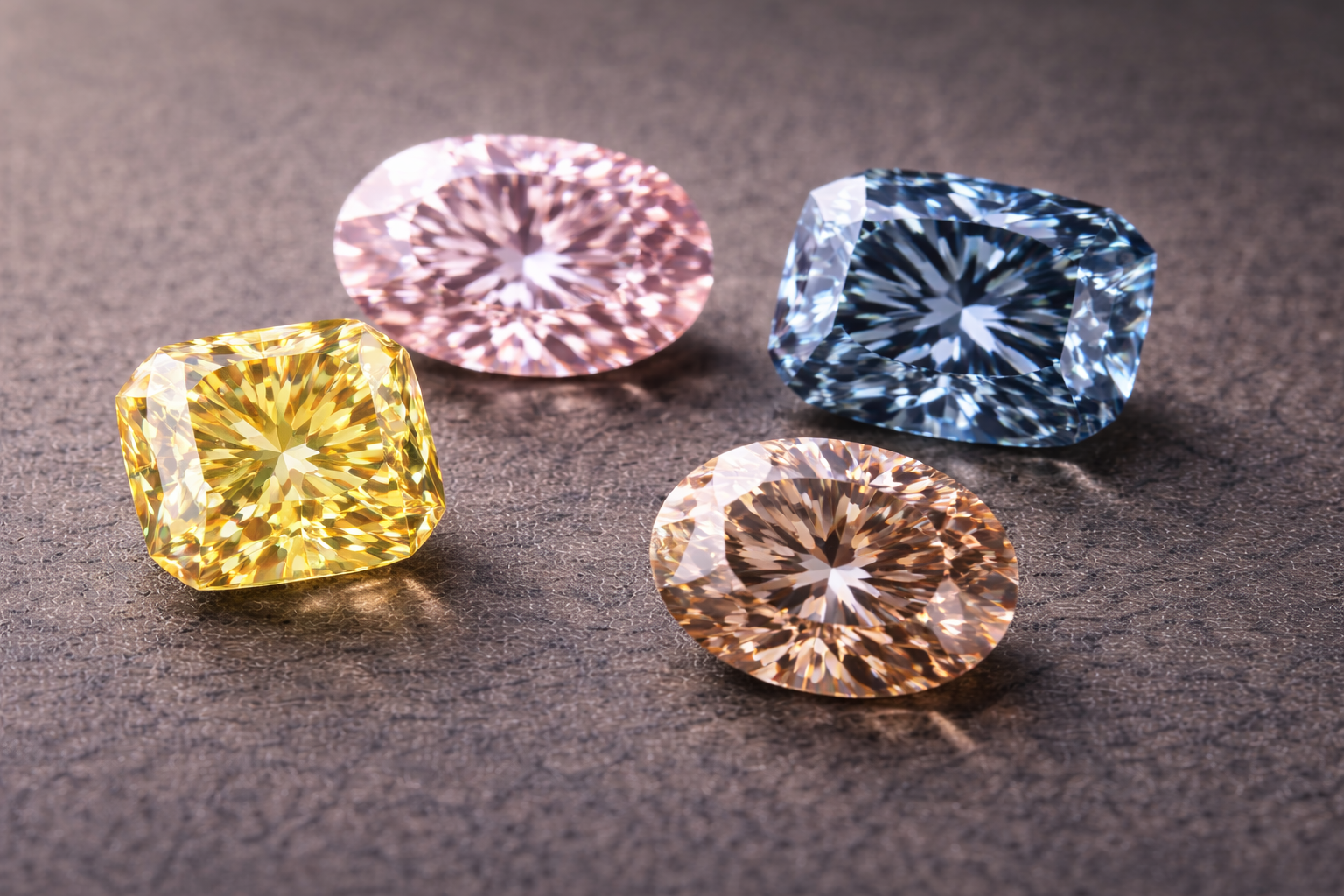
Colored diamonds are natural diamonds that have colors that go beyond the normal D-to-Z scale. Their colors come from small amounts of nitrogen (yellow) and boron (blue), structural changes (pink a...
Read moreColored diamonds are natural diamonds that have colors that go beyond the normal D-to-Z scale. Their colors come from small amounts of nitrogen (yellow) and boron (blue), structural changes (pink a...
Read more