
Cubic Zirconia vs Moissanite
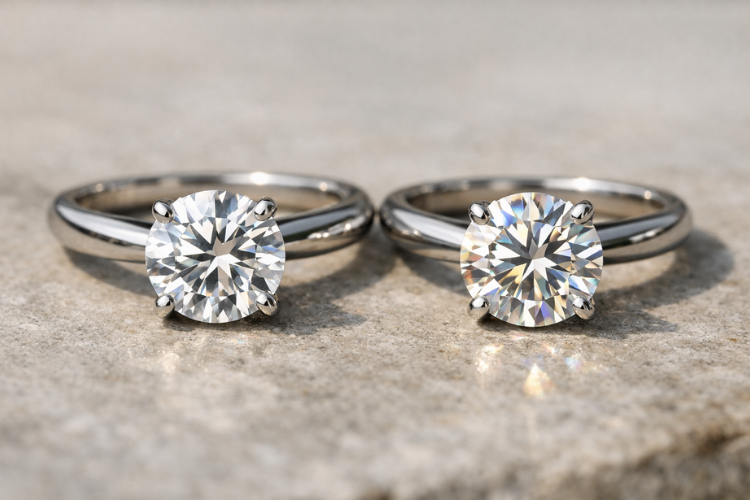

A diamond's appearance without the price or the ethical concerns of mined stones—that's the appeal drawing many shoppers toward diamond alternatives. For engagement rings, travel jewelry, and everyday sparkle, cubic zirconia and moissanite have become two of the most widely chosen substitutes (1).
They may look similar at first glance, but their behavior over time is quite different. One excels as an affordable fashion stone. The other carries a signature "rainbow fire" that many find captivating—and holds up well enough for daily wear. This guide explains the real differences in appearance, durability, quality markers, care, and purchasing guidance so you can choose with confidence.
Cubic Zirconia vs Moissanite at a Glance

Here's the comparison most shoppers want first—simple, practical, and decision-ready.
|
Factor |
Cubic Zirconia (CZ) |
Moissanite |
|
What it is |
Lab-created zirconium dioxide (ZrO₂) |
Lab-grown silicon carbide (SiC) |
|
Hardness |
~8–8.5 Mohs (good, but can scratch over time) |
~9.25 Mohs (excellent for daily wear) |
|
Sparkle style |
Bright, clean sparkle; can look "very perfect" |
Extremely high brilliance + stronger rainbow fire |
|
Color stability |
Can dull/scratch and may show warmth over time with heavy wear |
Very stable; doesn't "turn cloudy" from age—usually just needs cleaning |
|
Best for |
Fashion jewelry, travel rings, occasional wear, big looks on a small budget |
Engagement rings, daily wear, long-term pieces, high-sparkle lovers |
|
Price |
Lowest cost option |
Higher than CZ, still far below most mined diamonds |
Cubic Zirconia (CZ)
Cubic zirconia is a lab-made gemstone engineered to resemble diamond. Zirconium oxide (ZrO₂) is crystallized into a cubic structure under controlled conditions (2). Premium CZ straight from the box can look remarkably clean and colorless—often described as "ice white," with no visible inclusions.
The trade-off is durability. While CZ is hard enough for most jewelry, it is softer than moissanite and diamond, so extended wear causes minor abrasions that gradually reduce sparkle. CZ is widely used in fashion jewelry precisely because it delivers significant size and visual impact without a significant price tag (1). Our gemstone elegance collection includes CZ-set pieces in refined settings worth considering.
Moissanite
Moissanite is composed of silicon carbide (SiC) and is prized for its intense optical performance (4). Natural moissanite is extraordinarily rare, so virtually all jewelry-grade stones are laboratory grown. Moissanite reads as diamond-like—especially in well-cut, contemporary colorless grades—but has its own distinct personality. In most lighting conditions it produces more rainbow flashes than diamond, a quality that sets it apart (2).
With a hardness of approximately 9.25 Mohs, moissanite holds up exceptionally well to daily use. It retains its polish over years of wear and is a frequent choice for engagement rings and daily-wear pieces among shoppers who want both high brilliance and genuine durability (3). Browse our moissanite earring collection to see how this stone performs across different settings.
The 4 Differences That Matter Most

1) Durability & Daily Wear
For pieces worn every day—especially rings—durability tends to be the deciding factor.
-
Moissanite's hardness approaches that of diamond, making it highly scratch-resistant and well suited to daily rings (2).
-
CZ is durable enough for occasional wear, but micro-abrasions accumulate faster on ring surfaces that brush against desks, doorknobs, and gym equipment. Over years, those small scratches cause CZ to appear less crisp, even after cleaning (2).
The practical takeaway: moissanite is generally the stronger choice for a center stone you plan to wear for years without replacement. CZ is hard to match for trend jewelry, travel, or occasional-wear pieces where appearance matters more than longevity.
2) Sparkle & "Diamond-Likeness"
Both stones sparkle—but differently.
-
Cubic zirconia produces a bright, clean look that reads as diamond-like to most eyes, particularly in smaller sizes and quality cuts.
-
Moissanite tends to be more vivid—its refractive index and dispersion create stronger fire (more colorful flashes) than diamond, which can be remarkable in sunlight and under spotlights (2).
Shoppers who love moissanite's extra fire tend to commit quickly. Those who prefer a more subdued, classic diamond look often choose a smaller moissanite, a cut designed to reduce color flash, or a lab-grown diamond instead (1).
3) Color, Clarity & How They Age
Both stones appear near-perfect when new. What changes over time depends on wear, surface condition, and cleaning habits.
Cubic Zirconia
CZ is typically produced with flawless clarity and true colorlessness. Heavy daily wear introduces surface buildup and abrasion that diminish its vibrancy. After several years, some pieces may also develop a slightly warmer tone (2).
Moissanite
Contemporary moissanite is available in colorless and near-colorless grades and remains stable over time. When moissanite appears dull, it's almost always residue from lotion, soap, or skin oils rather than any permanent change in the stone itself (3).
4) Cost & Value
Cubic zirconia is the most affordable path to a large, brilliant look. Moissanite costs more than CZ but delivers better performance under daily wear and a longer aesthetic lifespan.
A simple way to frame it:
-
Cubic zirconia has the lowest upfront cost, making it excellent for trend-driven styles, travel rings, and fashion jewelry.
-
Moissanite offers stronger long-term value per wear, making it the preferred choice for daily sparkle and engagement rings (3).
Both are purchases made for beauty and performance—neither should be viewed as a financial asset (1). For inspiration across both stones, explore our luxury gemstones collection.
How to Choose the Right Stone
Use this section as a quick decision guide.
Choose Cubic Zirconia if…
-
Budget is the primary factor and you want the most sparkle for the least spend.
-
The piece is a travel ring, a statement fashion accessory, or something you'll wear occasionally.
-
You're comfortable replacing the stone after years of daily wear if needed (2).
Choose Moissanite if…
-
The piece will see daily use—an engagement ring, wedding band stack, or everyday studs.
-
Rainbow fire and high brilliance are part of the appeal.
-
You want a stone that stays visually stable with minimal upkeep for many years (3).
If you want the most "diamond-like" look
A few tips that come up often:
-
A smaller moissanite will show less rainbow fire than a large one—useful if you prefer a subdued look.
-
Cut quality and setting design matter enormously—clean prongs and balanced proportions support a diamond-like optical result.
-
Resist the impulse to maximize size—very large stones accentuate the differences between these materials and diamond (1).
Quality Checklist (What to Look For Before Buying)
Cubic Zirconia Quality Checklist
-
Cut first: crisp facet edges, good symmetry, lively sparkle. Poorly cut CZ can look glassy.
-
Clarity/appearance: avoid stones that look hazy straight out of the box.
-
Setting quality: many disappointing CZ experiences trace back to cheap prongs and low-quality plating rather than the stone itself. A secure setting in skin-friendly metal makes a measurable difference (1).
-
Know what you're buying: CZ is sometimes confused with "zircon," which is a distinct natural gemstone (1).
Moissanite Quality Checklist
-
Color grade: for a bright white look, select colorless or near-colorless grades.
-
Cut style: some cuts are optimized to read as diamond-like; others are designed to emphasize moissanite's distinctive fire.
-
Documentation: for meaningful purchases such as engagement rings, choose sellers who provide clear disclosures and any available authenticity confirmation for the stone (3).
-
Reputable seller: moissanite is widely available, so a vendor with transparent specifications, clear return policies, and aftercare support matters more than marketing claims (1).
Care, Cleaning & Maintenance

Routine cleaning (safe for both)
-
Mix warm water and mild dish soap.
-
Soak the jewelry for a few minutes.
-
Use a soft toothbrush to gently clean around the stone, paying attention to the underside.
-
Rinse and pat dry with a lint-free cloth (1).
This routine is usually enough to restore full sparkle.
Avoid harsh chemicals. Bleach, chlorine, and abrasive cleaners are off-limits. Even if a stone can tolerate certain chemicals, the metal and plating often cannot—and abrasives will dull finishes over time (1).
Ultrasonic/steam cleaning
Moissanite is generally durable enough for professional cleaning methods, though the setting always matters. With CZ, caution is advisable—if the setting is weak or the stone already has chips, aggressive cleaning can create new problems. When uncertain, soap-and-water cleaning is the safer default (1).
Prevent scratches and loosened settings
-
Store pieces separately to avoid friction between stones and metals.
-
Remove rings for heavy chores, gym workouts, or any activity that risks knocking the stone against hard surfaces.
-
Inspect prongs regularly—most lost stones are lost because of the setting, not because of the gemstone itself (1).
Common Myths (Cleared Up)
Myth 1: "Moissanite is the same as cubic zirconia."
They are entirely different materials: moissanite is silicon carbide, CZ is zirconium dioxide. Their durability and optical behavior differ significantly as a result (4).
Myth 2: "They're fake and look cheap."
High-quality CZ and moissanite can look exceptional. The "cheap look" almost always traces to poor cut quality or flimsy metal settings—not to diamond alternatives as a category (1).
Myth 3: "They always turn cloudy."
Moissanite does not permanently cloud with age; any dullness is surface residue and cleans off readily (3). CZ can lose crispness over time, mainly from surface abrasion on a ring worn every day, but consistent cleaning and careful wear slow that process considerably (2).
Myth 4: "Lab-grown diamond, moissanite, and CZ are all the same."
A lab-grown diamond is still a diamond—identical in chemical structure to a mined stone. Moissanite and CZ are different gemstones that resemble diamond visually but are chemically distinct (1). If a true diamond is what you want, browse our diamond engagement rings or the full rings collection.
FAQs
1) What's the main difference between CZ and moissanite?
Moissanite is harder, more durable, and produces stronger rainbow fire with high brilliance. CZ is considerably less expensive and can look remarkably clean when new, but it shows wear earlier in daily rings (2).
2) Does moissanite sparkle more than diamond?
Moissanite often shows more fire (colorful flashes) than diamond because its dispersion is higher. Many people describe it as extra sparkly or fiery, particularly in bright lighting (2).
3) Will CZ turn my finger green?
The stone itself won't. Green discoloration comes from the metal—typically copper or a plated alloy. Choosing better base metals—sterling silver, solid gold, or quality vermeil—usually eliminates the issue (1).
4) How can I tell if a stone is CZ, moissanite, or diamond?
At-home tests are unreliable. Standard diamond testers identify CZ easily, but older models can mistake moissanite for diamond. A jeweler with proper tools can confirm the stone type precisely (1).
5) Are these environmentally friendly choices?
Both avoid mining and are generally considered lower-impact alternatives, though laboratory production does consume energy. Many buyers choose them for both ethical and practical reasons (1).
6) Can I insure or appraise a CZ or moissanite ring?
Yes. Appraisals typically assess replacement value and the quality of the setting. Insurance is available, especially when the piece includes precious metal or additional stones (1).
Conclusion
Beautiful, eye-catching jewelry doesn't require a diamond price tag. Moissanite and cubic zirconia both deliver genuine sparkle at a fraction of the cost—each with its own strengths. For fashion pieces, travel rings, and trend-driven styles, CZ is an excellent low-cost choice, particularly with a well-executed cut and a solid setting. Moissanite is the wiser option for daily wear: its hardness and remarkable fire make it especially well suited to engagement rings and classic styles that need to look good for years without excessive upkeep.
The right decision comes down to how well a stone fits your lifestyle, price range, and preferred aesthetic—not whether it is "real" or "simulated." CZ wins on upfront cost for maximum visual impact. Moissanite wins on longevity for pieces worn every day. See both in our gemstone elegance collection and the luxury gemstones collection for a side-by-side sense of what each looks like in quality settings.
Ready to find your ideal stone? View our curated selection of moissanite jewelry to compare designs side by side, from everyday studs to engagement rings. Discover the piece you'll love wearing every day by exploring our online catalog.
Discover the brilliance that truly lasts.
Explore Diamond and Sapphire's curated collection of fine diamond and moissanite jewelry—crafted for enduring beauty and timeless elegance.
Read more
How Much Should a Wedding Ring Cost?
Wedding rings can cost anywhere from under $500 for a simple band to many thousands of dollars for elaborate diamond or platinum designs. The “three-month salary” rule is outdated—experts recommend...
Read moreHow Much Should a Wedding Ring Cost?
Wedding rings can cost anywhere from under $500 for a simple band to many thousands of dollars for elaborate diamond or platinum designs. The “three-month salary” rule is outdated—experts recommend...
Read more