
Frequently Asked
Channel-Set Engagement Rings FAQ
What is a channel-set engagement ring?
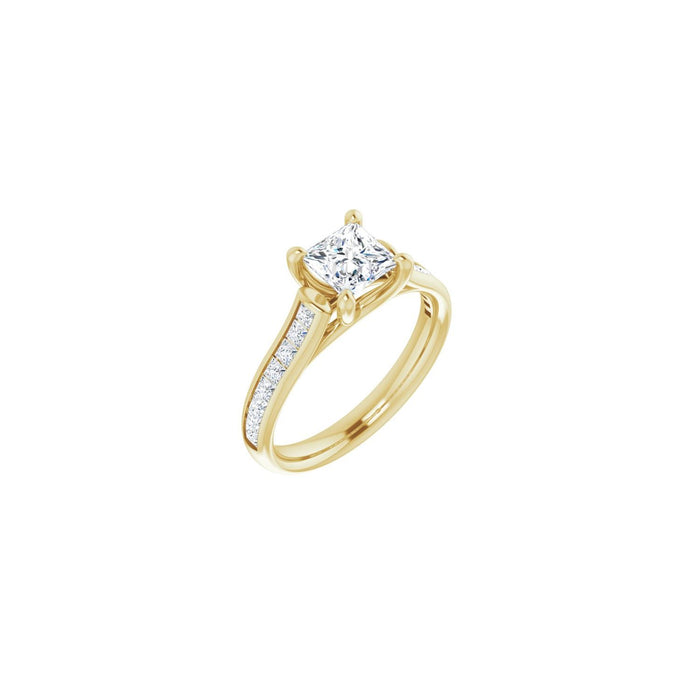
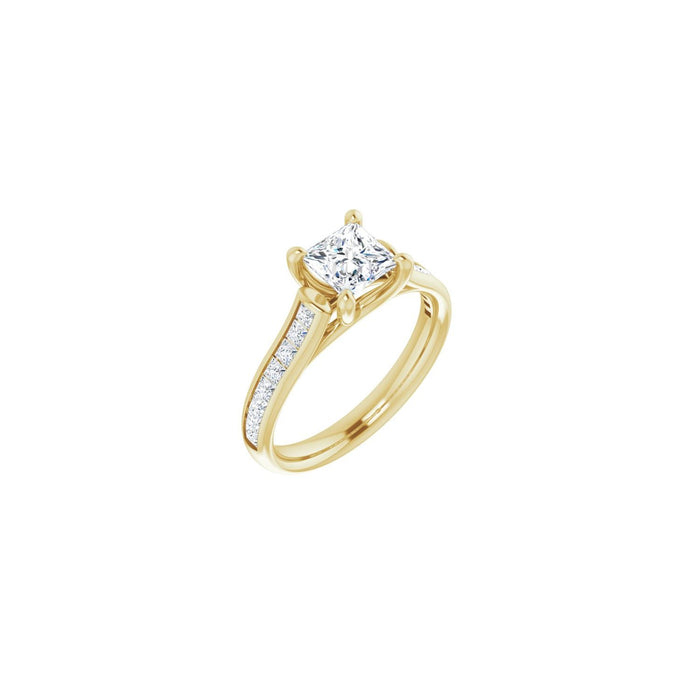
Channel setting seats a row of accent diamonds inside a groove cut directly into the band, then secures them under two continuous rails of metal, one on each side. The stones sit girdle to girdle with no metal between them, so from above you see an unbroken ribbon of diamond framed by polished gold or platinum. No prongs, no beads, no claws. The technique demands more precision than prong work, since every stone must be cut to sit flush at exactly the same height, and that precision is what you feel when you run a finger across the finished band: it is completely smooth. Every ring in this collection pairs a channel-set band with a real, independently certified lab-grown center diamond, shown at its complete all-in price.
Channel-set or pave: which should I choose?
Choose by how you live and what you want the band to say. Pave scatters more fire because each tiny stone is lifted on miniature prongs and catches light from more angles, but those prongs can snag fine knits and they need periodic checking. A channel trades a little of that fire for a lot of security and polish: the accents are shielded behind solid rails, the surface stays smooth against gloves and hair, and the line of light reads tailored rather than glittery. People who type all day, garden, climb, or work clinical shifts tend to land on channel and never look back. If you love the pave look, we build that too; see our pave engagement rings and compare the two side by side.
Do channel-set diamonds fall out?
Channel setting is among the most secure ways to set small diamonds, which is exactly why it is so common on wedding bands meant for daily wear over decades. Each stone is captured on two sides by a rail of solid metal that runs the length of the row, so there are no individual prongs to bend or wear thin. A stone can only come loose if the rail itself is bent by a hard knock, which is rare in normal wear. The sensible habits still apply: take the ring off for the gym and heavy lifting, and have a jeweler check the channel once a year when the ring is cleaned. Do that and a channel band will outlast most prong-set bands it is compared against.
Why do channel settings pair so well with princess-cut diamonds?
Because both are built from straight lines. A princess cut is square with sharp corners, so princess accents placed side by side in a channel meet edge to edge with no gaps and no metal showing between them, forming what looks like a single continuous strip of diamond. Round accents in a channel leave small curved spaces at each meeting point; square ones do not. Pairing a princess center over princess channel accents doubles down on that geometry, which is why it is the signature version of the style and why four of the seven rings in this collection take that form. The channel rails also cover the accents' pointed corners, the most fragile part of a princess cut, so the pairing is more durable as well as sharper looking.
Can a channel-set ring be resized?
Honest answer: within a smaller range than a plain or pave band. Because the channel and its stones run along the shank, a large size change can distort the rails and unseat the accents, so most jewelers keep channel resizes to about a half size in either direction. Our approach is to make the problem disappear before it exists: every ring here is made to order in your exact size, so the channel is built around the finger it will live on. If you are proposing on the sly and need to guess, tell our concierge; we will help you estimate from a borrowed ring or a traced band, and we will confirm what adjustment room your chosen design allows before you order.
Are lab-grown diamonds real diamonds?
Yes. A lab-grown diamond is crystallized carbon, the same material as a mined diamond in every chemical, physical, and optical respect, grown in weeks instead of a billion years. It is not a look-alike such as moissanite or cubic zirconia; it tests as diamond because it is diamond. The center of every ring in this collection is graded by an independent laboratory such as GCAL, IGI, or GIA, and each ring links to its certificate. Going lab-grown is what lets you put a bigger, brighter center above that channel of accents for the same budget, and if you would rather have a natural center, our concierge will source and quote one.
What does the all-in price include?
The complete ring you see in the photograph: the channel-set band with its accent diamonds, the certified lab-grown center stone, the setting work, and finishing to your ring size. We do not advertise a bare setting-only price and add the center at checkout. Complete rings in this collection start at $1,479 and run to about $2,100 as shown, with larger centers, different color and clarity grades, and natural diamonds available beyond that through our concierge. The number on the page is the price of the finished ring on her finger.
How long does a channel-set ring take to make?
Each ring is made to order, and channel work is the slow, careful part: the groove is cut, each accent is seated flush, and the rails are burnished over by hand. Most rings ship within about two to three weeks. If a proposal date or anniversary is driving the timeline, tell us the date and we will confirm feasibility before you pay. Made to order is also what makes the sizing honest; the channel is built to your finger from the start, which matters more for this style than any other in the shop. Care is simple: warm water, mild soap, a soft brush along the channel, and a professional check once a year.