
Frequently Asked
Pear Engagement Rings FAQ
Which way does the point on a pear ring face?
Convention points the tip toward the fingertip, away from the hand, and there is a good reason for it beyond tradition. Worn that way, the long axis of the pear runs with the finger and visually stretches it, so the hand looks slimmer and more elegant. It also keeps the delicate point tucked at the top of the ring where it is easier to protect. A handful of people wear the point toward the wrist for a subtle reverse look, and that is entirely a matter of taste. Every pear in this collection is set point-up in the classic orientation, and you are free to wear it however feels right to you.
Does a pear diamond look bigger than a round of the same weight?
It usually does. A pear carries much of its carat weight in a wide, elongated face rather than in depth, so it presents more surface to the eye than a round of identical weight. In practice a well-cut one-carat pear can read close to a carat and a quarter round from across a table. That extra spread is one of the main reasons couples choose the shape: you get presence on the finger without paying for the deeper stone. The long silhouette is also what makes a pear so flattering, since it draws the eye down the length of the hand rather than sitting in a single compact spot.
What is the bowtie effect, and should I worry about it?
Every elongated shape, including the pear, can show a faint dark shadow across its center called a bowtie, caused by the way light travels through the stone. A slight bowtie is normal and even adds a little contrast; a heavy, blacked-out one is a sign of a poorly cut stone. We select pear centers that are cut to keep the bowtie soft and the face lively from edge to edge, and because each stone links to its own certificate and photography, you can judge it for yourself before you buy. If you ever want a second opinion on a particular diamond, our concierge will walk you through it.
Are lab-grown diamonds real diamonds?
Yes. A lab-grown diamond is chemically, physically, and optically the same material as a mined diamond, pure crystallized carbon, grown in a matter of weeks instead of over a billion years. It is not a simulant like moissanite or cubic zirconia; it tests as diamond because it is diamond. Every pear in this collection is a lab-grown stone graded by an independent laboratory such as GCAL or IGI, and each ring links to that certificate so you can read the exact carat, color, clarity, and cut for yourself. Choosing lab-grown is what lets us put a top-color, high-clarity pear at the center of a complete ring for a fraction of the mined-stone price.
How is the fragile point on a pear protected?
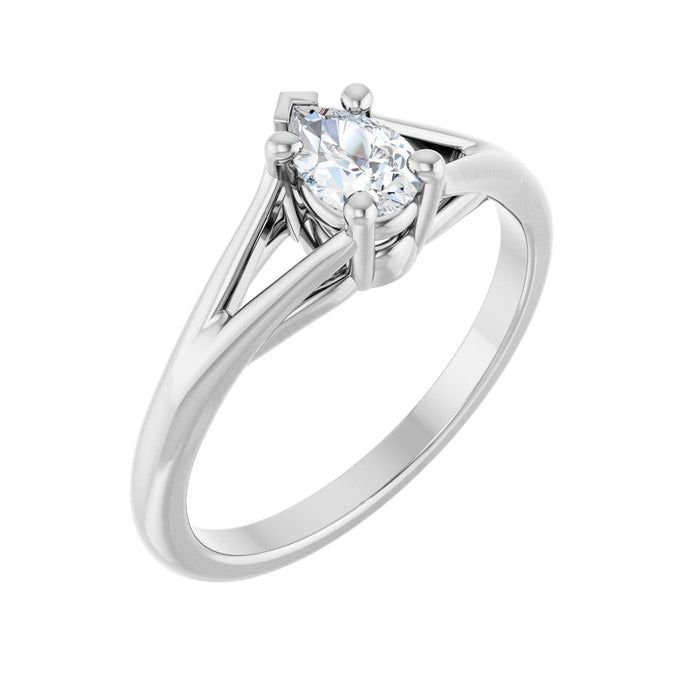
The tip is the one spot on a pear that needs looking after, and good setting design handles it. Many of our pear rings cap the point in a V-shaped prong that fits over it like a small helmet, guarding the most vulnerable corner from knocks. Others use a cathedral shoulder or a half-bezel rim to brace the stone along its edges. A lab-grown pear is just as hard as any diamond, so with a sensible setting and normal care it holds up to daily wear for a lifetime. If your partner is especially hands-on, the V-prong and half-bezel styles are the ones to look at first.
What carat size should I look at?
This collection runs from about 0.7 up to 2.1 carats, which covers where most pear shoppers land. Because a pear faces up larger than its weight, you can often choose a slightly smaller stone than you would in a round and still get the look you want. A 0.7 to 1.0 carat pear is graceful on smaller hands and reads bigger than the number suggests; the 1.5 carat pieces are the sweet spot for presence and balance; and the 2.1 carat rings make an unmistakable statement without a traditional-jeweler price. If you are torn, a three-stone or baguette-accented setting adds width and makes a modest center look more generous.
Which setting works best for a pear diamond?
It comes down to how the ring will be worn. A solitaire or V-prong solitaire puts all the light on the teardrop and guards the point. A three-stone design adds side diamonds that widen the face and carry real symbolic meaning. Baguette-accented and V-tip baguette settings run clean rectangular side stones down the shoulders for an Art Deco look that lengthens the whole ring. A half-bezel wraps the long edges in a protective rim for a modern, snag-free feel, while bypass and twisted vine bands give the pear movement and a touch of vintage character. There is no wrong answer, only the one that fits her hand and her days.
Can I use a different diamond than the one shown?
Absolutely. Each ring is photographed and priced with a specific, sensibly matched lab-grown pear so you can see a real, honest all-in cost rather than a setting-only teaser. If you would like a different center, a larger stone, a natural mined diamond, or a particular color or clarity, contact our concierge and we will hand-select options and quote the exact all-in price before you commit. A full self-serve ring builder is on the way; for now a real person does the matching, which most buyers actually prefer for a purchase this important.
How does sizing work, and when will my ring ship?
Every pear engagement ring is finished to order in the size you choose, so it arrives ready to propose with. If you are buying as a surprise and do not know the size, order close and we can adjust, or request our free ring sizer. Because these are made to order, most orders ship in roughly one to two weeks; the exact window is listed on each product page and in your confirmation. If you are working toward a specific date, tell our concierge and we will confirm the timeline first. Every ring ships fully insured and free, with 30-day returns, a free first-year resize, and a lifetime warranty on the setting.
Is the price really all-in?
Yes, and that is the whole point of how this collection is built. The price on each product page is the complete ring: the setting, the certified lab-grown pear center shown, and the labor to set and finish it in your size. There is no separate diamond to add at checkout and no setting-only sticker designed to look cheaper than the real cost. If you swap to a different center through our concierge, we requote the full number the same honest way before anything is charged.