
Frequently Asked
Princess Engagement Rings FAQ
What is a princess cut diamond?
A princess cut is a square (sometimes slightly rectangular) diamond with sharp 90-degree corners and full brilliant faceting, the same kind of many small triangular facets you find on a round. That faceting is why a princess cut sparkles so much like a round while keeping a clean, contemporary square outline. It was developed in the 1960s and 1980s and is now the most popular of the fancy (non-round) shapes. If a round is the traditional choice and an emerald cut is the understated one, the princess cut is the modern one: geometric, bright, and a little bit bold.
Are lab-grown diamonds real diamonds?
Yes. A lab-grown diamond is chemically, physically, and optically the same material as a mined diamond, pure crystallized carbon, grown in a matter of weeks rather than over a billion years. It is not a simulant like moissanite or cubic zirconia; it tests as diamond because it is diamond. Every princess cut in this collection is a lab-grown stone graded by an independent laboratory such as GCAL or IGI, and each ring links to that certificate. Choosing lab-grown is what lets us put a top-color, high-clarity princess cut at the center of a complete ring for a fraction of the mined-stone price.
Why are princess cut rings often better value than round?
Two reasons. First, cutting a round diamond wastes more of the original rough crystal, while a princess cut is squared off in a way that keeps much more of it, so less material is lost and the price per carat runs lower. Second, because princess cuts hold their weight in depth, you get a real diamond of serious carat weight for less than the round equivalent. Pairing that efficiency with a lab-grown stone is how a top-color, high-clarity princess cut lands at a genuinely reasonable all-in price here.
Do princess cut diamonds sparkle as much as round?
Nearly. The princess cut uses brilliant-style faceting, so it throws a lot of fire and returns light well, far more like a round than a step cut such as an emerald or Asscher does. The difference is character: a round scatters sparkle evenly in a circle, while a princess cut sends it out in brighter, chunkier flashes with a sharp geometric feel. Many people who love sparkle but find the round too traditional choose a princess cut for exactly this reason.
Do the sharp corners chip easily?
The corners are the one thing worth understanding. They are the pointiest part of the stone and, if left completely exposed, are the spot most likely to catch or chip over years of wear. The fix is simple and built into good settings: V-prongs that cap each corner, a channel or bezel that covers them, or cathedral arches that shield them. Several designs in this collection, including the V-prong baguette, channel-set, and half-bezel settings, are chosen specifically to protect those corners so you get the square look with none of the worry. A lab-grown stone is also just as hard as a mined one, a perfect 10 on the Mohs scale.
What carat size should I look at?
This collection runs from about 0.7 up to 2.6 carats. A princess cut faces up a touch smaller than a round of the same weight because more of its weight sits in the depth, so many people go a little higher on carat than they might with a round. A 0.7 to 1.0 carat princess is bright and easy to wear every day; the 1.2 to 1.5 carat pieces are the sweet spot for presence without excess; and the 1.9 and 2.6 carat rings make a genuine statement at a price a traditional jeweler could not match. A three-stone or baguette setting adds width and makes any center read larger still.
Which setting works best for a princess cut?
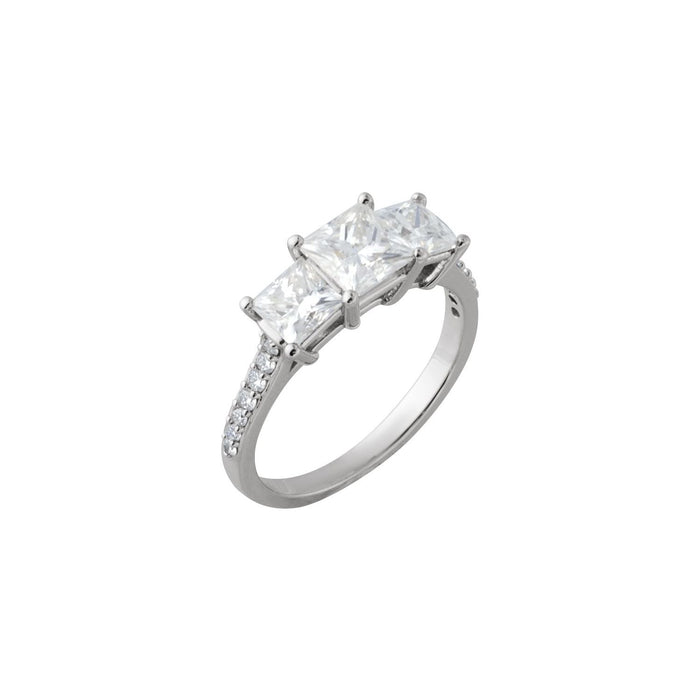
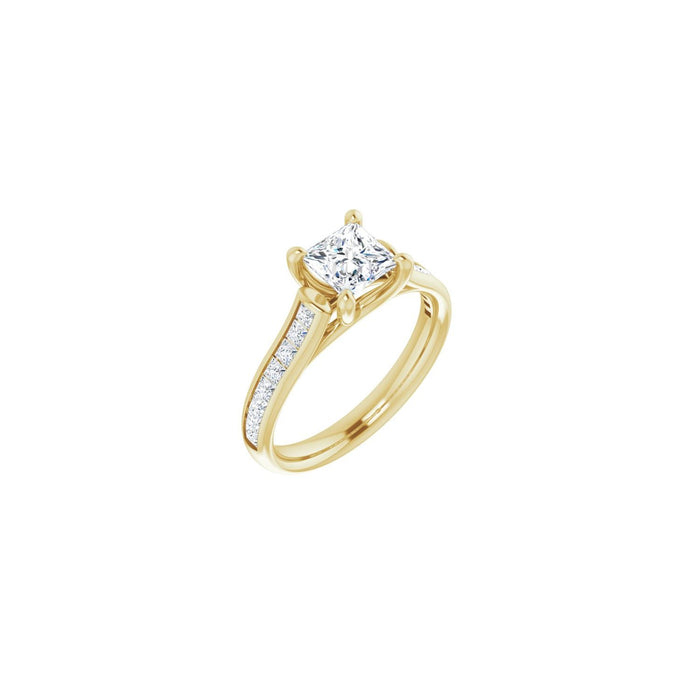
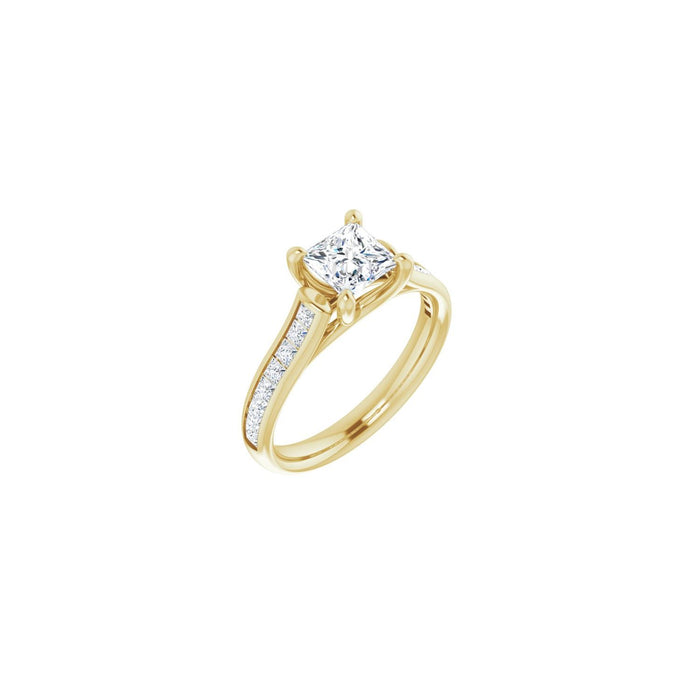
The princess cut loves clean, geometric settings that echo its square lines and protect its corners. A pavé solitaire keeps the square stone in the lead with fine sparkle down the band. A channel-set band tucks matching square accents flush beside it for snag-free wear. The hidden halo adds a secret collar of diamonds that shows only from the side, while cathedral arches lift and guard the stone. For larger centers, a V-prong baguette setting caps every corner in Art Deco style, and a three-stone design squares off matched side stones for a bright, symbolic look. There is no wrong answer, only the one that suits her hand.
Can I use a different diamond than the one shown?
Absolutely. Each ring is photographed and priced with a specific, sensibly matched lab-grown princess cut so you can see a real, honest all-in cost rather than a setting-only teaser. If you would like a different center, a larger stone, a natural mined diamond, or a particular color or clarity, contact our concierge and we will hand-select options and quote the exact all-in price before you commit. A full self-serve ring builder is on the way; for now a real person does the matching, which most buyers prefer for a purchase this important.
How does sizing work, and when will my ring ship?
Every princess cut engagement ring is finished to order in the size you choose, so it arrives ready to propose with. If you are buying as a surprise and do not know the size, order close and we can adjust, or request our free ring sizer. Because these are made to order, most orders ship in roughly one to two weeks; the exact window is listed on each product page and in your confirmation. If you are working toward a specific date, tell our concierge and we will confirm the timeline first. Every ring ships fully insured and free, with 30-day returns, a free first-year resize, and a lifetime warranty on the setting.
Is the price really all-in?
Yes, and that is the whole point of how this collection is built. The price on each product page is the complete ring: the setting, the certified lab-grown princess-cut center shown, and the labor to set and finish it in your size. There is no separate diamond to add at checkout and no setting-only sticker designed to look cheaper than the real cost. If you swap to a different center through our concierge, we requote the full number the same honest way before anything is charged.