
Baguette vs Emerald Cut
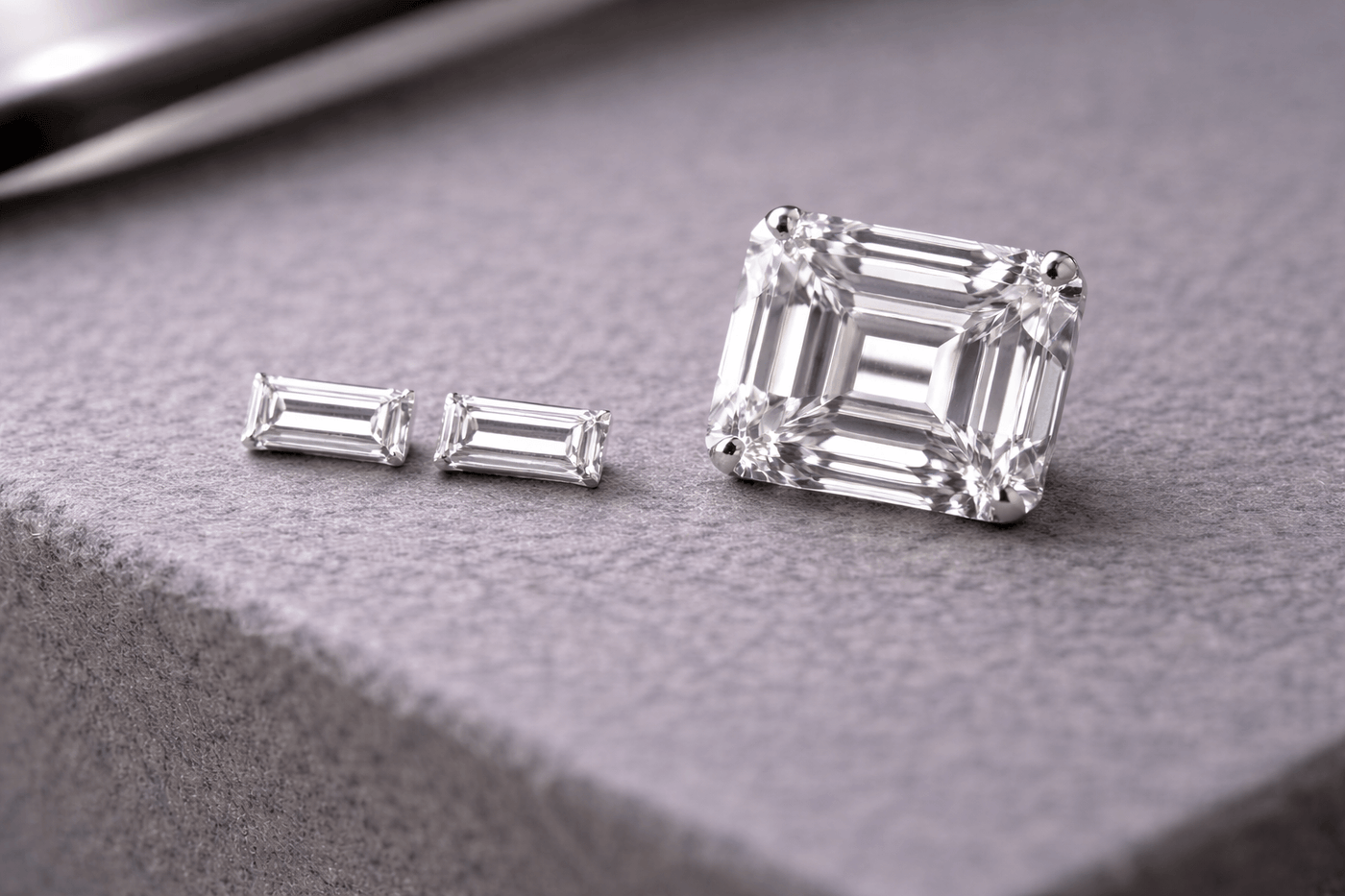

The cut is the language that shapes each diamond's story. Step-cut stones—baguette and emerald among them—rank among the most compelling in fine jewelry. Their straight lines and geometric planes have graced some of history's most celebrated pieces, and they still draw in modern brides and serious collectors. What draws people to step-cuts is their composed, reflective quality: rather than the scattering brilliance of round stones, they produce the "hall of mirrors" effect—wide flashes that reveal a stone's inner clarity and luster. The baguette and the emerald cut are the defining styles within this family, yet each has a distinct personality. A baguette reads as a slim rectangle born from the Art Deco era; an emerald cut offers a broader, longer rectangle with trimmed corners and an unmistakably vintage sensibility. This guide covers their origins, the variations within each style, and how to choose, care for, and wear these two cuts.
What Is Baguette vs Emerald Cut?
Step‑Cut Foundations
Step-cut diamonds carry rectangular or square facets arranged in concentric rows, giving them a stair-like appearance. This architecture prioritizes clarity and luster over scattered fire. Brilliant cuts deploy triangular facets to maximize flame; step-cuts deliver something quieter—a refined, glassy shine. Because long facets create broad flashes and expose the stone's interior with little distraction, clarity and color matter enormously here. Carré, baguette, Asscher, and emerald are all popular step-cut shapes. Each has its own history, but all share that "hall of mirrors" quality that suits buyers who prefer understated sophistication over high drama.
Baguette Cut Diamonds
A baguette diamond is a small rectangular or tapered step-cut stone with square corners and parallel sides (1). The name comes from the French word for "stick." These stones typically carry 14 facets and span length-to-width ratios of up to 5:1—ranging from nearly square to strikingly elongated. Straight baguettes keep sides parallel with right-angle corners; tapered baguettes narrow toward one end, producing a trapezoid profile. Cartier revived the style in 1912, and the sleek rectangular form became a hallmark of Art Deco jewelry (4). Their clean geometry makes baguettes ideal as side stones, channel-set accents, or halos around a center gem. Browse our natural diamond rings to see how baguette accents frame center stones at their best.
Emerald Cut Diamonds
An emerald cut diamond has a rectangular outline with beveled corners and concentric rows of long, narrow facets across the crown and pavilion. The style was developed for cutting emeralds—beveling the corners reduced breakage—but it gained traction for diamonds in the early 1900s and was formalized in the 1940s (4). These diamonds carry 50 to 58 facets. A generous, open table shows off clarity and color with extraordinary directness, producing less scintillation but a beautiful, cinematic shimmer (2). The elongated shape flatters the finger and carries a vintage elegance that keeps it among the most requested choices for diamond engagement rings and statement pieces.
Historical Context
The baguette cut appeared before the mid-1500s and was brought back into fashion when Cartier revived it in 1912—a perfect match for the geometric rigor of the Art Deco movement. The emerald cut has an even longer lineage, descending from early table and point cuts. By the 1940s, diamond cutters had refined its proportions for both durability and optical performance. Both shapes endure today precisely because step-cut simplicity never ages. (4)
Types / Variations of Baguette and Emerald Cuts
Straight Baguette

Straight baguette diamonds take the form of a slim, clean rectangle—long parallel sides, square corners. They span a wide range of length-to-width ratios, from nearly square to 5:1, making them adaptable to both delicate accent work and bolder statement settings. Most straight baguettes carry 14 facets, producing a soft flash rather than a sharp point of light. Their crisp geometry looks at home in channel or bar settings, as side stones flanking an engagement ring center, or in any design with a mid-century sensibility. Durability is moderate; square corners can chip without protection, so jewelers typically recommend bezel or bar settings. Their simplicity pairs effortlessly with minimalist designs while adding quiet elegance to more complex compositions. (1)
Tapered Baguette

Tapered baguettes share the same step-cut facet structure but narrow toward one end, creating a trapezoid profile. That gradual taper draws the eye inward and is often used to frame a center stone, easing the visual transition between side and center in a way that feels intentional rather than abrupt. Three-stone and cluster rings frequently incorporate tapered baguettes, as do Art Deco and Mid-Century designs. Jewelers can orient the angled sides toward or away from the center stone depending on the effect they want. As with straight baguettes, protective settings are advisable. The tapered baguette adds a sense of movement to a ring while preserving the clean, linear aesthetic that defines this cut family. (1)
Brilliant and Fancy Baguettes

Most baguettes are purely step-cut, but some feature brilliant facets on the pavilion for added sparkle. These stones preserve the classic baguette silhouette while triangular facets increase scintillation and light return. Designers have also put baguettes to more inventive use—in the ballerina ring, tapered baguettes radiate outward around a center stone like the skirt of a tutu (1). Slightly curved or angled baguette placements create dramatic fan shapes in cocktail rings and earrings. Even in these more elaborate arrangements, the essential step-cut character of the baguette remains—additional facets simply expand the range of light and angle the stone can exploit.
Emerald Cut Variations

Emerald-cut diamonds share a rectangular profile and beveled corners, but facet arrangement and length-to-width ratio create real variation in character. A classic emerald cut sits around 1.30 to 1.50, producing a balanced rectangle. Longer ratios push the shape toward the dramatic; ratios closer to 1.1 approach a square and begin to resemble an Asscher cut. Some cutters adjust step-facet angles to optimize light return or chase a more antique look. Older emerald cuts may carry slightly wider corners or higher crowns. Across all these variations, the defining hall-of-mirrors effect holds—and precise symmetry remains non-negotiable. (4)
How to Identify Quality in Step‑Cut Diamonds
Prioritize Clarity and Color
Baguette and emerald cuts expose a diamond's interior in a way brilliant cuts never do. Their broad, open facets function as windows—inclusions and body color that a round brilliant would conceal appear clearly here. For emerald cuts in particular, look for stones graded VS2 or higher to protect the hall-of-mirrors effect from visible imperfections. Color reads easily too; stones in the G–H range typically appear white, though larger stones can benefit from a grade or two higher. Even smaller baguettes should be clean and free of visible inclusions. The right test: examine the stone in multiple light sources to confirm that its step-cut facets reveal the level of purity you expect. (2)
Insist on Certification
A diamond grading report from a respected laboratory confirms what you are actually buying. IGI grades fancy-shaped diamonds across four criteria: polish and symmetry, proportions, craftsmanship for that specific shape, and light return. The "Excellent" designation is reserved for stones that meet high standards in each category. GIA certification documents the 4Cs—cut, color, clarity, and carat weight—giving you a clear picture of a stone's attributes. For step-cut diamonds, certification matters more, not less: small asymmetries or misaligned facets have outsized consequences for how the stone looks. A grading report ensures you know exactly what you are purchasing. (7)
Match Baguette Sets Carefully
For channel or halo settings, baguettes are typically sold in matched pairs or suites. Confirm that stones are equal in length, width, and depth—any inconsistency becomes immediately visible when stones sit side by side in a row. Color and clarity should be matched to the center stone and to each other; step-cut facets amplify even minor mismatches. Examine facets closely for chips or scratches, and avoid stones with dark spots or visible inclusions that the open facets will only magnify (1). Baguettes are often sold by millimeter size rather than carat weight, so always request exact measurements and verify they fit the intended setting before purchase.
Buying Guide: How to Choose the Right Cut

Budget and Carat Weight
Baguette diamonds are small accent stones and generally more affordable per piece than a center-stone emerald cut. Step-cut diamonds reward spending on clarity above all else—high-clarity stones command higher prices because there is nowhere to hide. If you are drawn to an emerald cut, put more of your budget toward clarity and color rather than simply chasing a larger carat weight. Baguettes can bring a vintage quality to a ring at a modest cost, but cutting corners on quality is counterproductive; mismatched or poorly cut baguettes will undermine even an otherwise beautiful design.
Lifestyle and Durability
Daily habits matter here. Baguettes have square corners that can chip without protection; channel, bezel, and bar settings are designed for exactly this reason. Set correctly, their low profile rarely catches on fabric. Emerald-cut diamonds carry beveled corners that improve resilience, but their broad table remains vulnerable to impact. Active lifestyles call for lower-profile settings with sturdy prongs or a bezel. For hands-on work, a ring with baguette accents may serve better than an emerald-cut center stone—which is more prominent and therefore more exposed. (1)
Occasion and Aesthetics
Emerald-cut diamonds command attention as center stones, and their elongated axis makes fingers appear longer and more slender. Trends reports have noted sustained demand for fancy-shaped diamonds—emerald and oval cuts in particular—driven by their flattering proportions and cool, measured elegance (6). Baguette cuts, by contrast, shine as supporting players: in three-stone, halo, or cluster settings their straight lines complement any center shape and give contemporary designs a geometric, Art Deco edge. The decision often comes down to the overall effect you want: an emerald solitaire projects quiet strength with a period sensibility, while baguette accents layer in fine detail and architectural interest.
Long‑Term Value
Step-cut diamonds are perennial rather than trendy. For generations, collectors and jewelers alike have associated them with understated refinement—a quality that outlasts short fashion cycles and supports long-term desirability. An emerald cut with strong color and clarity grades, accompanied by a high-quality grading report, will remain a sought-after stone. Baguettes contribute to a piece's vintage character and matched-set craftsmanship, even if they function as secondary stones. High-quality step-cut diamonds, chosen with care, become heirlooms. Browse our full rings collection to compare settings and styles.
Care, Cleaning & Maintenance

Cleaning and Everyday Care
Broad step-cut facets pick up smudges and oils more visibly than brilliant cuts do—maintaining that mirror-like shine takes consistent attention. Once or twice a week, soak your diamond jewelry in a mild solution of warm water with a few drops of dish soap. Use a soft toothbrush to work gently behind the pavilion and between prongs where dirt accumulates, then rinse thoroughly and dry with a lint-free cloth. Abrasive cleaners and chlorine bleach are off-limits; both can scratch the diamond or degrade metal settings. Ultrasonic cleaners are generally safe on secure settings, but consult a jeweler before using one on older or more delicate mountings that may not tolerate vibration. (5)
Storage and Professional Maintenance
Proper storage prevents step-cut diamonds from scratching each other or softer neighboring gems. Keep each piece in its own pouch or padded compartment—avoid tossing rings together in a drawer or jewelry box. Because baguettes and emerald-cut stones have exposed corners and edges, have a jeweler inspect prongs and settings at least once a year; a loose stone that is not tightened promptly can chip or be lost. Use a padded travel case when pieces are on the move. Even well-kept diamonds benefit from periodic professional cleaning and polishing, which restores sharp edges and removes buildup that home cleaning misses. Step-cut diamonds cared for attentively will hold their brilliance across generations. (5)
Common Myths & Misconceptions
Myth: Baguette Diamonds Are Low Quality
A common assumption holds that because baguettes are small accent stones, quality matters less. The opposite is true. Their long, open facets reveal inclusions and asymmetries that brilliant cuts would hide, meaning cutters actually need higher-quality rough to produce clean baguettes. GIA recommends selecting baguettes with consistent color and clarity and avoiding stones with inclusions or off-symmetry facets (1). Well-chosen, well-cut baguettes elevate a piece; stones that are mismatched or poorly graded can undermine the whole design.
Myth: Emerald Cuts Lack Sparkle
Because emerald cuts do not produce the scattered fire of a round brilliant, some buyers assume they are dull. The character of their light is different, not lesser. According to GIA, the long, narrow facets of an emerald cut create concentric rows on crown and pavilion that generate the impression of a hall of mirrors (2). The result is broad, dramatic flashes rather than tiny points of light—a quality that many find more sophisticated. A high-quality stone in a compatible setting makes the most of this distinctive effect.
Myth: Step‑Cut Diamonds Are Out of Fashion
The idea that baguette and emerald cuts belong to a different era does not hold up against current data. National Jeweler's trends reporting shows that fancy-shaped diamonds—emerald and oval shapes leading the way—are among the most requested styles in modern engagement rings (6). Designers appreciate their elongated profiles and polished sensibility; buyers respond to how they look on the hand. Baguettes are equally in demand as geometric accent stones in contemporary settings. Step-cuts are not a throwback—they are a permanent part of fine jewelry's vocabulary. See the range in our diamond classics collection.
Pros & Cons of Baguette vs Emerald Cut
Feature |
Baguette Cut |
Emerald Cut |
Shape & Appearance |
Long, slim rectangle with square or tapered corners; step‑cut facets produce a subtle flash. |
Rectangular outline with beveled corners and larger step facets; hall‑of‑mirrors effect. |
Brilliance |
Minimal scintillation; understated sparkle best for accents. |
More brilliance than baguettes but less than round cuts; emphasizes luster over fire. |
Clarity Emphasis |
Small size hides inclusions somewhat but requires matching color and clarity when used in sets. |
Large open facets reveal inclusions and color; high clarity and color grades recommended. |
Durability |
Square corners can chip; protective settings advised. |
Beveled corners offer more strength but large tables can still be vulnerable. |
Versatility |
Excellent as side stones, channel or bar settings; adds Art Deco flair; rarely used as center stones. |
Popular center stone choice; suits solitaire, three‑stone and halo designs; elongates the finger. |
Cost & Value |
Often more affordable due to smaller size; quality matching increases cost. |
Higher cost for larger stones with high clarity; retains value due to timeless appeal. |
Maintenance |
Regular cleaning and secure settings required to prevent chipping. |
Requires cleaning to maintain luster; prongs must protect corners. |
Trends & Modern Market Demand
Contemporary Popularity
Fancy-shaped diamonds—emerald and baguette cuts chief among them—are drawing sustained consumer attention. National Jeweler's survey of engagement ring trends found that buyers are gravitating toward elongated shapes like the emerald and oval cuts for their elegant proportions and flattering effect on the hand. Designers expect these shapes to hold their place in future collections. Fashion houses have incorporated baguette accents into contemporary work, using their geometry to construct halos and sunburst patterns that would be impossible with round stones. The renewed appetite reflects a broader move toward cuts that offer something distinct from the standard round brilliant. (6)
Art Deco Revival
Period-inspired jewelry has come back strongly, and baguette diamonds are central to that story. The Cape Town Diamond Museum documents how baguette cuts, though they predate the Art Deco era by centuries, became synonymous with it after Cartier's 1912 revival (4). The clean lines and geometric discipline of that period align closely with contemporary minimalism, which is why baguette accents translate so well into modern design. Emerald cuts carry a related appeal—celebrities and collectors have long gravitated to them for their period glamour and quiet authority. The combination of historical resonance and current relevance keeps demand for both cuts steady.
Investment & Resale Value
Step-cut diamonds have long been read as markers of sophistication, which contributes to their staying power as collectibles. Sotheby's notes that emerald, Asscher, and baguette cuts carry a timeless appeal and remain associated with refined taste. Because these cuts place the stone's clarity on full display, collectors prize top-quality examples. Emerald-cut diamonds with high color and clarity grades, supported by GIA or IGI certification, consistently attract serious buyers. Baguettes, while secondary stones, can enhance the antique value of a well-matched piece or a period design. As with any diamond, long-term value hinges on quality, certification, and market demand—but step-cuts tend to weather trends gracefully. Explore fine examples in our luxury gemstones collection.
Who Should Buy Baguette vs Emerald Cut?

Baguette Lovers
If subtlety and precision appeal to you, the baguette is a natural fit. Straight and tapered baguettes work beautifully as side stones in engagement rings—they add Art Deco sharpness without competing with the center gem. They suit buyers who are drawn to vintage or minimalist aesthetics and want light without flash. On smaller hands and fingers, a baguette's slim profile draws the eye toward the center stone rather than covering the finger (1). Couples designing custom rings often use matched baguettes to frame a colored gemstone or brilliant cut, achieving a composed, architectural look that feels personal and considered.
Emerald‑Cut Admirers
For buyers who want to make a strong statement while keeping the mood quiet and elegant, the emerald cut delivers. Its length flatters long or slender fingers, and the hall-of-mirrors effect gives it a depth that vintage enthusiasts find irresistible (3). An emerald-cut center stone pairs beautifully with tapered baguette shoulders for a cohesive step-cut look, or with a halo for added presence. Buyers who are willing to prioritize quality over carat weight will get the most from this cut—and the most from their investment.
Frequently Asked Questions (FAQ)
Q1: What defines a baguette diamond?
A: A baguette diamond is a slender, rectangular step‑cut stone with straight or tapered sides and square corners. It typically has about 14 facets and may be almost square or elongated up to a 5:1 length‑to‑width ratio (1).
Q2: What makes an emerald cut different from a baguette?
A: Emerald‑cut diamonds are larger step‑cut stones with beveled corners and concentric rows of long facets. Their open table and elongated shape create a dramatic hall‑of‑mirrors effect and showcase clarity, whereas baguettes are usually smaller accent stones with straight or tapered edges (2).
Q3: Why do emerald cuts require higher clarity grades?
A: Emerald cuts have large, open facets that act like windows into the diamond. Inclusions and body color are easily visible, so higher clarity and color grades (VS2 or better and G‑H or higher) are recommended to maintain a pristine appearance (2).
Q4: Are baguette diamonds expensive?
A: Baguette diamonds are generally more affordable per stone because they are smaller and often used as accents. High‑quality baguettes with good color and clarity do cost more, and matching multiple stones in a set increases the price further.
Q5: Do emerald‑cut diamonds look larger than other cuts?
A: Emerald cuts often appear larger per carat because of their broad table and elongated shape. Their "north‑south" axis makes the finger look longer, adding to the impression of size (2).
Q6: How should I clean my step‑cut diamond ring?
A: Soak the ring in warm water with mild dish soap, gently brush with a soft toothbrush to remove dirt, rinse thoroughly and dry with a lint‑free cloth. Avoid harsh chemicals and have prongs checked regularly to prevent damage (5).
Expert Jeweler Tips
Match Your Baguettes
Building a ring with baguette accents requires careful stone selection. Even small differences in length or width become obvious once stones sit side by side in a channel or bar setting. Match color and clarity to the center stone, and decline any baguettes that show chips, inclusions, or facet asymmetry (1). Symmetry is the standard; clean, even facets create a smooth, cohesive band, while uneven cuts make the whole ring read as unfinished.
Prioritize Clarity in Emerald Cuts
Emerald cuts make inclusions and color more visible than nearly any other shape. GIA notes that the long facets of an emerald cut amplify these characteristics while reducing the scintillation that can mask them in other shapes (2). Choosing a stone graded VS2 or above, in the colorless or near-colorless range, keeps the hall-of-mirrors effect vivid and appealing.
Maintain Your Step‑Cut Jewels
Step-cut diamonds stay safe and brilliant with consistent care. Clean at home weekly with mild soap and water, and schedule a professional inspection of prongs and settings annually (5). Active lifestyles call for storing pieces separately to prevent scratching, and bezel or channel settings to protect baguette corners. Professional cleaning removes accumulated buildup that home routines miss, restoring the sharp, glassy surface that defines this cut family.
Conclusion
The baguette and the emerald cut represent two distinct expressions of the step-cut tradition. Baguettes—slim and precise—bring vintage geometry to accent roles, framing center stones or building out geometric patterns. Emerald cuts, with their broad planes and cinematic hall-of-mirrors shimmer, hold their own as center stones of genuine presence. Both demand exceptional clarity and exact symmetry to show their best. Their appeal has endured through centuries of jewelry design precisely because composed elegance does not expire. Understanding what separates a baguette accent from an emerald center—how to care for each, what to look for when buying, and what each brings to a finished piece—puts you in a position to choose a diamond that genuinely suits you. Chosen thoughtfully and cared for well, a step-cut stone becomes something that carries both beauty and meaning across a lifetime.
Sleek lines. Sophisticated sparkle.
Compare baguette and emerald cut diamonds in Diamond and Sapphire's refined collections.
Read more

To make white gold, yellow gold is mixed with white metals like nickel, palladium, zinc, or copper. Then, rhodium is used to cover it for a bright, white finish (1). 14K (58.3% gold) and 18K (75% g...
Read more
How much should an engagement ring cost?
How much should an engagement ring cost? There’s no fixed rule. The old “two months’ salary” guideline is largely outdated. In the U.S., couples spend about $5,000 on average for an engagement ring...
Read more