
How is moissanite made?
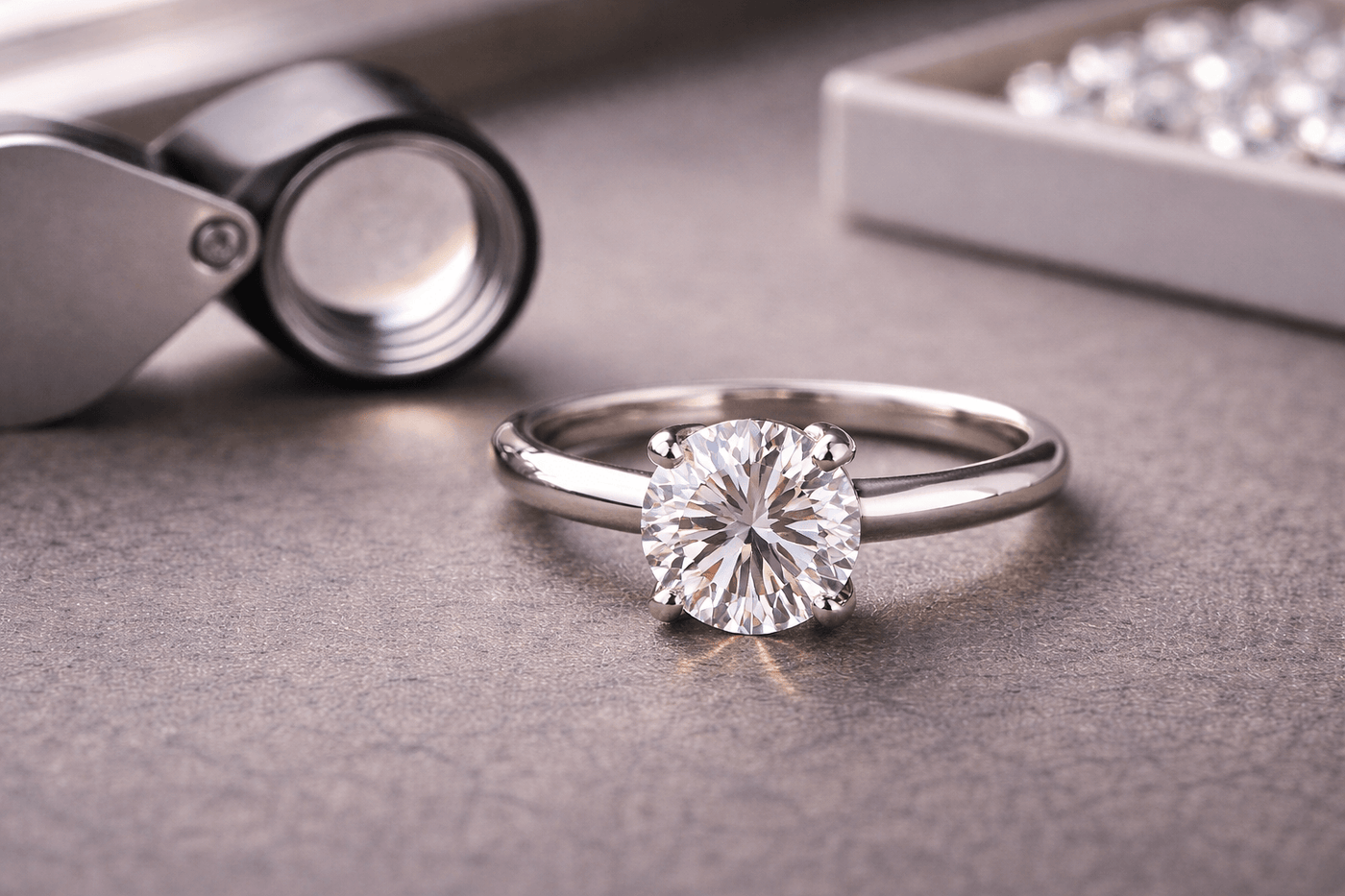

In 1893, scientists discovered tiny crystals inside a meteor crater in Arizona—a find that revealed moissanite's extraordinary cosmic origin. In a very real sense, it was stardust that became a gemstone. Today, scientists produce moissanite in laboratories, yielding a stone with diamond-like brilliance and hardness approaching that of diamond (2). The result is a stone of exceptional brilliance and strength, at a fraction of the cost and without the sourcing concerns associated with mined diamonds.
This guide covers what moissanite is, how it is made, the differences between natural and lab-created varieties, how to assess quality, and what to look for when selecting the right stone. It also addresses cleaning and care. By the end, you will understand why moissanite has become such a popular diamond alternative—and whether it is right for you.
What Is Moissanite?
Moissanite is a gemstone composed of silicon carbide (SiC). French chemist Henri Moissan first identified it in the late 1890s after finding tiny crystals inside a meteor crater. Naturally occurring moissanite is extraordinarily rare and almost always too small to facet, which is why virtually all moissanite used in jewelry today is grown in laboratories (3). It is a real gemstone with its own unique properties, even though it isn't mined from the ground.
Moissanite is one of the best substitutes for diamonds in terms of looks and performance. It has a very high refractive index, between 2.65 and 2.69, and strong dispersion, which makes it very bright and gives it rainbow flashes of light. It is very durable for everyday wear because it has a Mohs hardness of about 9.25, which is just below that of diamond (4).
A well-cut moissanite can look almost exactly like a diamond in real life, especially to someone who isn't trained to tell the difference. But gemologists can tell the difference between the two by looking for small differences like double refraction and unique optical patterns. Moissanite is not a "fake" diamond; it is a distinct gemstone valued for its brilliance, durability, and accessible price.
Types of Moissanite (Natural vs. Lab-Created)
Natural Moissanite

Natural moissanite is extraordinarily scarce. Henri Moissan first identified it in 1893 in fragments of the Canyon Diablo meteorite in Arizona (1). Since then, tiny amounts have been detected in certain rocks and meteorites, but no crystals large enough to be faceted into gemstones have ever been found. Moissanite appears in nature only as microscopic grains or inclusions. Industry experts confirm that natural moissanite exists, but no mineable or facetable deposit has ever been located (3). Because this type of gemstone is so rare, almost all of the moissanite gems you see for sale today were grown in a lab.
Lab-Created Moissanite

Scientists came up with ways to make moissanite in labs because it is so rare in nature. Silicon carbide crystals were successfully grown as early as the middle of the 20th century, but gem-quality moissanite didn't hit the jewelry market until the 1990s. The company C3, now known as Charles & Colvard, made the first lab-created moissanite gemstones as a diamond alternative in 1998.
Modern lab-grown moissanite is made by slowly crystallizing silicon carbide in furnaces or reactors that are very hot. These steps make it possible for large, single crystals, called boules, to form. These boules are then cut and polished into gemstones. Thanks to advances in technology, it is now possible to make moissanite that is very pure and even colorless. For instance, Charles & Colvard's high-end "Forever One" moissanite is colorless in the D–F range and made to very high clarity standards, with stones that are at least VVS clarity (5).
You can also find less expensive grades of lab-grown moissanite. These may have a little warmth, usually in the G–H near-colorless range, or they may have subtle tints in earlier generations. Still, the overall quality has gotten a lot better over time, and a lot of these stones still look colorless when they are set in jewelry.
To sum up, all moissanite used in jewelry today is grown in a lab and comes in different levels of quality. Reputable manufacturers usually tell you the color and clarity of their stones, which can range from icy white and colorless to slightly warmer. To choose the moissanite that best fits your style, expectations, and budget, you need to know about these differences, which you will learn more about later in this guide.
How to Identify Quality in Moissanite
As moissanite becomes more popular, it's important to know how to tell a good stone from a bad one. Not all moissanite is the same quality. Here are some important things to look for and advice on how to tell if a moissanite is of high quality:
-
Certification & Authenticity: If you want to buy moissanite, look for one that comes with a grading report or certificate from a trusted lab. The International Gemological Institute (IGI) has started giving out grading reports for moissanite. They do this by laser-engraving each stone with a unique ID to prove that it is real (2). This makes sure that you get real, high-quality moissanite and not a lower-quality simulant or stone that has been mislabeled.
-
Color Grade: Moissanites can be completely colorless or have very light tints. Choose a colorless moissanite (usually graded D, E, or F in color) for the most diamond-like look. Forever One and other top-tier moissanite fall in the D–F range (5). Stones that are close to colorless G–H can be a great deal, but they might look a little warm next to a very white diamond. If you want that icy white sparkle, you should choose a higher color grade.
-
Clarity: Most moissanite is grown to be very clear. In fact, most high-quality moissanites have a clarity rating of VS to VVS, which means that there are almost no visible inclusions. Charles & Colvard even raised the standard for their best stones to VVS (5). When looking at a moissanite, it should look clear to the naked eye, with no obvious specks or haziness. Moissanites with lower clarity may have small inclusions, but these are not common in the market. If the stone looks clear and bright to the naked eye, it usually has high clarity.
-
Cut Quality: The cut of moissanite has a big effect on how brilliant it is, just like diamonds. A moissanite that is cut well will reflect light beautifully and hide any small flaws. Look for stones that are advertised as having great or perfect cuts. Just like they do for diamonds, IGI grades moissanite for how well it is cut (5). Make sure the facets are sharp and even. Don't buy stones with a "window" (a dull, see-through center) or facets that aren't even. A moissanite that has been cut with precision will bring out the most of that fiery sparkle and hide the double refraction as much as possible.
-
Size & Shape Considerations: Quality can also mean picking the right size and shape for your taste. Round brilliant moissanites sparkle the most like diamonds. Fancy shapes like ovals and pears are also pretty, but you can sometimes see the doubling effect of moissanite's refractive properties in certain shapes, like an emerald cut. In general, the bigger the moissanite, the more of its extra "fire" and any slight color you can see. This isn't a bad thing; it's just something to keep in mind. If you want a really big stone (3 carats or more), getting a top color grade and a great cut will make sure the stone looks bright and white.
Tip: Viewing a moissanite and a diamond side by side under magnification is helpful. For everyday moissanite pieces beyond the ring, explore our moissanite earrings collection. You might notice that the edges of the moissanite's facets are doubled (because of birefringence) or that it has a little more rainbow fire. These are small signs of what it is. But a good moissanite should look very bright and clear to the naked eye. You can be sure that you are getting a high-quality moissanite if you pay attention to its color, clarity, and cut and think about its certification.
Buying Guide: How to Choose the Right Moissanite

Choosing moissanite is a great way to get a lot of sparkle without spending a lot of money. It helps to think about how you'll wear the stone and what matters most to you when looking for the right one and setting.
One of the best things about moissanite is that it is cheap. It helps you get the most out of your money, and you can often pick a bigger or better center stone than you could with a diamond. Lab-created or alternative gemstones, like moissanite, are used in engagement rings that cost about $2,500 on average. A typical natural diamond engagement ring costs about $6,800 (3). That means you can get a bigger carat size, a more complex design, or a better cut without losing brilliance or durability. Moissanite shines and lasts a long time, and it's much cheaper than diamonds.
Your way of life should be a big part of your choice. Moissanite is a great choice if you want to wear your ring every day, even when you travel, work out, or do hands-on activities. It has a Mohs hardness rating of about 9.25, which means it is very hard to scratch and is good for wearing every day (2). A lot of people like moissanite as a worry-free choice for travel rings or everyday jewelry because it looks like a diamond but doesn't have the stress of losing or damaging a more expensive stone. It was also grown in a lab and is free of conflict, which is important to buyers who care about making ethical and environmentally friendly choices.
Think about what you will do with the moissanite. If you want an engagement ring that will last a lifetime, you might want a colorless stone that is well-cut and set in a classic way. You could look into fancy shapes or even colored moissanite for fashion jewelry or right-hand rings. Some couples also choose bigger moissanite stones for travel or backup rings. They like the big sparkle and keep their more valuable rings safe at home. Moissanite looks great in any light, and in low light or at night, it often shows even more fire than diamonds.
If your skin is sensitive, moissanite itself isn't a problem. The gemstone is inert and won't react with skin or chemicals (1). Most of the time, the metal setting is what causes irritation. Choosing hypoallergenic metals like platinum or 18K gold can help. Moissanite also stays stable over time; it won't change color or break down, and any dullness is usually just surface buildup that can be easily cleaned.
Moissanite is not a stone that you should invest in. It doesn't go up in value like other lab-created gems, and it doesn't have a lot of resale value (6). The metal is worth more than the stone itself when you sell it. Most people buy jewelry to wear and enjoy rather than to resell. With moissanite, the lower upfront cost typically matters far more than long-term value. Think of it as a beautiful, wearable luxury—not a financial asset.
The best moissanite for you is the one that fits your lifestyle and what you want. Moissanite is hard to beat if you want the most sparkle, the best durability, the best value, and the best ethical sourcing. It's perfect for people who want a bold, bright look without spending too much or worrying too much. A natural diamond may still be the better choice for you if rarity, tradition, or resale value are more important to you. Otherwise, moissanite is a great and sure way to wear beautiful jewelry every day.
Care, Cleaning & Maintenance
One of the best things about moissanite is that it's easy to take care of. It's almost as hard as diamond and won't scratch or cloud. Your moissanite will stay as fiery as ever with just a little bit of regular care. This is how to keep it shiny:

-
Regular Cleaning: You should clean moissanite jewelry the same way you clean diamonds. Soaking the ring in a mild degreasing solution, like a few drops of dish soap in warm water or an ammonia-based jewelry cleaner, and then gently brushing the stone with a soft toothbrush is a tried-and-true method (8). Pay attention to the bottom of the stone (the pavilion), where oils can build up. Use warm water to rinse and a cloth that doesn't leave lint to dry. This routine, which you should do once a week or every two weeks, will get rid of any film from lotions or hand oils that can dull the shine.
-
Avoid Harsh Chemicals: Moissanite is very strong and chemically stable on its own, but you should keep it away from harsh chemicals that could change the metal setting. Bleach, chlorine, and rough cleaners can hurt or change the color of the gold or platinum in your ring. For everyday cleaning, soap and water are the best. You can use commercial jewelry cleaning solutions that are safe for gemstones to get a deeper clean, or you can take the ring to a jeweler for professional ultrasonic cleaning.
-
Safe for Ultrasonic/Steam: Thanks to moissanite’s toughness, it is generally safe to use ultrasonic cleaners or steam cleaners (methods which some softer gems can’t tolerate). There are no coatings or treatments on moissanite that you might strip off – it’s a solid, hard crystal. Many bench jewelers will routinely ultrasonic-clean moissanite rings during servicing. Just ensure any side gemstones in the ring (if not moissanite) can also handle it, and that prongs are secure (loose stones can sometimes fall out in ultrasonic).
-
No “Clouding” Over Time: A common question is whether moissanite will lose its brilliance or cloud up after years of wear. The answer is no – moissanite remains brilliant over time. It does not have the instability that causes some imitation stones (like certain types of cubic zirconia) to haze or change color. High-quality moissanite comes with assurances of lasting quality; for example, some manufacturers provide a lifetime warranty on the gemstone’s brilliance and color (2). This means the sparkle you see today is here to stay. If your moissanite looks cloudy, it’s almost certainly just dirty – a good cleaning will restore its sparkle.
-
Routine Check-ups: Although the stone is hard, remember to occasionally check your jewelry settings. Prongs can loosen slightly over years of wear (this is true for any ring). It’s smart to have your ring professionally inspected once a year or so to ensure the moissanite is secure and the metal is in good shape. This preventative care will avoid any accidental loss of the stone.
By following these simple care tips, your moissanite will continue to shine brilliantly for a lifetime. In fact, many people find moissanite even easier to maintain than a diamond – since it picks up less grease and its high dispersion helps it look bright even when it’s a bit smudgy. A little soak and brush will keep your moissanite jewelry looking like new.
Common Myths & Misconceptions
-
Myth: “Moissanite is just a fake diamond.”
Reality: This isn't true in real life. Moissanite is a real gemstone made of silicon carbide, not plastic, glass, or something that looks like a gemstone. People often choose it instead of diamonds, but at the atomic level, it is very different from diamonds (8). Gemologists can easily tell moissanite apart from other gems because of its unique physical and optical properties. It's not right to call it "fake"; moissanite is a mineral that was grown in a lab and is used in fine jewelry, not just costume jewelry. -
Myth: “Moissanite isn’t as durable – it will scratch or cloud over time.”
Reality: In real life, moissanite is very strong. It ranks about 9.25 on the Mohs hardness scale, making it the second hardest gemstone used in jewelry. It is also very hard to scratch (3). It's great for wearing every day, and it doesn't turn yellow or cloudy as it gets older. High-quality moissanite is chemically stable and usually comes with a lifetime guarantee of brilliance. When a stone looks dull, it's usually because lotions or soap have built up on its surface. This can be easily fixed by cleaning it properly. Moissanite is very similar to diamond in terms of how long it lasts and how strong it is. -
Myth: “Anyone can always tell it’s a moissanite.”
Reality: Most people can't. A well-cut, colorless moissanite can look almost exactly like a diamond to the naked eye. In some lights, it has a similar shine and even more fire. Moissanite's thermal conductivity is very close to that of diamonds (4), which means that regular diamond testers can be fooled. Only trained gemologists with special tools, like electrical conductivity testers, or with magnification can tell the difference for sure. To the average person, it just looks like a pretty, shiny stone. -
Myth: “Moissanite is cheap and not for serious jewelry.”
Reality: Moissanite is cheaper because of how it is made, not because of how good it is. Moissanite is often set in 14k or 18k gold and platinum, just like diamonds, in fine jewelry. A lot of couples choose moissanite on purpose for their engagement rings. In fact, a survey from 2021 found that moissanite was the most popular diamond alternative for engagement rings, especially among younger buyers (3). It's worth comes from how beautiful, strong, and meaningful it is, not how much it costs.
Pros & Cons of Moissanite
|
Pros |
Cons |
|
Significantly less expensive than a comparable diamond (and lab-created means no mining or conflict involved). You can get a larger or higher-quality stone for your budget, guilt-free. |
Low resale value – Moissanite generally has little secondhand market value. It’s not an investment and may resell only for a fraction of its purchase price. |
|
Exceptional brilliance & fire – Moissanite has a very high refractive index (~2.69 vs 2.42 for diamond), giving it tremendous sparkle and even more colorful fire (“rainbow flashes”) in certain lighting. Many find it as dazzling as a diamond. |
Slightly different appearance – Trained eyes might notice moissanite’s stronger fire or its double refraction (seeing doubled facets under magnification), which differ from a diamond’s look. In very large sizes, these differences can be easier to spot. |
|
Extreme durability – Moissanite is hard (9.25 Mohs) and tough, ideal for daily wear and engagement rings. It resists scratches and chips, lasting a lifetime. You don’t have to worry about babying the stone. |
Not naturally occurring – Lacks the rarity and “natural romance” of a mined gem. Some tradition-minded buyers feel a lab-grown stone is less symbolic. For example, a portion of consumers still say it’s important their ring’s center stone be natural. This perception is subjective, but it’s a consideration. |
Trends & Modern Market Demand
Moissanite has gained significant traction as shoppers seek ethical, affordable alternatives to mined diamonds. IGI's recent grading efforts for brands like Charles & Colvard show that demand is growing and that the industry is working to make quality reporting clearer and more consistent (3). The article also says that moissanite's high refractive index and long-lasting quality have been known for a long time, but the fact that there are now truly colorless and high-quality stones is drawing a new wave of interest (3). These changes all point to a market that is becoming more mature, with brands setting their moissanite products apart by being more open and honest about their quality.
Fashion trends are amplifying this momentum. Dorsey's recent jewelry line features multicolored moissanite in shades like viridian green and slate blue, designed for everyday layering (9). Many people like moissanite because of its cosmic backstory and the fact that they can choose unique colors that are personal and expressive. As more people learn about how traditional mining hurts the environment, moissanite is in a great position to become an even bigger part of both engagement rings and modern fine jewelry.
Investment & Resale Value

Moissanite is beautiful and long-lasting, but it's better to think of it as a personal or sentimental purchase than as a way to make money. Forbes notes that lab production eliminates the need for mining and significantly reduces production costs; moissanite rings are often only 5–10% of the price of a comparable diamond (6). But because moissanite is so cheap, it doesn't have the natural scarcity that makes prices go up over time.
Certification programs are helping to build trust with customers and make sure that what they buy is real. However, the fact that there is so much moissanite means that resale values are still low (3). Natural diamonds, rare colored gemstones, or vintage jewelry may be better choices for buyers who want to invest for the long term or resell later. The sparkle, durability, and meaning of moissanite to the person wearing it are what make it valuable, not what it might be worth in the future.
Who Should Buy Moissanite?
Moissanite is a great choice for many jewelry lovers, especially those who care about how bright it is, how cheap it is, and where it comes from. If you can relate to any of the following, you should think about moissanite:
-
Budget-Conscious Buyers: Moissanite is the best choice for you if you want a big or high-quality center stone without spending a lot of money. It's perfect for someone who wants a beautiful ring but would rather spend their money on a house, a wedding, or other important things. For the price of a 0.5 carat diamond, you can get a 2-carat moissanite. That's a big win in terms of how much it looks like it costs.
-
Ethical & Eco-Conscious Consumers: Moissanite is grown in a lab, so it doesn't hurt the environment as much as mining does, and it doesn't fund wars. If you're worried about the moral issues of mining or the damage that gem extraction does to the environment, moissanite will put your mind at ease. You can be sure that your gem was made with little harm to the environment and no shady work practices. You can feel good about wearing it because it's a luxury that lasts.
-
The Big-Style Dreamer: Maybe you've always wanted a ring that really stands out, like a big rock or a fancy halo, but your budget for diamonds means you can only get something simple. You can be big and bold with moissanite. Do you like how a 3-carat solitaire looks? You can get moissanite for a lot less money, and no one will know it's not a diamond (unless you tell them). It lets you make that dream ring come true without having to give up anything.
-
Someone Who Prioritizes Durability: Do you work with your hands, live an active life, or just don't want to worry too much about your ring? Moissanite is strong and can handle it. Moissanite is strong and won't chip or scratch easily, so nurses, teachers, and fitness fans will all love it. It's tough enough for everyday use, coming in second only to diamond.
-
Young Couples/Gen Z and Millennials: Younger people have been especially excited about moissanite. A lot of people in Gen Z don't think there's anything wrong with choosing a lab-grown stone. They think it's a smart and fashionable choice. Surveys show that moissanite is the most popular diamond alternative among engaged couples in the past few years, especially those in their 20s (3). Moissanite is perfect for you if you agree with modern values and don't think that an engagement ring has to be a mined diamond.
-
Travelers and Worriers: People who travel a lot or are worried about wearing a very expensive ring in public should think about moissanite. You can have the look of an expensive ring without the same level of financial risk. A lot of experienced travelers bring a moissanite version of their ring (or one that looks like it) on vacation. Knowing that you can get a new ring for a reasonable price if something happens to your beautiful ring gives you peace of mind, even if you wear it every day.
-
Those Who Love Sparkle: If you love sparkle, moissanite will make you happy. It has a great fire and brilliance. Some people even like its more colorful "disco ball" flashes better than a diamond's. If you see rainbows in your ring and it makes you happy, moissanite might be a better choice for you than a diamond.
On the other hand, who might not like moissanite? Someone who really values the rarity and tradition of a natural diamond might be happy with it in a way that a lab gem can't. For example, if having a gemstone that formed on Earth over billions of years is very important to you, a diamond might make you happy in a way that a lab gem can't. If you're thinking of a ring as a family heirloom or an investment piece, you might choose a diamond because it keeps its value over time (even though, as we've already said, regular diamonds aren't great investments either, but they seem to have more long-term value). Some people are just emotionally drawn to the idea that a natural diamond is one of a kind. That's fine; jewelry is very personal.
Frequently Asked Questions (FAQ)
-
Is moissanite natural or lab‑created?
True natural moissanite is extremely rare and found only in tiny crystals within meteorites; virtually all moissanite on the market is lab‑grown by replicating high‑temperature conditions to produce silicon carbide crystals (4). -
How is moissanite manufactured?
Gem‑quality moissanite is grown through a seeded sublimation process derived from the Lely method, where silicon carbide powder vaporizes at about 2,500 °C and re‑crystallizes on a seed crystal under controlled temperature gradients and atmospheres (4). -
What distinguishes moissanite from diamond?
Moissanite has higher refractive indices (2.648–2.691), greater dispersion and a hardness of about 9.25, giving it exceptional brilliance; however, it is doubly refractive, which can produce facet doubling, and it is far more abundant than diamond (4). -
Is moissanite ethical and environmentally friendly?
Yes. Because moissanite is lab-grown from silicon and carbon, its production avoids mining and the associated environmental disruption; Forbes notes that lab growth eliminates the need to remove tons of earth to retrieve a single carat of diamond (6). -
How do I clean moissanite jewelry?
Use warm water with mild detergent and a soft brush to clean moissanite, rinsing thoroughly; avoid abrasive powders and ensure settings are secure before using ultrasonic cleaners or steamers (4). -
Does moissanite pass diamond testers?
Standard thermal probes often misidentify moissanite as diamond because their thermal conductivities are similar; specialized testers using optical or electrical measurements are required to distinguish them (4). -
Are there certifications for moissanite?
Yes. IGI issues Certificates of Authenticity for lab‑grown moissanite, detailing carat weight, shape and colorless characteristics, and uses 4Cs‑based grading standards; such certificates help verify quality and authenticity (3).
Expert Jeweler Tips for Moissanite
When you look at moissanite stones, make sure to do so in different types of light. This helps you see their sparkle and fire to their fullest, as well as any noticeable tint or optical effects. Because moissanite is doubly refractive, rotating the stone may make the edges of the facets look a little bit doubled. A well-cut moissanite reduces this effect, so pay attention to how clear and sharp the facets look as the stone moves (4).
Always ask for a grading certificate from a well-known lab like IGI. Certification proves that the stone is real and gives you important information about its quality, which makes you feel better about buying it (3). If you're thinking about getting colored moissanite, pick colors that look good with your skin tone or go well with the jewelry you already wear. Some colors that are trending are especially appealing, and limited-run hues add further exclusivity. For collectors drawn to color, our luxury gemstones selection is worth exploring (9).
The choice of setting is also important. Bezels and halos are examples of protective designs that not only make the stone look better, but also help protect it from everyday bumps and wear. Finally, find a good jeweler who knows about moissanite's special qualities and can help you choose the right custom options to make sure your piece looks great and lasts for a long time.
Conclusion
From meteorite debris to modern laboratory gemstone, moissanite has established an identity entirely its own—not a copy of anything, but a stone prized for its brilliance and longevity.
Moissanite offers exceptional sparkle, durability, and value. It wears beautifully every day, glitters with fire and life, and avoids many of the financial and ethical complications associated with other gemstones. That balance is precisely what makes it so compelling.
Choosing a gemstone is ultimately personal. Moissanite is an option that did not exist a few decades ago—a chance to wear something that genuinely shines, born of both science and nature. It demonstrates that luxury need not come at a high cost or an environmental price. Whether you are drawn to its cosmic origin, its outstanding durability, or its stunning brilliance, moissanite has a great deal to offer.
This guide was designed to give you a clear, expert-informed view of what moissanite is, how it is made, and why it matters—so you can decide with confidence. If a gemstone feels right when you wear it, you have made the right choice. For many people, moissanite is exactly that stone.
If moissanite's unique beauty has inspired you, now is the perfect time to see its sparkle for yourself. Not everything that shines is a diamond. It could be something even more beautiful and easier to get! We invite you to look through our carefully chosen selection of moissanite jewelry, which includes engagement rings and earrings. You'll see why so many people love this gem. Don't miss your chance to own a gemstone that really shines like a star. Go to our website and let moissanite make your story shine. Enjoy every second of the sparkle!
Crafted science. Captivating sparkle.
Discover our premium moissanite designs, chosen for exceptional brilliance and refined elegance.
Read more
Colored diamonds are natural diamonds that have colors that go beyond the normal D-to-Z scale. Their colors come from small amounts of nitrogen (yellow) and boron (blue), structural changes (pink a...
Read more
Engagement Ring Styles: A Complete Guide
There are many different styles of engagement rings, from classic solitaires and vintage three-stones to modern bezel and pavé settings. Each style has its own look, strength, and meaning. When you...
Read more