
Frequently Asked
Lab-Grown Diamond Engagement Rings FAQ
Are lab-grown diamond engagement rings set with real diamonds?
Yes. The center of every laboratory-grown, or lab-grown, diamond engagement ring in this collection is real diamond: pure crystallized carbon, chemically and optically identical to a mined stone and just as hard at 10 on the Mohs scale. It is not moissanite or cubic zirconia, which are different materials that only resemble diamond. The one difference is origin. A lab-grown diamond forms in a controlled chamber over weeks rather than deep in the earth over millions of years, and every product page says plainly which kind of diamond you're buying.
Why does a lab-grown diamond cost less than a natural one?
Because growing a diamond is far less expensive than finding and mining one, and the saving is passed into the price of the stone. In practice, the budget that buys a modest natural center often buys a noticeably larger or higher-grade lab-grown one. The prices shown here are complete, with the center stone included, so what you compare across designs is the whole ring rather than a setting with a stone still to add.
Does a lab-grown diamond hold its value?
Not in the way a financial asset does, and it's better to know that going in. Lab-grown diamonds have a limited resale market, and their prices have fallen as production has grown. That is exactly why they're good value to wear and poor value to speculate on. Buy one because you love the ring and want more diamond for your money, not as an investment.
Can anyone tell a lab-grown diamond from a mined one?
Not by eye, and not with a jeweler's loupe. Telling them apart requires laboratory instruments that read trace growth patterns inside the crystal. On the hand, a lab-grown diamond looks, sparkles, and wears exactly like any other well-cut diamond.
Which diamond shapes does the collection include?
Six: pear, marquise, princess cut, emerald cut, cushion, and oval, with pear, marquise, princess, and emerald cut making up most of the designs. Pear and marquise elongate the finger and look larger for their weight than most shapes. The princess cut gives the most sparkle in a square outline, and the emerald cut trades sparkle for long, glassy step facets that show a diamond's clarity. Cushion and oval offer a softer middle ground.
What setting styles are available for lab-grown diamond engagement rings?
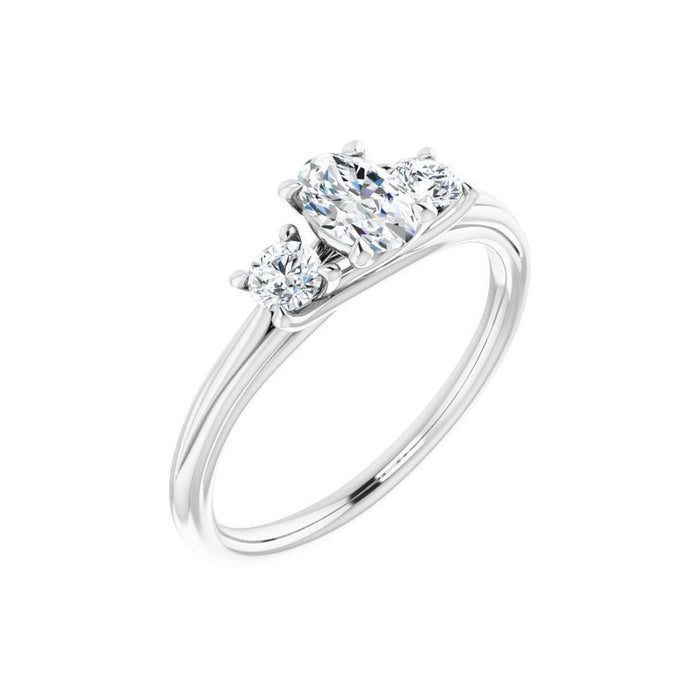
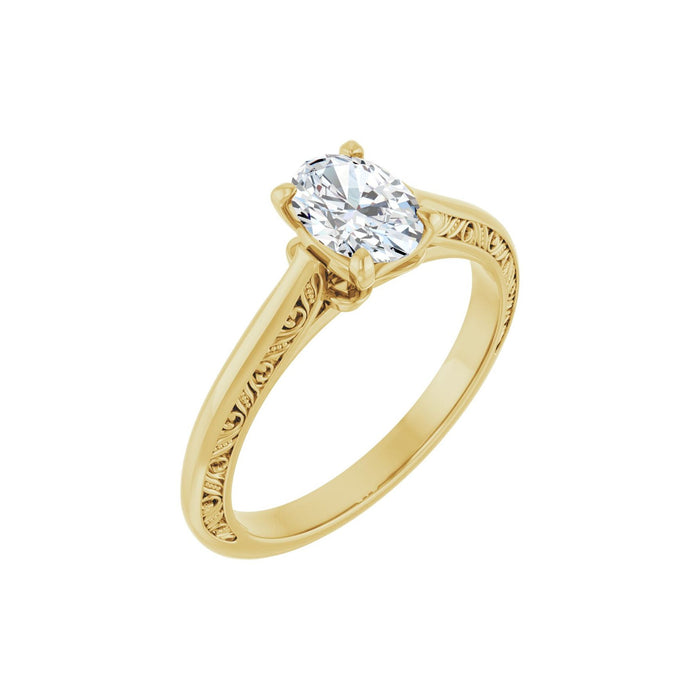
Nearly every major style. Solitaires range from the Petite Solitaire and Classic Solitaire to Knife-Edge, Tapered, Split-Shank, and Bypass Pavé bands. Hidden-halo and full halo designs include a Pavé Double-Halo for pear and a Vintage Milgrain Halo for several shapes. Three-stone rings come with tapered baguette, straight baguette, trillion, half-moon, pear, marquise, or round side stones, and there are graduated five-stone designs for princess cuts. Channel-set, bezel, Twisted Vine, Crown Half-Halo, and vintage milgrain solitaires round out the range.
What does east-west mean in a ring title?
An east-west setting turns an elongated diamond sideways, so it lies across the finger rather than along it. Here it appears on emerald-cut and marquise designs, such as the Emerald-Cut East-West Bezel Solitaire and the Marquise East-West Split-Shank Halo. The look is architectural and unexpected, and it makes a familiar shape feel new without changing the stone at all.
Are pear and marquise diamonds more fragile?
The diamond itself is as hard as any other, but the pointed tips of a pear or marquise are its most exposed spots, and a hard knock right on a point can chip it. A setting that covers the tips solves this. The Star-Set V-Prong design cradles the marquise points in V-shaped prongs, and the bezel-set, Half-Bezel, and Bezel Bypass designs wrap the edge in metal.
Platinum, 18K, or 14K gold?
Rings are offered in 14K and 18K white gold, yellow gold, and rose gold, and in platinum, with each design's options listed on its page. Platinum is the densest and most durable choice for prongs that must hold a center for decades. 18K gold carries richer color, while 14K is slightly harder and less expensive. White metals make a colorless diamond look its whitest; yellow and rose gold add warmth.
What if I order the wrong ring size?
Measure carefully first, because every ring is made to the size you select and all rings are final sale; they cannot be returned or exchanged for another size. Our sizing guide explains how to measure at home or size from a ring she already wears.
How are the rings shipped, and what warranty comes with them?
Many rings are made to order, and each product page shows its ship time. Delivery within the US is free by fully insured UPS Ground, and because these rings exceed the $500 mark, they typically qualify for free UPS Express, signature required. Every lab-grown diamond engagement ring carries a lifetime warranty against manufacturing defects.