
 View Piece
 View Piece
 View Piece
 View Piece
 View Piece
 View Piece
 View Piece
 View Piece
 View Piece
 View Piece
 View Piece
 View Piece
 View Piece
 View Piece
 View Piece
 View Piece
 View Piece
 View Piece
 View Piece
 View Piece
Frequently Asked
Emerald Cut Engagement Rings FAQ
Is an emerald cut engagement ring set with an emerald?
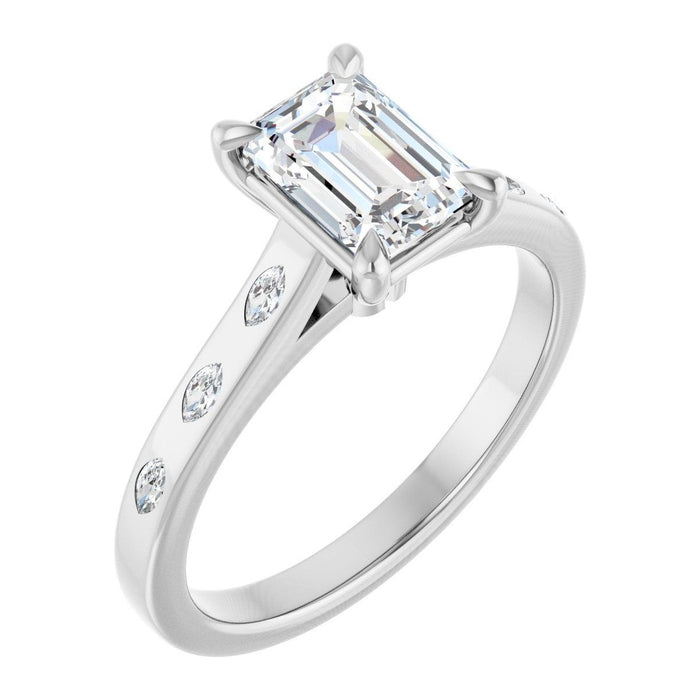
Not here. Emerald cut is the name of a shape and faceting style, and every ring in this collection holds an emerald-cut diamond. The cut takes its name from the cutting style traditionally used on the gemstone, but the stone in these rings is a colorless lab-grown diamond sold to an F-G color specification. You get a rectangular outline with trimmed corners, long parallel facets along the sides, and a wide, open table on top. The trimmed corners are practical as well as handsome, since they remove the sharpest points a rectangle would otherwise have. When you read a product title on this page, the words emerald cut always describe the diamond's shape, never its color or species.
Why choose an emerald cut diamond?
An emerald cut looks calm and architectural. Instead of the scattered sparkle of a brilliant cut, its step facets show broad flashes of light and dark that move as the hand turns, an effect many people associate with Art Deco jewelry. The long outline lengthens the look of the finger, and the clean lines pair naturally with baguette and step-cut side stones. It suits a wearer who prefers clarity and proportion over glitter. If you want a long shape with more sparkle, compare our oval engagement rings; for a square with brilliant faceting, see our princess engagement rings. Many buyers look at all three before settling on one.
Are the diamonds in these rings real?
Yes. Every center and accent diamond in this collection is lab-grown, and lab-grown diamonds are real diamonds. They are chemically and physically the same as mined diamonds and share the same hardness, 10 on the Mohs scale; they are simply grown in a laboratory rather than formed underground. Each product page labels its stones as lab-grown. If you would rather wear a natural emerald-cut diamond, use Design Your Ring to choose a loose natural diamond and then a setting. To compare lab-grown options in other shapes, browse our lab-grown engagement rings, where every design carries a lab-grown center, or the wider diamond engagement rings collection.
Why do color and clarity matter more in an emerald cut, and do these come with a report?
A step cut has a large, open table and long, flat facets, so it works a little like a window. Inclusions and any hint of body color are easier to see than in a brilliant cut, which breaks light into many small flashes that help hide them. That is why these centers are sold to an F-G color, VS clarity specification: F-G faces up near-colorless, and VS clarity means minor inclusions that are typically not visible without magnification. The stones are not individually graded and do not come with a grading report. For a diamond with its own report, use Design Your Ring, where natural diamonds come with GIA reports and lab-grown diamonds with IGI, GCAL or GIA reports, so you know exactly which stone you are buying.
What carat sizes are available?
Carat weight is chosen on each product page from a published range of 0.65 to 4.00 ct. Petite bands top out at a smaller maximum than the wider settings, and the sizes offered for each design are listed on its page. These are nominal weights, the standard sizes the centers are cut and sold to, not a figure measured on one individual stone. The price changes as you move between weights and stays all-in throughout. Larger emerald cuts show off the step facets well, which is another reason the VS clarity specification matters. If you want an exact measured weight, or a particular length-to-width look, choose a loose diamond in Design Your Ring instead.
What does east-west mean on an emerald cut ring?
East-west means the diamond is set horizontally, with its long side running across the finger instead of along it. The usual orientation, north-south, points the length toward the fingertip and makes the finger look longer. Turning the stone sideways gives a lower, wider, more contemporary look that sits neatly beside a wedding band and stacks well with other rings. This collection includes east-west accented, cathedral pavé and bezel solitaires. The orientation does not change the diamond itself or its specification, only how it presents on the hand. If you are unsure, compare an east-west design with a north-south design from this page side by side; the difference is easy to judge in the photos.
How durable is an emerald cut, and how should I care for it?
Diamond rates 10 on the Mohs scale, so it will not scratch in daily wear. The emerald cut's trimmed corners remove the sharpest points, which helps, but those corners are still the edges most likely to chip under a hard knock. Prongs over each corner, double claw prongs or a bezel give that protection; our bezel engagement rings enclose the whole edge. Because the open table shows everything beneath it, a film of lotion or soap is more noticeable on a step cut. Soak the ring in warm water with mild dish soap, brush gently underneath with a soft toothbrush, rinse and dry. Remove it for heavy work, and check the prongs every few months.
Which metal works best with an emerald cut diamond?
You can choose 14K white gold, 14K yellow gold, 14K rose gold or platinum. White metals suit the shape's cool, crisp character and keep an F-G color center looking clean. Platinum is naturally white, dense and heavier on the hand, while 14K white gold gives a similar look at a lower price; white gold is commonly rhodium plated, and that finish can need refreshing in time. Yellow gold leans into the vintage feeling of a step cut, especially in milgrain or bezel designs. Rose gold is softer and more romantic, and it warms the long facets slightly. Each product page shows every metal option and how the price changes, so you can compare before you decide.
How do I choose my ring size, and how long does a ring take?
Every ring is made to order in the ring size you choose when you buy. Our sizing guide explains how to measure at home; measure late in the day with warm hands, and if it is a surprise, size a ring the wearer already wears on that finger. Wider designs, such as split shanks or triple-row pavé, can feel snugger than a petite band. Most rings ship in about 5 to 10 business days, and each product page shows its own timing; ready-to-ship pieces leave in 2 to 3 business days. Delivery is complimentary, fully insured UPS Express with a signature required. For a firm date or an unusual size, email concierge@diamondandsapphire.com before ordering.
What does the price include, and what if I need to return it?
Prices are complete and all-in, from $1,509. The figure covers the center diamond, every side and accent diamond, and the setting in your chosen metal. Carat weight, metal and the amount of diamond in the setting move the price; a petite solitaire typically starts lowest, while three-stone and pavé halo designs carry more diamond. You may return a ring within 30 days of delivery if it is unworn and in original condition; engraved and custom pieces are final sale. A free lifetime warranty covers manufacturing defects, such as a prong or setting failing under normal wear, but not loss, theft or accidental damage. Adding the ring to a jewelry insurance policy covers those risks.