



Frequently Asked
Princess Cut Diamond Engagement Rings FAQ
Why choose a princess cut diamond engagement ring?
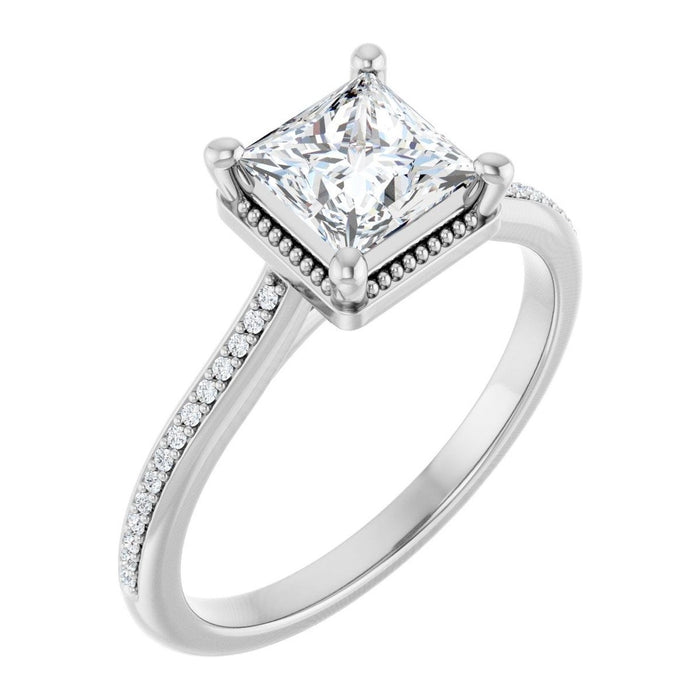
A princess cut diamond engagement ring gives you a crisp square outline with the lively, broken-up sparkle of a brilliant cut, because its facets run all the way into the corners. It reads more modern and architectural than a round, and it lines up neatly beside baguettes, trillions, and channel-set bands. It also suits someone who finds a round too familiar but doesn't want an elongated shape like an oval. The trade-off is the four pointed corners, which need a setting that protects them.
Are the diamonds in these rings lab-grown?
Yes, every center and accent in this collection is a laboratory-grown diamond, and each title says so. Lab-grown diamonds are real diamonds, chemically and optically identical to mined stones, with the same hardness of 10 on the Mohs scale; they simply formed above ground. If you'd rather start from a natural diamond, Design Your Ring lets you choose a loose stone first and then the setting to hold it.
What center sizes can I choose?
Centers are offered at 0.75, 1.00, 1.25, 1.50, and 2.00 carats, and each product page lists the weights that design accepts. A princess faces up a little smaller than a round of the same weight, since more of its weight sits in its depth, so a halo or a pavé band is a useful way to add presence without moving up a size. The petite solitaires do the opposite, keeping every eye on the square itself.
Which setting best protects the corners of a princess cut?
A bezel, which wraps the whole edge in metal, gives the most protection, and the Bezel-Set Solitaire, Bezel-Set Pavé Solitaire, and Bezel-Set Hidden-Halo are built that way. In a prong setting, look for a prong sitting over each corner, the standard approach for a square stone. A pavé halo adds a frame that tends to take a knock before the center does. Diamond won't scratch in daily wear, but a hard blow to an exposed point can chip it, so take the ring off for the gym or moving boxes.
What is a hidden halo?
A hidden halo is a ring of small diamonds set beneath the center, under the girdle, so it shows only from the side. From above you see a clean square solitaire; in profile, a flash of pavé. This collection uses the detail in several ways: the Hidden-Halo Solitaire, the Bezel-Set Hidden-Halo, the Hidden-Halo Pavé Cathedral, and the Triple-Row Pavé Hidden-Halo, which carries the most sparkle along the band.
Solitaire, three-stone, or five-stone?
Solitaires keep the focus on one square, whether on a plain petite band, a cathedral, a split shank, or a twisted vine. Three-stone princess cut engagement rings add side stones, and the shape of those sides changes the mood: trillions point outward for a wider look, tapered baguettes and step-cut sides feel cleaner and more Art Deco, and round sides soften the geometry. The Graduated Five-Stone and the All-Princess Graduated Five-Stone stretch a row of diamonds across the finger for the most presence.
Which metal should I choose?
Every design is offered in 14K white, yellow, or rose gold, or platinum. White gold and platinum keep the whole ring cool, so the square reads as one clean shape; platinum is denser and heavier on the hand and wears well on prongs over the years. Yellow and rose gold give the crisp corners a warmer frame and the band more presence. Each product page shows how the price changes between metals.
What does the price include?
The price shown is the complete ring, with the center stone included, along with every accent and side diamond and the setting in the metal you choose. Carat weight, metal, and how much diamond sits in the setting are what move it: petite solitaires sit toward the lower end, while five-stone rows and triple-row pavé carry more diamond weight. There is nothing to add for stones at checkout.
How do I get the right ring size, and can I return the ring?
Each ring is made to the size you choose, so rings are final sale and can't be returned, which makes the size the one thing to get right before ordering. Our sizing guide covers measuring at home; measure at the end of the day, when fingers are at their usual size. Wider designs, such as the triple-row pavé and five-stone rings, fit more snugly than a slim petite shank, worth weighing if you fall between sizes.
How long does a princess cut engagement ring take to arrive?
Many rings are made to order, and each product page shows its own ship time, so check it before you set a proposal date. Shipping within the US is free and fully insured by UPS Ground; at $500 and above it upgrades to free UPS Express, signature required. A lifetime warranty against manufacturing defects comes with each one.
How do I care for a princess cut diamond?
Soak the ring in warm water with a little mild dish soap, brush gently under the stone with a soft toothbrush, then rinse and dry. Pay attention to the corners and any pavé, where lotion collects and dulls the sparkle. Check the corner prongs every few months, and if one seems lifted or catches on a sweater, stop wearing the ring and get in touch with us before it goes back on.