
 View Piece
 View Piece
 View Piece
 View Piece
 View Piece
 View Piece
 View Piece
 View Piece
 View Piece
 View Piece
 View Piece
 View Piece
Frequently Asked
Round Engagement Rings FAQ
Why are round engagement rings still the most popular choice?
Round engagement rings stay on top because the round brilliant is the cut most carefully engineered for light, with facets arranged to send brightness back up through the top of the stone. It also forgives a great deal. A round masks faint body color well, never looks tied to a decade, and sits easily beside almost any wedding band, which is why so many couples start here and stay.
Are lab-grown diamonds real diamonds?
Yes. Every center in this collection is a laboratory-grown diamond, chemically and optically identical to a mined diamond and just as hard, 10 on the Mohs scale. The only difference is where the crystal formed. Each title names the stone plainly, and choosing lab-grown is what lets a larger or brighter round sit at the center of a complete ring for the same budget.
What carat sizes are offered?
Center stones are offered at 0.50, 0.75, 1.00, 1.25, 1.50, and 2.00 carats, chosen on each product page. A round shows its weight honestly, without the stretch an oval or pear gets from its length, so what you select is close to what the eye reads on the hand. Between 1.00 and 1.50 carats is where many buyers land: generous on most fingers and practical for daily wear.
Which setting suits a round diamond?
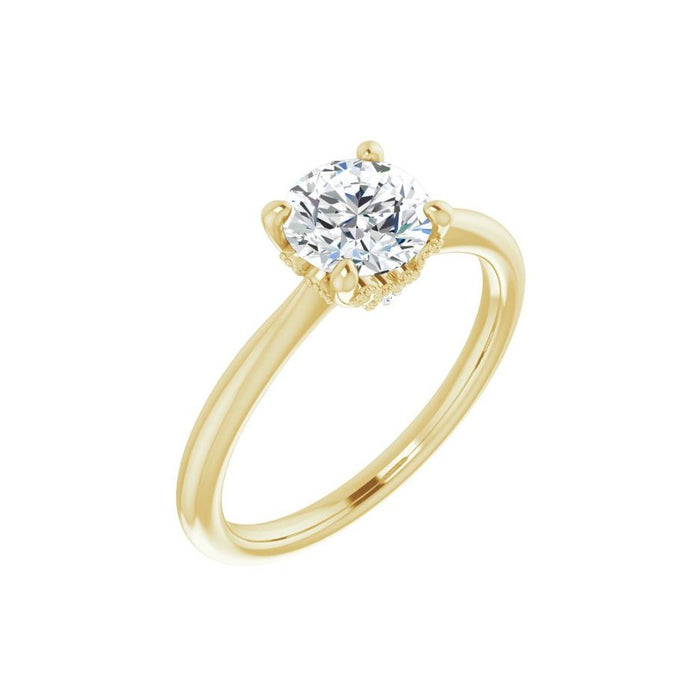
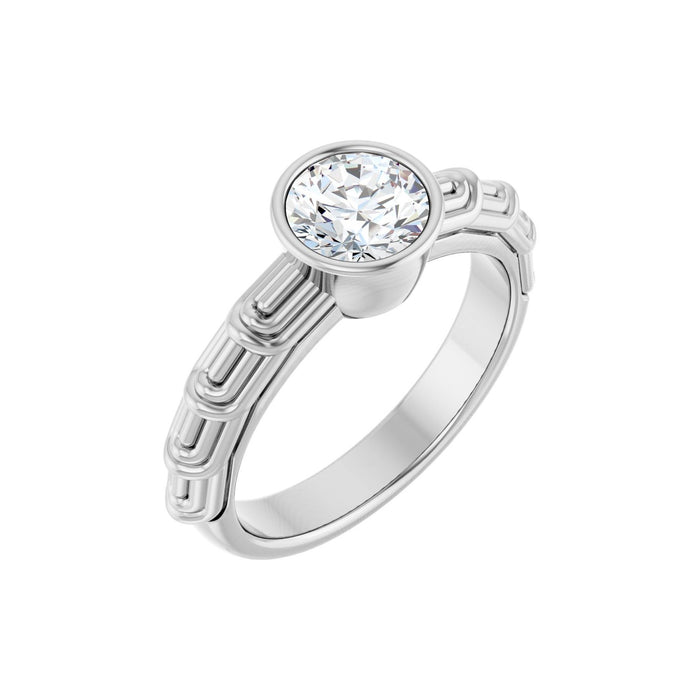
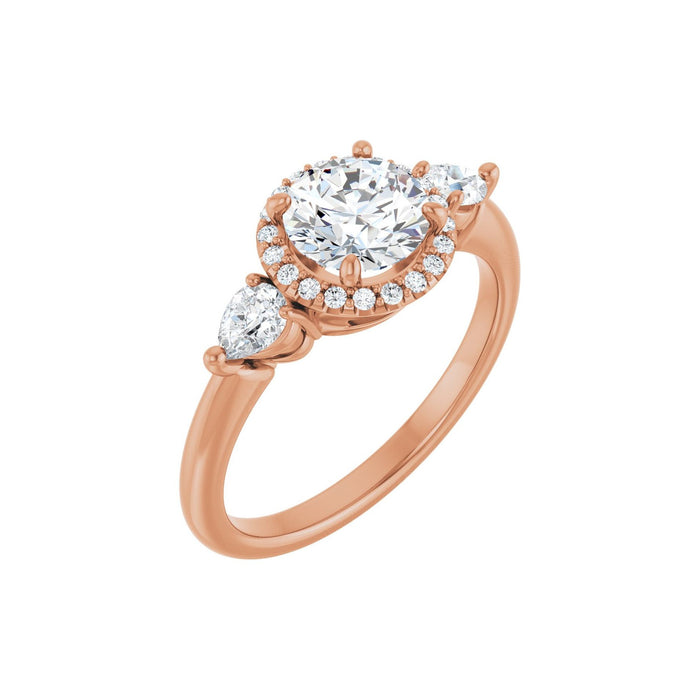
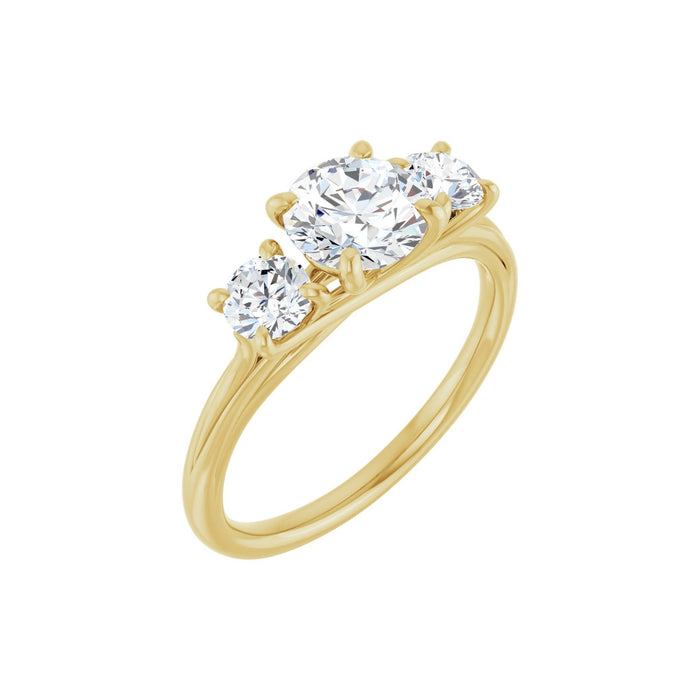
That depends on how the ring will be worn. The claw-prong, twin-prong, milgrain, and classic solitaires keep every bit of attention on the stone. The bezel-set solitaire wraps it in a smooth rim of metal for hands that work. The split-shank halo and double-row pavé add a frame of small diamonds, and the two three-stone designs, one with pear-shaped sides, widen the face of the ring across the finger.
What is the difference between claw prongs and twin prongs?
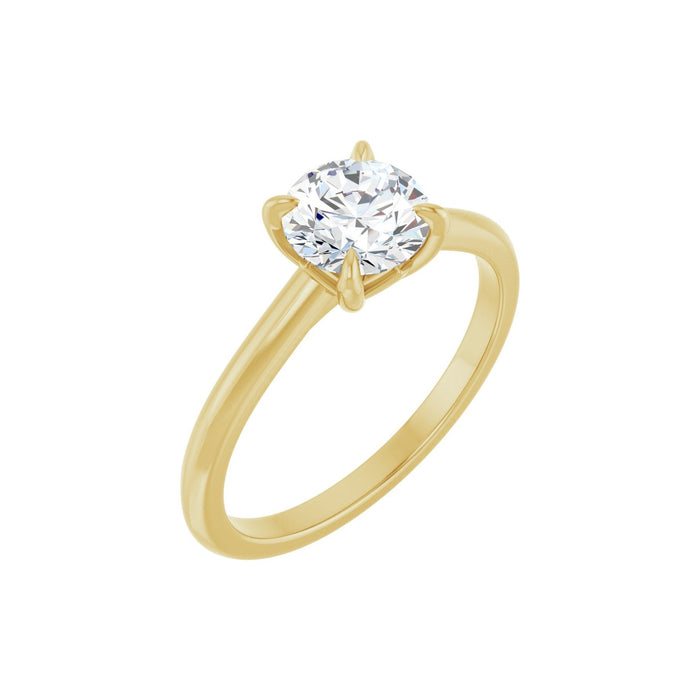
Claw prongs taper to a fine point that grips the stone with very little metal showing, so the diamond looks almost unheld from above. Twin prongs place two slim prongs at each position instead of one, which adds security and gives the head a more detailed, crafted look. Both styles leave the sides of the stone open to light; the choice is mostly about how much metal you want to see.
Which metal should I choose for a round engagement ring?
Choose from 14K or 18K white, yellow, or rose gold, or platinum. 14K is the harder, more everyday alloy; 18K holds more gold and shows a richer color. Platinum is dense and naturally white, and it suits the milgrain and pavé designs where fine metalwork needs to hold up for decades. White metals make the diamond read whiter; yellow and rose gold give the round a warmer, vintage cast.
Will a wedding band sit flush with these rings?
Most solitaires here pair easily with a straight band, especially the claw-prong and twin-prong designs. Halo and three-stone rings sit wider at the center, so a straight band may leave a small gap, and some people prefer a contoured band with them. If you already have a band in mind, ask us before you order and we will help you judge the pairing.
What is milgrain, and why choose it?
Milgrain is a row of tiny metal beads worked along an edge, a detail that softens the outline of a ring and catches light in small points. On the Milgrain Solitaire it gives a plain round setting a hand-finished, period feel without adding stones. It suits someone who likes the look of an older ring but wants a new, crisp center diamond.
How do I keep a round diamond bright?
Clean under the stone, where lotion and soap collect and dull the sparkle. A soak in warm water with a drop of mild soap and a gentle pass with a soft brush is enough, followed by a rinse and a dry cloth. Have the prongs checked once a year, especially on the claw-prong design, whose fine tips do the most work.
What does the price include?
Every price here covers the finished ring, center stone included. Choose the carat weight and metal on the product page and the price updates to match. There is no setting-only figure and no stone added later at checkout, so the number you see is the ring you receive.
Can a round engagement ring be returned?
No. Round engagement rings are made to the ring size you choose, so they are final sale, and engraved or personalized pieces are final sale too. Take your time with the measurement using our sizing guide; for a surprise proposal, a ring she already wears on that finger is the most reliable reference. Every ring is backed by a lifetime warranty against manufacturing defects.
How long will my ring take to arrive?
Many of these rings are made to order, so the ship time on each product page is the one to trust. Shipping inside the US is free by fully insured UPS Ground; spend $500 or more and the ring comes free by UPS Express, which requires a signature. If you are planning around a date, check the ship time first and allow a little extra room.