
 View Piece
 View Piece
 View Piece
 View Piece
 View Piece
 View Piece
 View Piece
 View Piece
 View Piece
 View Piece
 View Piece
 View Piece
 View Piece
 View Piece
 View Piece
 View Piece
 View PieceTop Holiday Gift Pick
 View Piece
 View Piece
 View Piece
 View Piece
 View Piece
 View Piece
What alexandrite is
Alexandrite is a rare variety of the mineral chrysoberyl, famous for changing color with the light. GIA describes the finest stones as vivid green to bluish green in daylight or fluorescent light, turning intense red to purplish red under incandescent light. Major deposits were found in Russia's Ural Mountains in 1830, and the stone was named for the young heir Alexander II; its red and green echoed imperial Russia's military colors. The Ural mines are long exhausted, and most natural alexandrite now comes from Brazil, Sri Lanka and East Africa. Our alexandrite guide covers its story.
Natural and lab-grown alexandrite
Fine natural alexandrite is one of the more expensive colored gems, especially above a carat, so we offer two lanes and name each piece. Lab-grown alexandrite has the same chemistry, hardness and color change as mined stones and makes larger sizes realistic: it is the center of every engagement ring here, and of our pendants and most necklaces. Natural alexandrite appears in small, precise sizes, mostly 1.75 to 4 mm, in our fashion rings and in four necklaces whose titles say natural. One cocktail ring uses lab-grown alexandrite. Each product page states the lane.
Alexandrite, a June birthstone
Alexandrite shares June with pearl and moonstone, and GIA lists it for the 55th wedding anniversary. Two colors in one stone make alexandrite birthstone jewelry a memorable June gift. Read about the June birthstones, see birthstones by month, or browse birthstone jewelry.
How to judge alexandrite
The strength of the color change is everything: a stone that moves clearly from green to red is worth far more than one that shifts only slightly or looks muddy. Look at a piece in daylight and again under a warm lamp. Lab-grown alexandrite usually shows a strong, clean change. Small natural stones show a subtler shift, which is part of their charm and their rarity.
Caring for alexandrite
At 8.5 on the Mohs scale with excellent toughness and no cleavage, alexandrite is one of the best colored gems for an everyday ring. Clean it with warm, soapy water; ultrasonic and steam cleaners are usually safe as well. Store it apart from diamonds and sapphires, which are harder. More in our Mohs hardness scale and jewelry cleaning guide.
| Gem | Mohs hardness |
|---|---|
| Diamond | 10 |
| Sapphire and ruby | 9 |
| Alexandrite | 8.5 |
| Topaz | 8 |
| Amethyst and citrine | 7 |
| Opal | 5 to 6.5 |
How to choose alexandrite jewelry
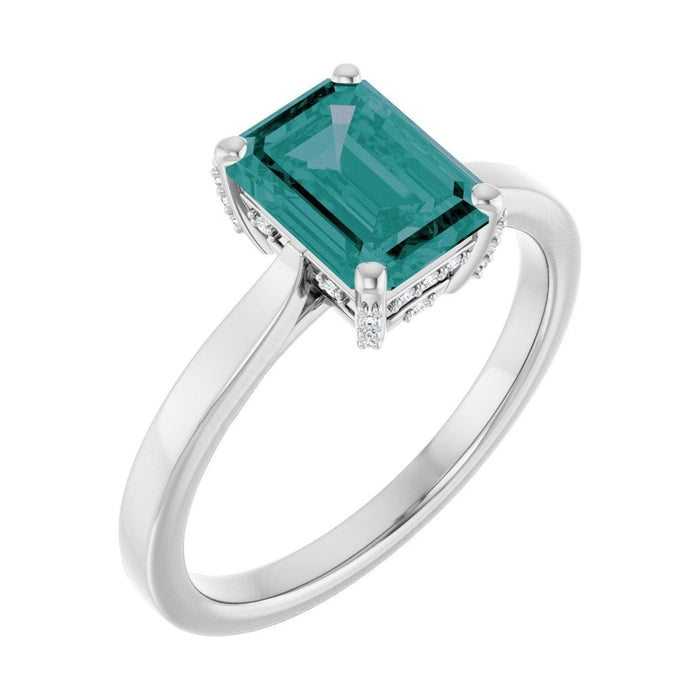
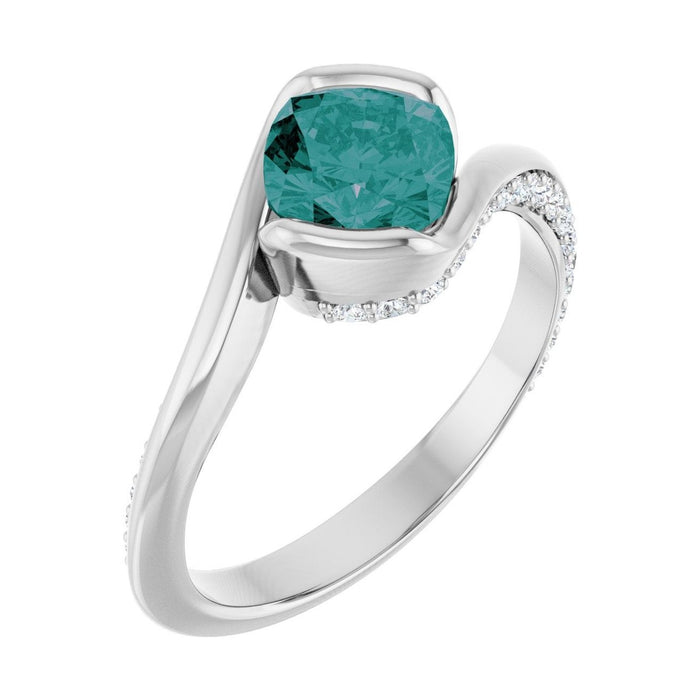
For an engagement ring, lab-grown alexandrite gives a generous center with a strong color change, in halo, three-stone and solitaire settings with round, oval, cushion, emerald-cut and princess centers from 1 to 2 carats. For a collector's piece, choose a natural alexandrite ring; the stones are small but rare. White gold and platinum keep the green crisp, while yellow and rose gold warm the red side of the change. Rings are made to order in your size, so start with the sizing guide.
Alexandrite Jewelry at a glance
| Piece | Wear level | Best settings | Good to know |
|---|---|---|---|
| Alexandrite engagement rings | Daily | Halo, three-stone, cathedral | Lab-grown; 14K or 18K gold |
| Alexandrite rings | Daily | Stackable, scroll, accent, bar | Natural, small stones; made to your size |
| Alexandrite necklaces | Low | Halo, bar, cross, evil eye | Mostly lab-grown; four natural |
| Alexandrite pendants | Low | Halo, art deco, two-stone | Mostly lab-grown |
Frequently Asked
Alexandrite Jewelry FAQ
What is alexandrite jewelry?
Alexandrite jewelry is any piece set with alexandrite, the color-change variety of chrysoberyl. Ours includes engagement rings, rings, necklaces and pendants in solid 14K gold, with 18K gold on the engagement rings and platinum on most other designs.
Is your alexandrite natural or lab-grown?
Both, clearly labeled. Our alexandrite engagement rings, pendants and most necklaces use lab-grown alexandrite. Our alexandrite rings set small natural stones, as do four necklaces whose titles say natural. Each product page states which.
Does alexandrite really change color?
Yes. It looks green to bluish green in daylight and shifts to red or purplish red under warm incandescent light. The strength of that change is the main measure of quality.
Is alexandrite the June birthstone?
Yes. Alexandrite shares June with pearl and moonstone, and GIA lists it for the 55th wedding anniversary. See the June birthstones.
Is lab-grown alexandrite real alexandrite?
Yes. Lab-grown alexandrite is chrysoberyl with the same chemistry, hardness and color change as mined alexandrite; it is grown under controlled conditions instead of found in the ground, and it costs far less in larger sizes.
Why is natural alexandrite so expensive?
Fine natural alexandrite is scarce, especially in larger sizes, and the original Russian mines are exhausted. That is why our natural stones are small and our larger centers are lab-grown.
Can you wear alexandrite every day?
Yes. At 8.5 on the Mohs scale with excellent toughness and no cleavage, alexandrite is well suited to rings worn daily.
Are alexandrite engagement rings a good choice?
Very much so: durable, rare in feel and full of personality. Ours set lab-grown alexandrite centers from 1 to 2 carats in 14K or 18K white, yellow or rose gold.
How do I clean alexandrite jewelry?
Warm, soapy water and a soft brush. Ultrasonic and steam cleaners are usually safe. See our jewelry cleaning guide.
Which metal looks best with alexandrite?
White gold and platinum flatter the green daylight color; yellow and rose gold warm the red evening color. Most pieces come in all three colors of 14K gold, and most fashion pieces also in platinum.
Do you sell alexandrite earrings?
Not at the moment. For June earrings, see pearl jewelry or moonstone jewelry.
How do I choose the right ring size?
Every alexandrite ring is made to order in the size you select, and rings are final sale, so measure first with our sizing guide. Between sizes, choose the larger one for wider bands.