

Frequently Asked
Pear Shaped Engagement Rings FAQ
Why choose pear shaped engagement rings?
Pear shaped engagement rings give you two shapes in one stone: the soft, rounded end of an oval and the tapering point of a marquise, joined in a teardrop. The long outline makes the finger look slimmer and longer, and a pear faces up larger than a round of the same carat weight because more of its weight sits in its spread. It stands apart from rounds and ovals without feeling unusual for its own sake, which is why so many people choose it as a quiet signature.
Are the diamonds lab-grown?
Yes. Every center in this collection is a laboratory-grown diamond, and the title of each ring says so. A lab-grown diamond is a real diamond, chemically and optically identical to a mined one, with the same hardness of 10 on the Mohs scale; it differs only in where it formed. The center stone options run from 0.65 ct to 2.75 ct, and the price you see includes the center and every accent diamond.
Which way should the point face?
By convention, the point faces the fingertip and the rounded end sits toward the wrist. Worn that way, the stone follows the line of the finger and lengthens the hand, which is how the rings here are designed and photographed. Some people prefer the point toward the wrist for a softer, less traditional look; it is the same diamond either way. If you want a ring set in the reverse direction, ask through our contact page before ordering so we can tell you whether that design allows it.
How do I protect the point of a pear-shaped diamond?
Choose a setting that covers the tip. The point is the thinnest part of the stone and the place most likely to chip if it strikes a hard edge. The Bezel-Set Solitaire wraps the entire outline in metal, the most protective option here, and the Half-Bezel Pavé Solitaire and Bezel Tapered-Baguette Three-Stone guard the sides while showing more diamond. Halo designs, including the Pavé Halo and the Pavé Double-Halo, shield the point with a frame of small diamonds.
What is the bow-tie effect?
It is a band of shadow across the width of an elongated diamond where the facets return less light, and every pear has some. In a well-cut stone it reads as depth and contrast; in a poorly cut one it becomes a dark stripe. Look at it in the photos and video on the product page, which is the honest way to judge it online.
Which setting style should I choose?
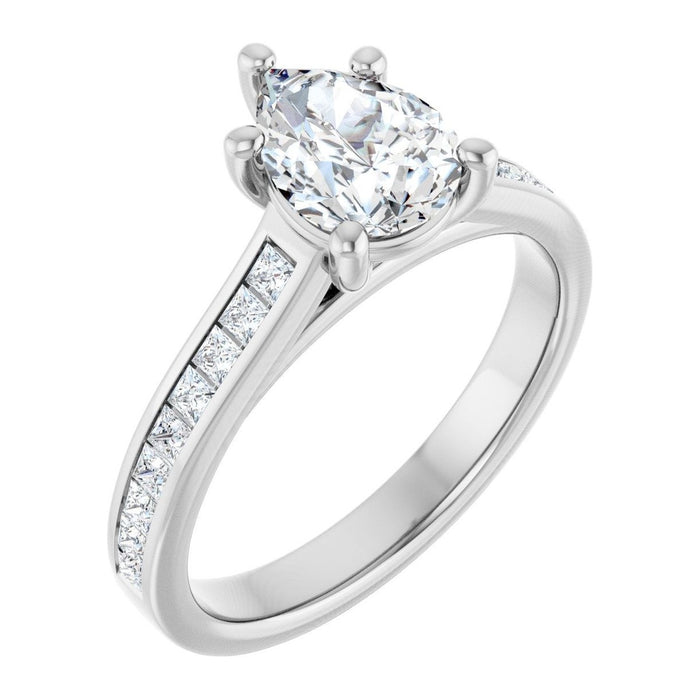
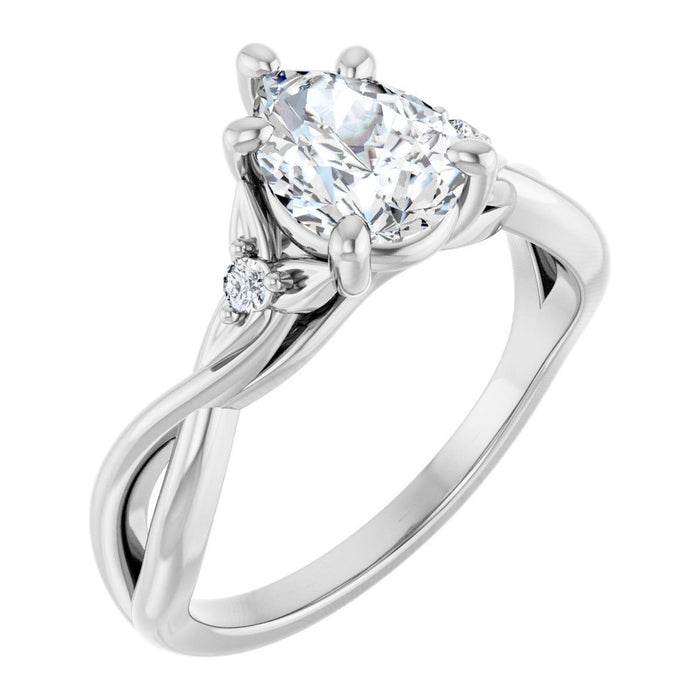
Think about how much the band should contribute. A Petite Solitaire or the Hidden-Halo Solitaire keeps attention on the center, with the hidden halo adding a ring of sparkle visible only from the side. Pavé styles, such as the Cathedral Pavé, Split-Shank Pavé, and Bypass Pavé Solitaires, add brilliance down the band. The Vintage Milgrain Solitaire and Vintage Milgrain Halo bring beaded edges for an heirloom feel, and the Twisted Vine and Crown Half-Halo designs are the most romantic of the group.
What about three-stone pear shaped engagement rings?
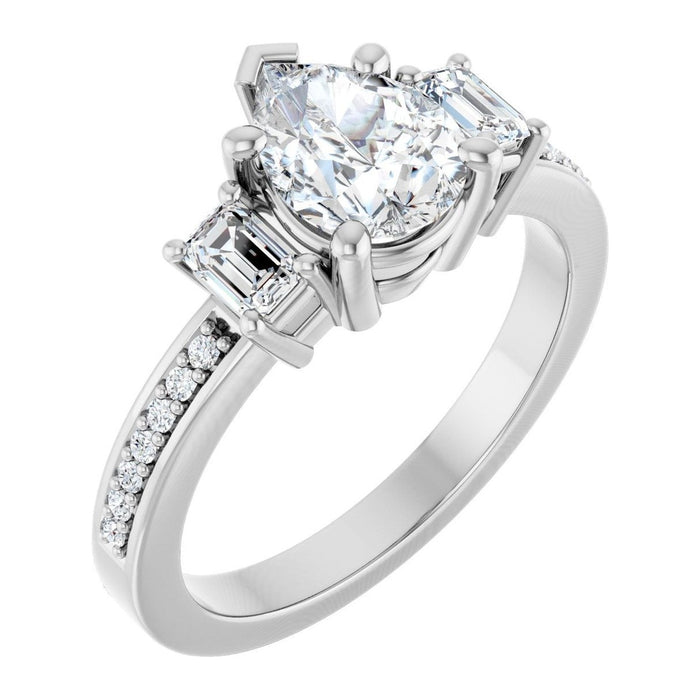
There are four, each with a different character. The Round-Side Three-Stone pairs the pear with round diamonds for the most classic look. The Marquise-Side version echoes the point with two tapering marquise stones, and the Bezel Tapered-Baguette and Pavé Step-Cut designs use long, step-cut sides for a cleaner, more architectural line. A three-stone ring reads wider across the finger, so it suits longer fingers and anyone who wants more presence.
Which metal suits a pear-shaped engagement ring?
Every ring comes in 14K white gold, 14K yellow gold, 14K rose gold, or platinum. White gold and platinum keep the diamond looking its whitest, and platinum is the densest and most durable choice, holding a bezel or fine pavé securely for decades. Yellow gold is warm and classic with vintage designs, and rose gold softens a modern pavé band.
How do I choose a size, and can I return the ring?
Measure carefully, because each pear-shaped engagement ring is made or sized to the ring size you choose, and every ring is final sale. We cannot accept returns or exchanges on rings, so please use our sizing guide and measure at the end of the day when fingers are fullest. Bands with pavé running far down the shank are harder to resize later, which is one more reason to get the size right the first time. Your ring is covered for life against manufacturing defects.
How long does it take to receive my ring?
Each ring is made to order, and the product page shows its ship time. Shipping is free and fully insured by UPS Ground anywhere in the US, and orders of $500 or more travel free by UPS Express, with a signature required so the ring is never left at the door.